
ibn arabi – a muslim mystic and philosopher
Muhammad ibn Ali Muhyi al-Din al-Arabi (his full name) descended from an Arab lineage steeped in Sufi piety. He was born in 1164 in Murcia, southern Spain, and received his early orthodox schooling in Lisbon before settling in Seville, the capital of the Almohad Caliphate, where he spent three decades studying Islamic law, the Quran, and various mystical traditions. His intense spiritual temperament and early visionary insights eventually strained relations with conservative religious scholars, prompting him to leave the Iberian peninsula behind.
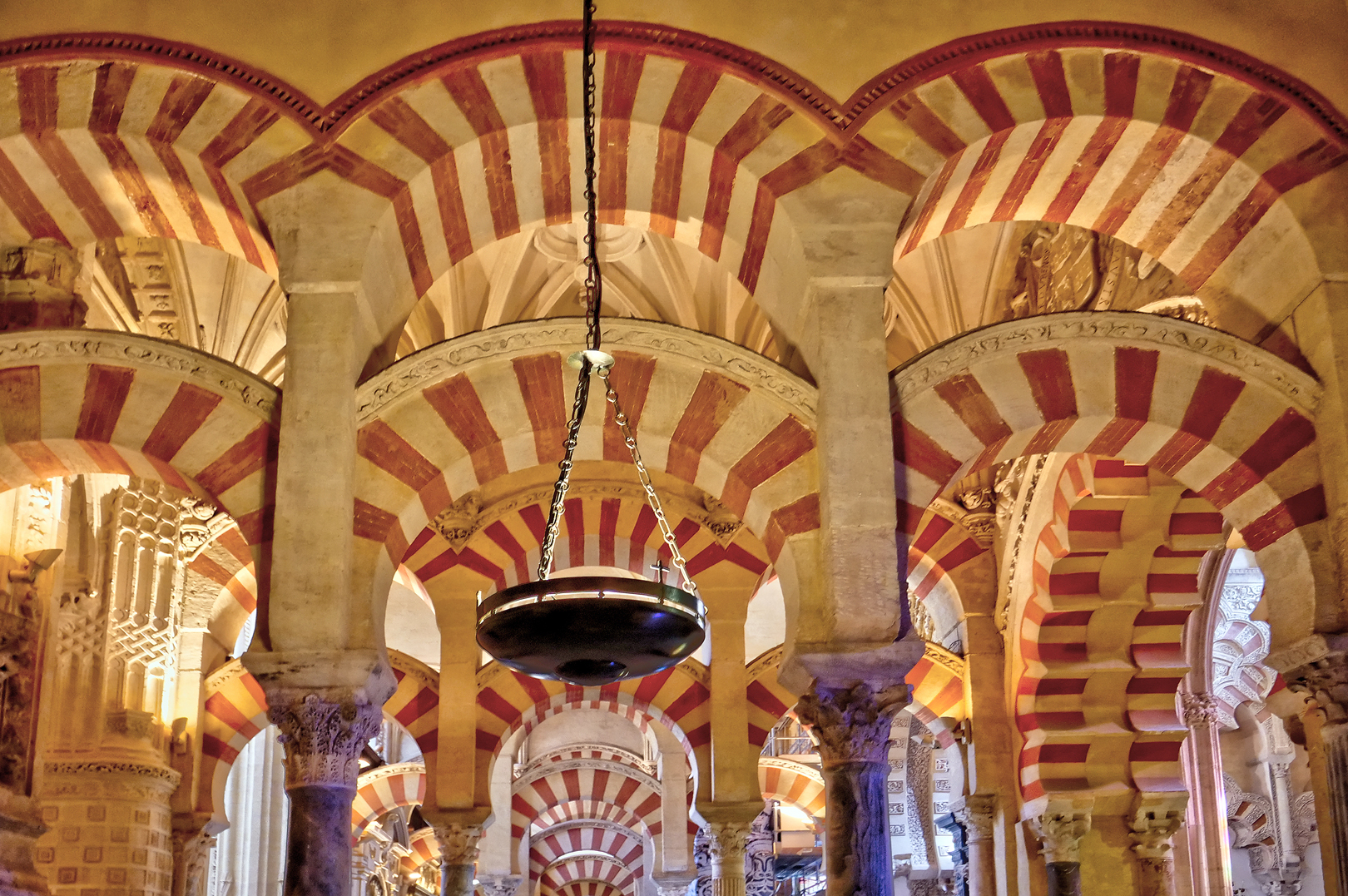
The Great Mosque (Mezquita) of Córdoba. Ibn Arabi, who isn’t shown in any paintings of his time, walked these arcades during his visits to the city.
In 1201 he embarked on a pilgrimage to Mecca, beginning an odyssey that led him across Egypt, Arabia, Iraq, Syria, and Anatolia. Reverently called al-Shaykh al-Akbar (“The Greatest Master”), he spent his eastern years writing prolifically—producing hundreds of treatises, most notably The Bezels of Wisdom (Fusus al-Hikam) and the encyclopedic Meccan Revelations (Al-Futuhat al-Makkiyyah)—before passing away in Damascus in 1240.
background
Ibn Arabi came of age when the power of the North African Islamic Berber Kings in Spain was already declining. However, Moorish al-Andalus was still a fertile ground for science, philosophy, and mysticism. During the centuries preceding him, cities like Córdoba and Seville had surpassed the great intellectual capitals of both Christian Europe and Byzantium, acting as the prime western conduit for the recovery of classical Greek philosophy and science.
Andalusia was immersed in an unmatched confluence of thought: Zoroastrian and Manichaean motifs, Hebrew and Christian scholasticism, Aristotelian and Neoplatonic logic, and the vast corpus of Islamic jurisprudence and theology were all accessible in local libraries. This vibrant, cross-pollinating soil provided the expansive vocabulary Ibn Arabi would later use to articulate his metaphysical vision.
Around 1180, in the shadow of Córdoba’s great arcades, a quiet encounter took place that captured the central tension of medieval philosophy: the meeting between the aging judge Averroës (Ibn Rushd), the supreme Aristotelian rationalist of the Western Islamic world, and the teenage Ibn Arabi, whose sudden mystical illumination had become the talk of Andalusia.
Curious to test the young visionary, Averroës arranged an interview through Ibn Arabi’s father. Ibn Arabi later recorded their electric exchange in The Meccan Revelations:
When I entered, the master arose from his place, showed me every sign of affection and respect, and finally embraced me. Then he said to me: ‘Yes.’ And I replied: ‘Yes.’ His joy increased at seeing that I had understood him. But then, immediately becoming aware of why he was joyful, I added: ‘No.’ At that, Averroës winced, the color drained from his face, and he seemed to doubt what he had thought.
Averroës asked him to explain how direct spiritual realization answered the questions posed by philosophical reflection: did mystical gnosis confirm the findings of logical inquiry? Ibn Arabi answered: “Yes and no. Between the yes and the no, spirits take flight from their matter, and necks detach from their bodies.” The old philosopher fell silent, shaken by the realization that rational deduction could map the exterior architecture of the cosmos, but direct illumination alone crossed the final threshold into presence.
Eighteen years later, in 1198, Ibn Arabi returned to Córdoba to witness Averroës’ funeral cortege. Watching the philosopher’s coffin balanced on a pack mule by bundles of his massive commentaries to equalize the load, Ibn Arabi murmured: “On one side the master, on the other his books. Tell me, did his hopes bear fruit?” It was a poignant farewell to the rationalist titan who had sought the divine through reason, while Ibn Arabi stepped forward to chart reality as an endless, unified theophany.
teachings
At the heart of Ibn Arabi’s thought is wahdat al-wujud (“the oneness of being”), the metaphysical insight that only one true reality exists, with all created phenomena serving as finite mirrors for the self-disclosure (tajalli) of the divine names and qualities. He avoided both naive anthropomorphism and distant transcendentalism, perceiving reality as both immanent in every form and transcendent in its unmanifest essence.
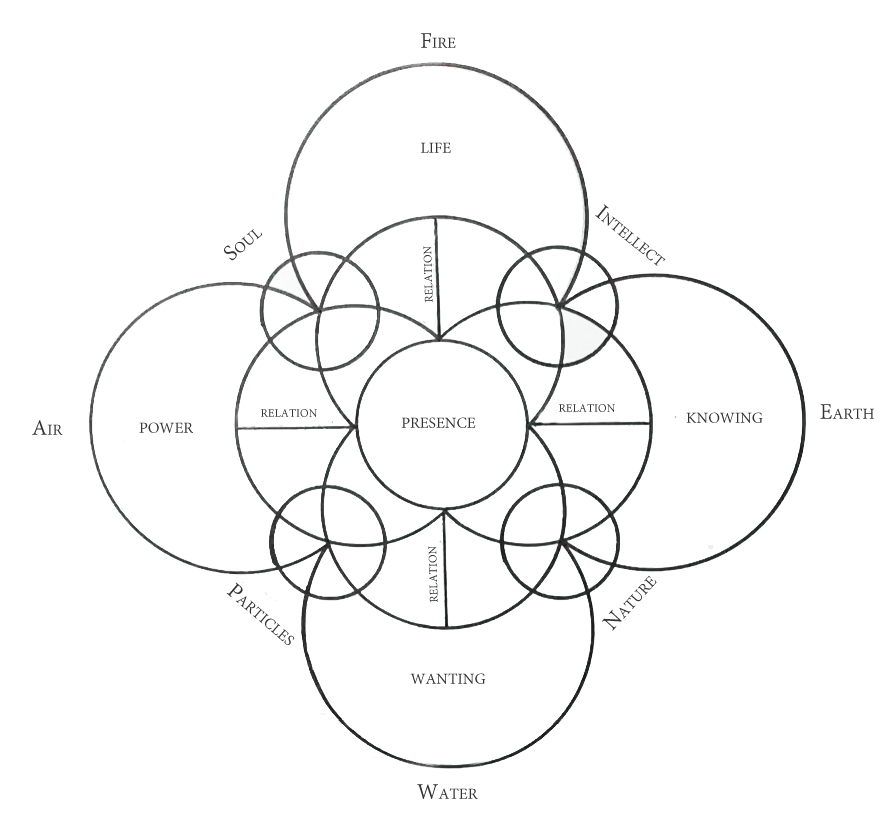 The schematic drawing captures this architecture of manifestation: at the center rests unconditioned PRESENCE, surrounded by four cardinal divine attributes—LIFE, KNOWING, WANTING (WILL), and POWER—which connect through reciprocal RELATIONS to manifest the subtle principles of existence (SOUL, INTELLECT, NATURE, PARTICLES) and crystallize outwardly as the four classical elements (FIRE, AIR, WATER, EARTH). The cosmos is thus a living mandala: an unbroken appearance of God (theophany) and revelation of the Divine Principle where the material world remains inseparable from the silent presence at its core.
In The Bezels of Wisdom, Ibn Arabi demonstrates clearly that non-dual realization is fundamentally embedded within Islamic revelation:
Do you not understand that the Reality is manifest through the attributes of relative beings, when He has informed us of that Himself, even through attributes of deficiency and blame? Do you not understand that the created being is manifest through the attributes of the Reality, from the first to the last, all of them being appropriate to it, even as the attributes of created beings are appropriate to the Reality? The words Praise belongs to God (Quran I,1) mean that every instance of praise, as respecting the one who praises or the one praised, reverts to Him. To Him the [whole] matter reverts (Quran XI,123), in which verse He embraces all [attributes] without reference to their praiseworthiness or blameworthiness, all being either the one or the other.
Today, his vision continues to resonate profoundly outside traditional academic and religious boundaries. There is a global platform that honors his legacy and demonstrates the vital relevance his work holds for contemporary seekers and scholars: The Muhyiddin Ibn Arabi Society