
the hathor temple at dendera

One of the finest examples of ancient Egyptian art is the temple of the Goddess Hathor in Dendera near Luxor with a particularly rich variety of artwork from Ptolemaic and Roman times. Hathor is a multifaceted mother and fertility goddess with a human body and face. Her face with the typical ears of a cow is shown four times on the top part of each column in the main temple.
Early texts refer to a temple at Dendera in Old Kingdom times, and several New Kingdom monarchs, including Tuthmosis III, Amenophis III, and Ramesses II and III are known to have embellished the structure. However, the temple of Hathor as we see it today was built and decorated mainly during the Graeco-Roman period. In those days the worship of Hathor was very important and rulers like Cleopatra VII, Nero, and Hadrian added some structures to the temple complex.
The main compound as it was during Roman times:

In addition to the traditional elements of the Egyptian temple—hypostyle halls, an inner sanctum, and various smaller chapels dedicated to various deities—the compound of Dendera featured a sanatorium and two birth houses (mammisi), which were designed as places especially for healing and personal protection of the individual . The purpose of the temples of the Middle and New Kingdoms was mainly to establish and preserve the status of the Pharaoh—especially Karnak was a power plant for the King to maintain Ma’at (cosmic order). The sanctuaries of the Ptolemaic and Roman periods, however, were much more centered on addressing the gods through worship, prayer and transforming rituals—similar to Delphi, Eleusis or Epidauros in Greece.
When Christianity became the state religion of the Roman empire, the Christian priests converted the temple into a church. They found it necessary to deface the Hathor images by chiseling off hundreds of noses and mouths—thus claiming the superiority of the new belief system. Fortunately, a lot of the other artwork remained intact, and the temple later escaped destruction by the Muslim conquerors—so the Hathor Temple remains one of the best-preserved testimonies of the ancient days. It survived despite the partial destruction of artwork in the main building and the almost complete demolition of the subsidiary temples of Hathor’s consort Horus and their child Ihy or Harsomptus which originally stood close by.
Nowadays, Dendera has developed into a New Age sanctuary where the worship of Hathor and Isis is being revived. Many Westerners make the pilgrimage to the temple, seeking meaning in the ancient Egyptian myths. Even though the local guides are traditional Muslims for whom the Hathor Temple is actually a place of illicit idolatry, for a little baksheesh the Egyptians are offering to introduce the visitor to the ancient mysteries and allow them to meditate and perform rituals on the sacred sites.
the outer and inner hypostyle halls


Photo 1:
The central strip of the ceiling flanked by six massive Hathor columns. 22 winged sun disks (Behedeti) represent the sun god Horus of Edfu, Hathor’s key consort, who acts as a protector for the processional path below. On the side registers of the ceiling the bright blue sky is visible, where the celestial barques (the “boat scenes”) carry the sun, moon, and stars across the sky of the outer bays.
Photo 2:
A high-resolution study of the four-faced Hathor capitals to the right of the entrance. The goddess is depicted with bovine ears, her face weathered but the structure of the sistrum-crown above her remain sharp. This architectural element transformed the column from a mere support into a ritual object—a giant rattle (sistrum) used to appease the gods and drive away chaotic disturbance from the sanctuary.
Photo 3:
Left of the entrance similar columns and a bit of the blue ceiling with some astronomical explanations. This direct vertical perspective focuses on the “Blue of Dendera.” The ceiling is divided into seven registers, acting as a celestial map. It depicts the signs of the zodiac (introduced during the Ptolemaic period), the planets, the constellations, and the journey of the sun and moon through the hours of the day and night. The survival of the deep lapis-blue pigment is a rare look at the original “color-coding” of the Egyptian cosmos.
Photo 4:
The transition from the outer hypostyle hall to the inner one and a view of the sanctuary. Walls, pillars, and ceiling full of scenes where the Pharaoh is seen interacting with deities, ensuring that the covenant between the royal authority and the divine power remains intact.
the chapels and the crypt
As you can see in the map above there are several chambers surrounding the inner sanctuary and the second hypostyle hall. Most of the walls are richly decorated with reliefs and hieroglyphs in the Ptolemaic style. These rooms functioned as repositories for the specific divine tools and symbolic requisites to perform the rituals that kept the temple’s spiritual mission alive.


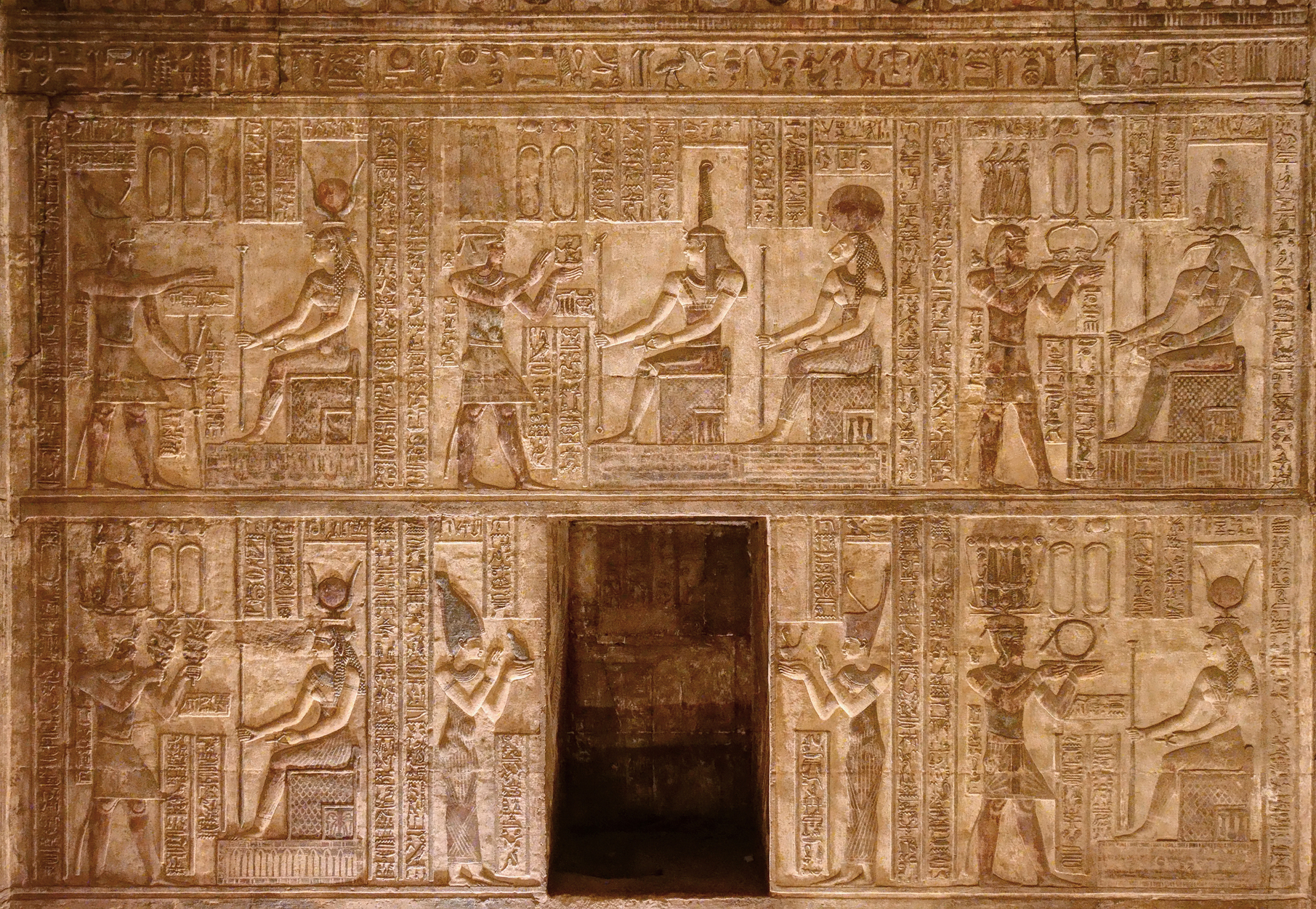


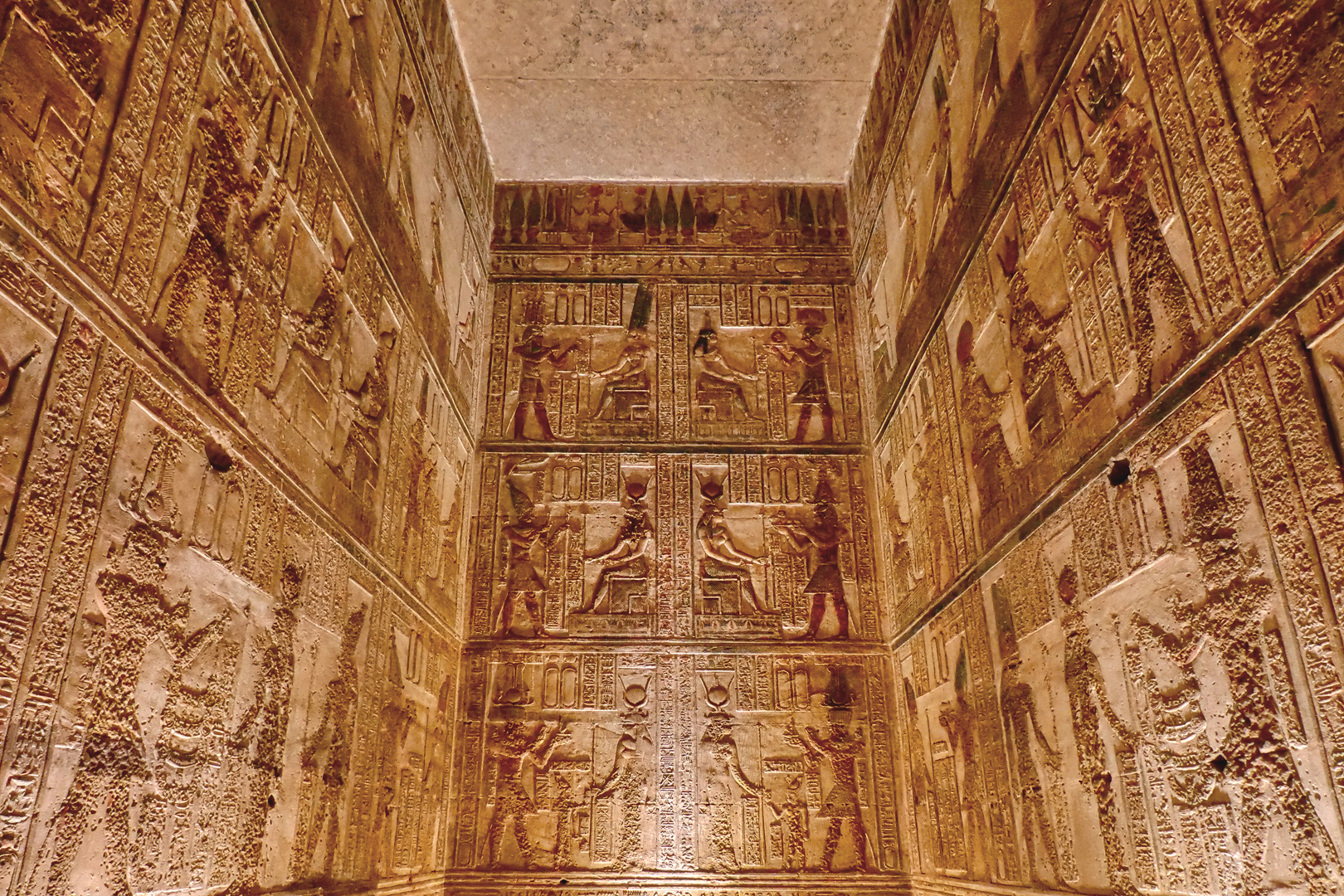
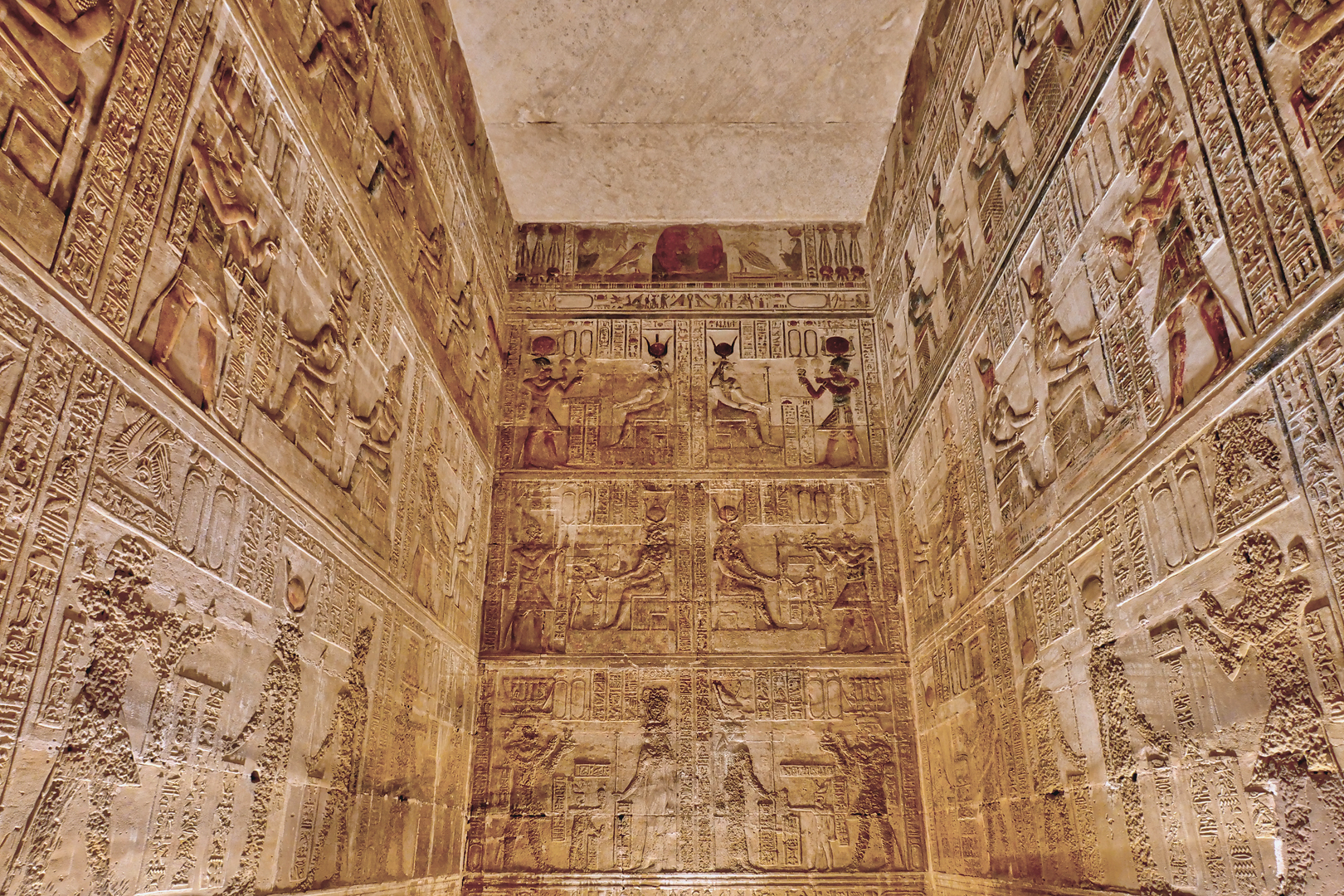


Photo 1: On the ceiling of one of the side chapels, the sky goddess Nut performs her eternal function: the creation of day and night. At first glance, one might only notice a face and two hands, but upon closer inspection, the entire movement of the celestial bodies is explained by the peculiar position that Nut’s whole body occupies.
Nut (pronounced with a u as in foot) is the personification of the sky. Her body spans the entire ceiling; her feet are planted on the left, her legs point straight upward, and her torso bends at the waist to allow her arms to reach back down toward the horizon. This personification provided the Egyptians with a practical framework for celestial events: thunder was interpreted as Nut’s laughter, and rain as her tears. In a daily cycle of cosmic data-processing, she swallows the sun each evening and gives birth to it every morning. The rays of the newborn sun are shown energizing Hathor, the goddess of the Earth, who resides in a lush valley. Nut is presented in a sexy dress consisting of celestial waves that leave the chest uncovered.
Photo 2: The top register features a falcon standing on a ceremonial shrine, representing the god Harsomtus. Below, the King is depicted in serial compositions, presenting offerings to seated deities, including Hathor.
Photo 3: One of the larger chapels located in the back of the temple. The artwork is well preserved, unlike many of the other chambers where Coptic Christians destroyed a lot of the reliefs—keen to execute an “ideological deep-cleaning” of the pagan imagery.
Photo 4: A close-up of photo 3. The central scene shows the king offering a statue of the god Heh, the personification of eternity, to Shu (the god of air, light, and wind) and Tefnut (the goddess of moisture, dew, and rain), who are seated on elaborately decorated thrones. As in very common in Ptolemaic temples, the cartouches are blank (a sign of the turbulent politics of the Ptolemaic dynasty), but the king is most likely Ptolemy XII Auletes (“Ptolemy the Flute Player”), the father of Cleopatra VII.
Photo 5: A close-up of a mirrored wall relief in one of the side chambers. This ‘mirroring’ was a fundamental principle of ancient Egyptian temple art known as heraldic balance: falcon-headed gods Horus of Edfu (left) and Ra-Horakhty (right) face their partner goddess Hathor/Isis. Expressing cosmic harmony and geographical dualism, the composition creates Ma’at (cosmic equilibrium) in the sacred space of the local Dendera sanctuary.
Photo 6: A wall relief divided into two main horizontal registers, each split into mirrored left and right halves. In the top register, the King makes ritual offerings to maintain the divine cycle. On the left, he stands before the seated goddess Hathor and her young son, Ihy, who shakes a sistrum, backed by a falcon-headed god. On the right, the scene mirrors this layout, presenting offerings to a different configuration of the core deities.
The bottom register features a ritual called “Striding of the Pharaoh”. In both the left and right scenes, the King wears an elaborate royal kilt and strides dynamically away from the center axis, looking back over his shoulder while holding a ceremonial staff and flail. He is backed by a Ptolemaic queen or princess wearing a tall feather headdress, who raises her hand in support. The King presents his protective movement to a seated goddess at each outer edge. On the right, the hieroglyphic text explicitly names her as Isis the Great, while the left text addresses Hathor. The blank ovals in front of the King’s face are cartouches left completely empty due to the rapid political turnover of the late Ptolemaic period.
Photo 7: Another chapel with sometimes mirrored images. The bottom row has been chiseled away and cannot be clearly identified.
Photo 8: Another similar chamber partly destroyed, but with unusually well preserved colors on the top rows.
Photo 9: The central theme of this chamber is the death and the resurrection of Osiris. On the third register there are three scenes with Osiris lying on the typical lion bed. In the middle scene Isis stands at the head of the bed, with wings outstretched, and at the foot of the bed her equally winged sister Nephthys. Above the scene is a line of hieroglyphic text with cartouches containing the word “wennefer” which is an epithet of Osiris meaning “the one who continues to be perfect”.
At the top of the wall is a frieze of goddesses with a solar disk and outstretched wings between which is a Djed pillar (a symbol of Osiris) with arms and hands holding a crook and flail, and wearing the atef crown, consisting of ram’s horns with a solar disk in the middle, and a uraeus serpent at each end, topped with two ostrich-feather plumes. In the centre of the scene is a cartouche containing the text “The god Osiris, Lord of Djedu”. Djedu was a town in the Nile delta which was the centre of worship of Osiris.
Photo 10: The dark and narrow crypt underneath the Hathor Temple was used by the priests to safely store sacred cult objects and precious statues of the gods.
the periphery

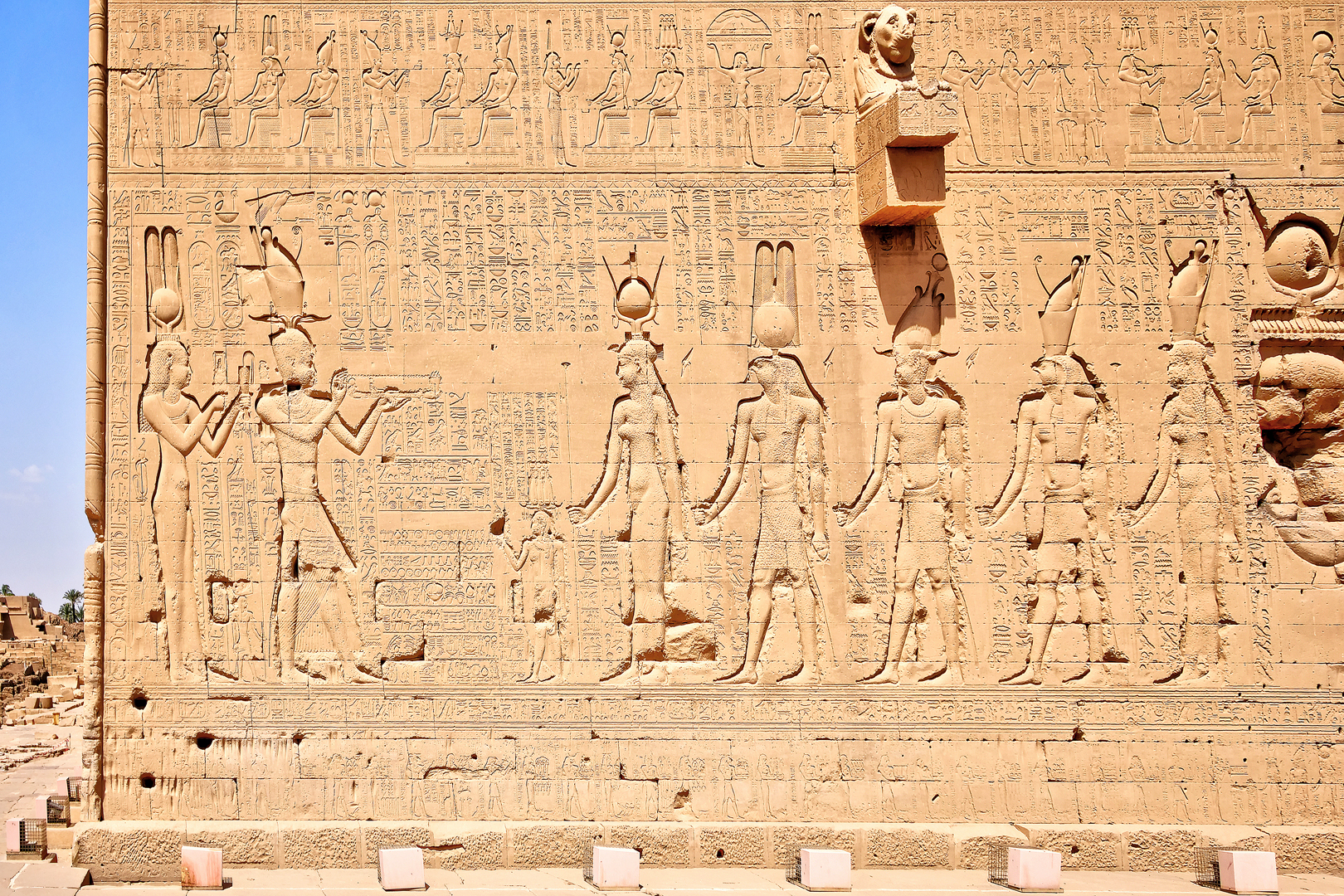
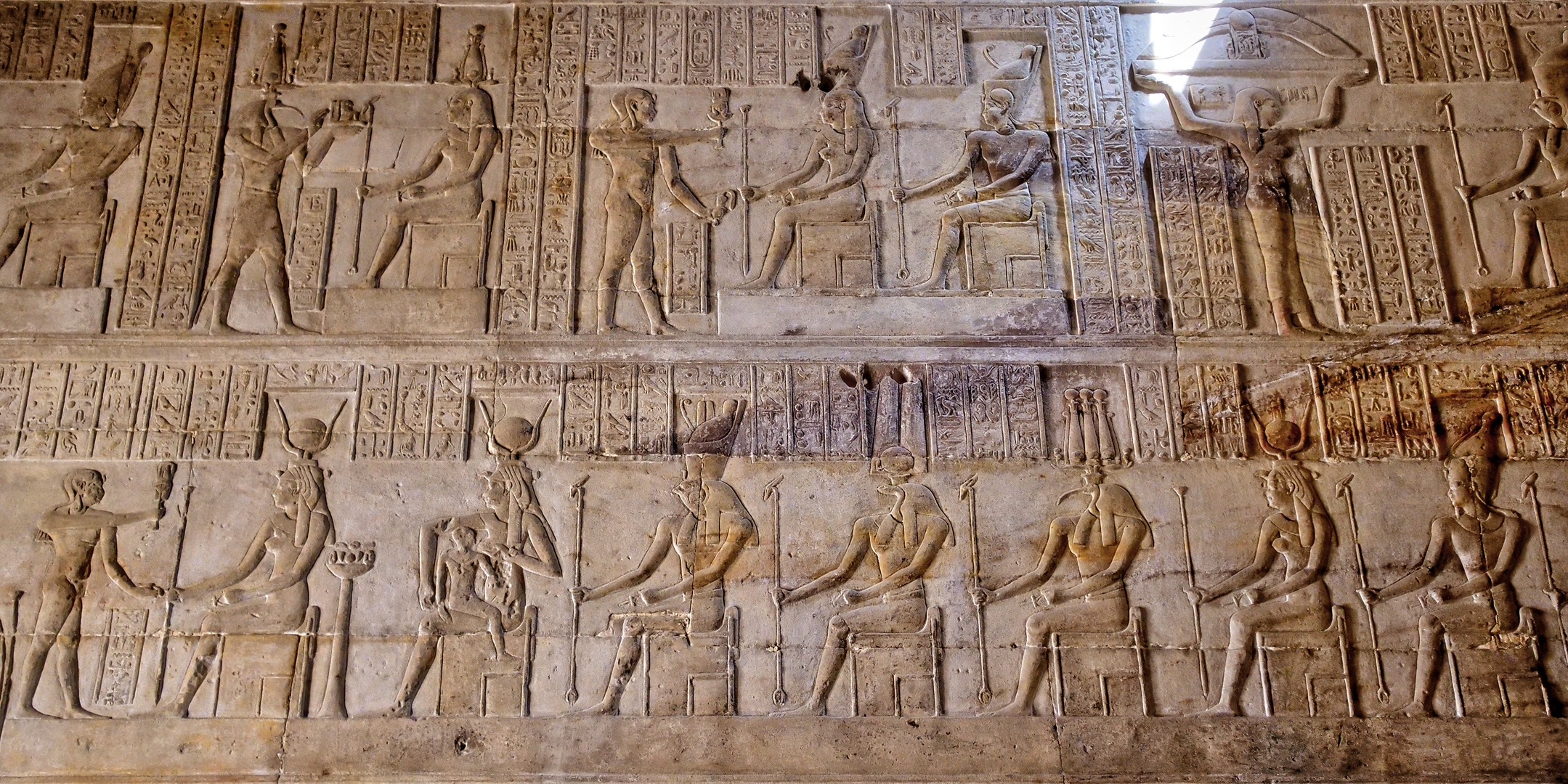
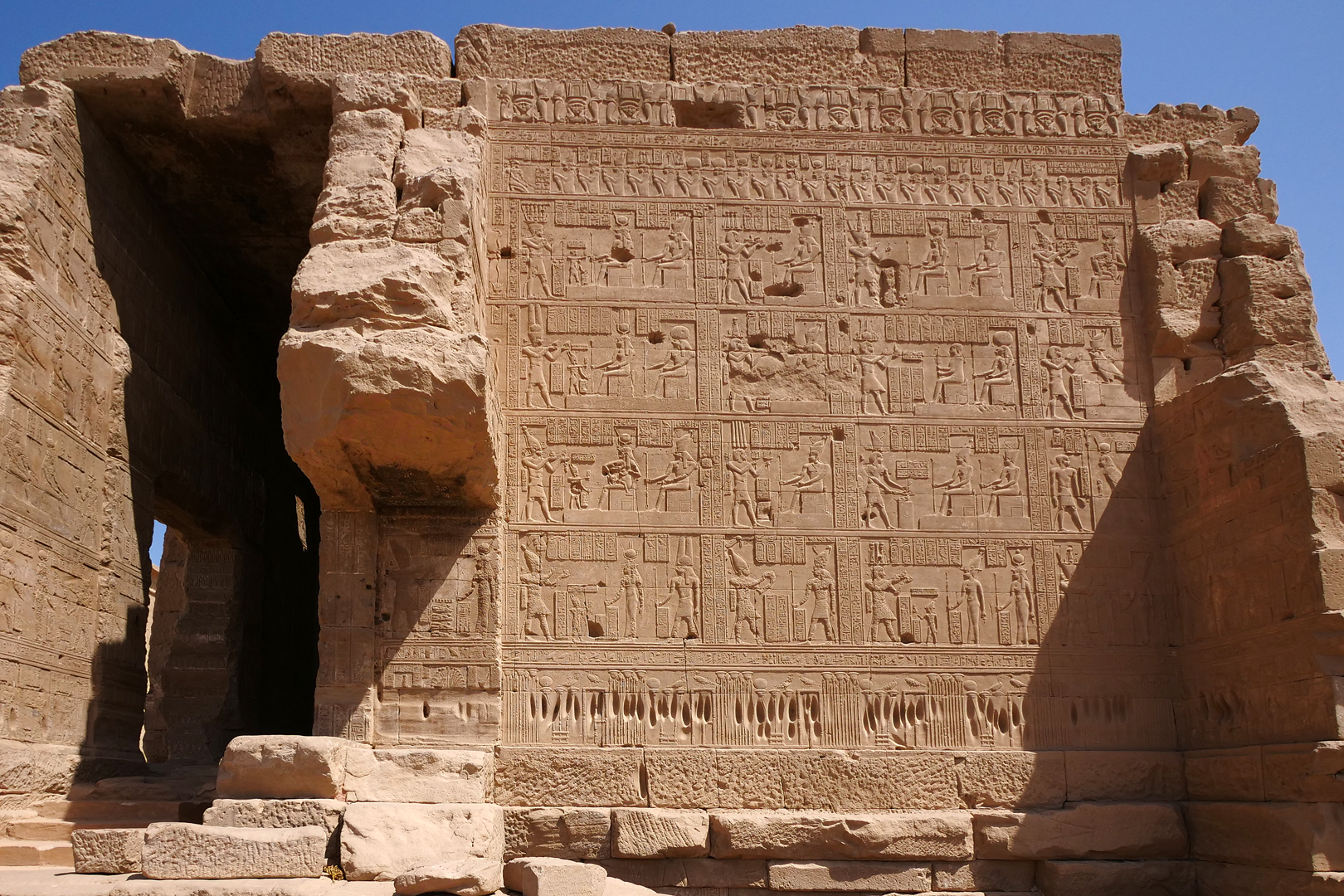
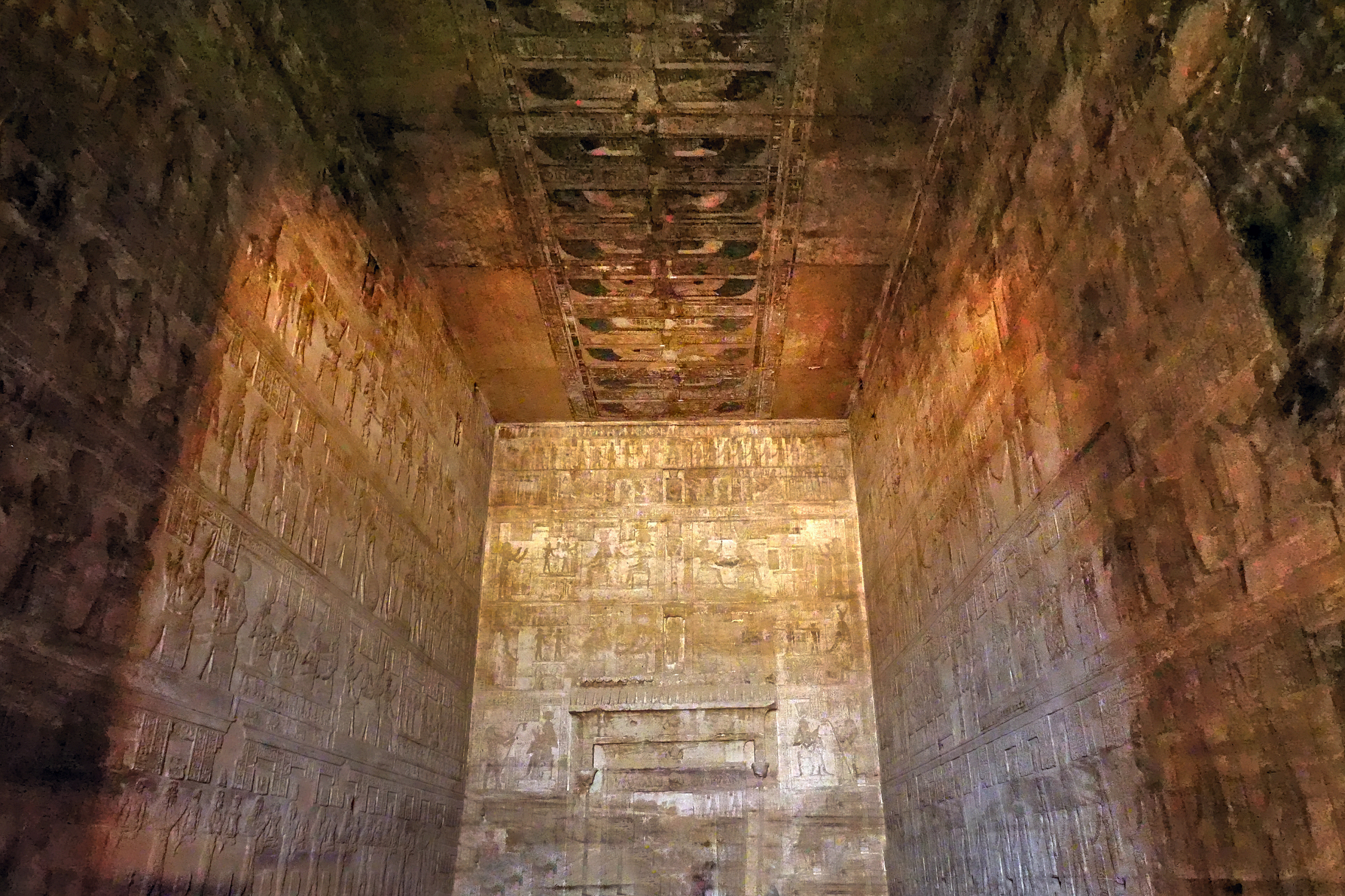
Photo 1: The Gate of Trajan and Domitian was constructed during the Roman era by the emperors with the same name. It served as the entrance gate to the Temple of Hathor, the main temple at Dendera.
Photo 2: On the exterior wall of the back of the main temple Cleopatra VII (left) and her son Caesarion are shown in a sunk relief carving. They are making offerings to a group of gods. Thus Cleopatra tried to establish her and Julius Caesar’s son as her successor.
Photo 3: Inside the Temple of the Birth of Isis behind the main sanctuary.
Photo 4: Reliefs on the outer walls of the Iseum (Temple of the Birth of Isis)
Photo 5: The Roman Mammisi (Birth House)