
the seven secrets of cultural evolution
Human beings have undertaken a long and turbulent journey from simple hunter gatherers—who lived more than 100.000 years ago—to contemporary hi-tec users. How could humans evolve so fast, while at the same time other species remained more or less the same. Many curious men and women have been observing and analyzing our journey and I would like to share with you the seven most interesting aspects:
1. The accidental growth of our brain
2. Humans learn best from mistakes
3. The huge size of our brain allows huge learning processes.
4. Humans are capable to pass on what they have learnt and thus are better capable of adaption.
5. Humans can project into the future
6. Evolution doesn’t care about the human projections. It simply unfolds according to the inherent laws of the dynamics of change.
7. Humans will exist as long as they are capable to adapt.
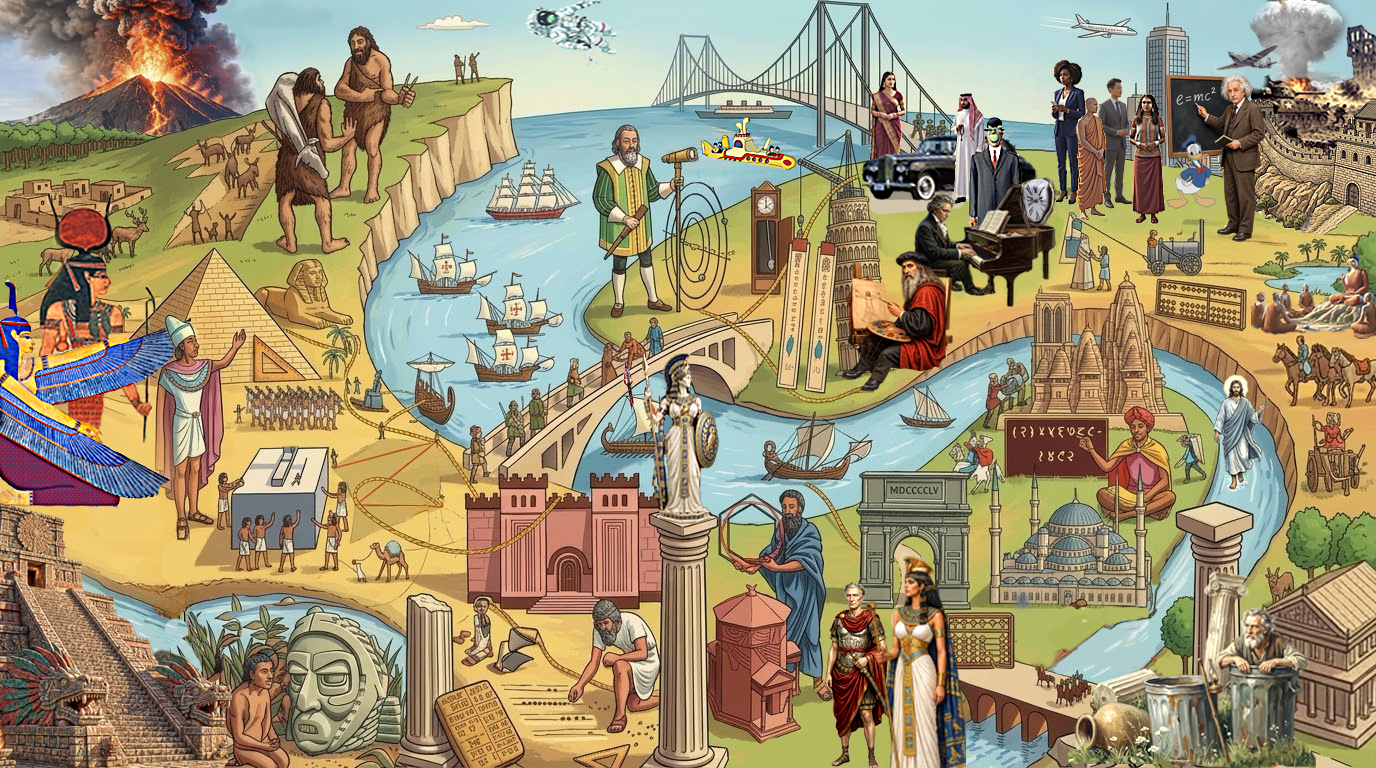
1. the three-tier evolutionary model
Human cultural transmission operates across three distinct evolutionary layers:
Hardware (Biology & Lineage): The physical human organism, neurological architecture, genetics, and vertical reproductive descent.
Operating System (Language & Social Architecture): Grammatical structures, legal codes, symbolic scripts, numerical conventions, and civic administrative tools that process information and coordinate collective life.
Apps (Ideologies & Beliefs): The transient theological doctrines, political movements, moral codes, and metaphysical narratives running on top of the operating system.
Unlike biological hardware—which relies strictly on slow, vertical generational inheritance—operating systems and ideological apps spread horizontally across populations through trade, conquest, migration, and pedagogy. The decisive mechanism of large-scale civilizational scale is the ability to decouple software from hardware, allowing diverse genetic populations to execute a shared cultural code.
Civilizational momentum was driven by intentional teleology and ethnic destiny, but also by uncontrollable elements like the climatic conditions, natural changes, and diseases.
2. the historical sequence
phase 1: worldwide polycentric origins (before 3000 bce)
Organized cooperation and monumental ambition did not diffuse from a single cradle. They ignited independently around the world wherever environmental and social conditions permitted it.
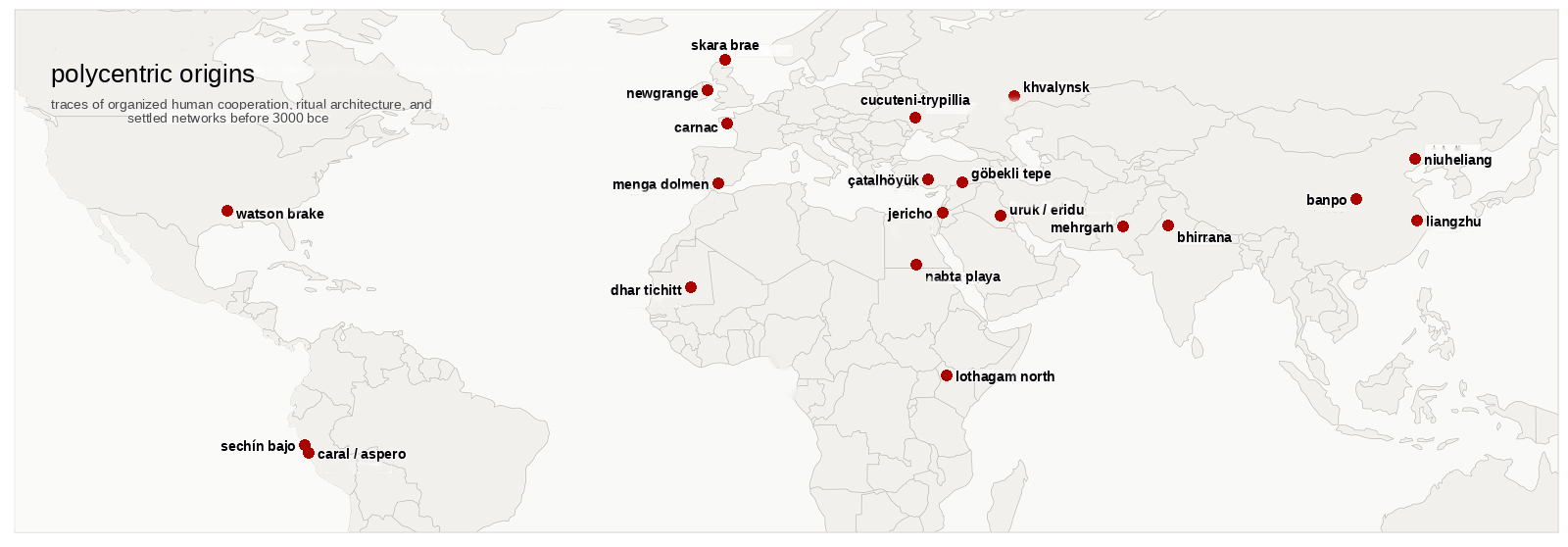
Monumentality and organized cooperation arose polycentrically across the globe wherever conditions permitted, rather than diffusing from a single origin point.
The Pontic-Caspian Steppe & Eastern Europe
Cucuteni–Trypillia Mega-Sites (c. 4100–3500 BCE | Ukraine / Moldova / Romania): Proto-urban settlements (Nebelivka, Talianki, Maidanetske) spanning 200–450 hectares and housing up to 20,000 people, featuring concentric ring layouts, assembly houses, kiln networks, and planned cycles of ritual burning and rebuilding.
The Kurgan Horizon (c. 4500–3000 BCE | Steppe from Dnieper to Volga): Sredny Stog and early Yamnaya pastoralist networks introducing monumental earthwork mounds (kurgans), horse management, wheeled wagon mobility, and long-distance metallurgy networks.
Khvalynsk Cemetery (c. 4300 BCE | Volga Region, Russia): Communal cemeteries demonstrating social differentiation, early horse exploitation, and long-distance trade in copper and prestige marine shells.
Atlantic & Northern Europe
Carnac Alignments (c. 4500–3300 BCE | Brittany, France): Expansive parallel alignments of thousands of standing stones and monumental barrows requiring sustained, multi-generational collective labor.
Newgrange & the Boyne Valley (c. 3200 BCE | Ireland): Engineered passage tombs aligned precisely to the winter solstice sunrise, constructed with advanced megalithic corbelling and water-resistant masonry.
Skara Brae & the Ness of Brodgar (c. 3200–3100 BCE | Orkney, Scotland): Stone-built domestic settlements integrated with stone drainage systems, built-in furniture, and monumental communal enclosures.
East Asia
Liangzhu Culture (c. 3300–2300 BCE | Yangtze Delta, China): A hydraulic city defined by an extensive water-management system of dams, reservoirs, and canals moving millions of cubic meters of earth, alongside elite craft workshops producing ritual jade cong and bi.
Hongshan Culture / Niuheliang (c. 3800–3000 BCE | Liaoning, China): A ceremonial complex spanning several square kilometers, featuring the “Goddess Temple,” stepped stone-cairn platforms, and circular ritual mounds.
Yangshao Culture / Banpo & Jiangzhai (c. 5000–3000 BCE | Yellow River, China): Planned circular settlements bounded by defensive communal moats, central clan plazas, specialized kiln zones, and collective storage facilities.
Daxi & Songze Horizons (c. 4400–3300 BCE | Middle/Lower Yangtze, China): Moated settlements with drainage and dyke systems for wet-rice cultivation and early craft specialization.
Africa
Dhar Tichitt Early Phase (c. 4000–3000 BCE | Mauritania): Pastoral communities managing lakeshore ecologies during the “Green Sahara” transition, laying the foundations for later dry-stone walled architectural complexes.
Pre-Kerma Horizon (c. 3500–3000 BCE | Nubia / Sudan): Settled pastoral-agrarian villages along the Middle Nile featuring collective storage pits, defensive ditches, and monumental cattle tumuli.
Lake Turkana Megaliths / Lothagam North (c. 3000 BCE | Northern Kenya): Communal pillar sites and cemetery platforms built by mobile pastoralists coordinating collective labor in response to regional climatic drying.
The Americas
Caral / Norte Chico Horizon (c. 3500–3000 BCE roots | Supe Valley, Peru): Coastal-inland agrarian-marine networks constructing monumental terraced platform mounds using shicra (woven reed bags filled with stone) for structural stability.
Sechín Bajo (c. 3500 BCE | Casma Valley, Peru): Early monumental sunken circular plazas and stepped ceremonial adobe-and-stone platforms.
Watson Brake (c. 3500 BCE | Louisiana, USA): An engineered oval enclosure of eleven earthen mounds interconnected by ridges, constructed by hunter-gatherers long before the adoption of intensive agriculture.
phase 2: consolidation along the cultural axis
Over millennia, isolated regional experiments intensified in an east–west corridor of high-density exchange between the Mediterraenan and the Indus Valley. Ideas, metallurgy, administrative technologies, and philosophical frameworks circulated continuously, filtering out fragile, localized traditions while sharpening institutional resilience.
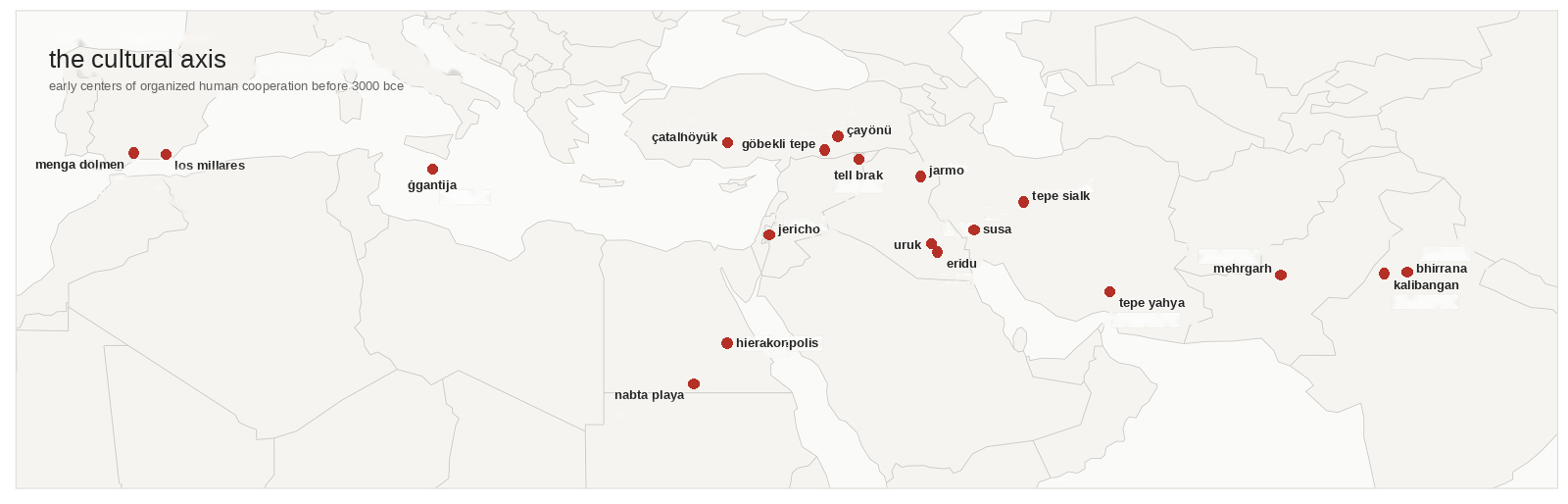
The emergence of dense, transmissible organizational networks across the central Afro-Eurasian belt.
The Mechanism of the Funnel:
Portability over Localism: Highly localized animisms were tied to specific geographic landmarks, sacred groves, and ancestor graves. When communities were displaced, the belief system collapsed. Surviving traditions abstracted reality into universal, portable principles (Dharma, Logos, Brahman, the Covenant, the Divine Essence) capable of being encoded onto parchment and transported anywhere.
The Monastic Hard Drive: Long-lived traditions established dedicated institutional architectures (Buddhist Sanghas, Christian monasteries, Islamic madrasas, Hindu mathas). These institutions served as distributed, fireproof archives, safeguarding philosophical texts, medical knowledge, and administrative records through imperial collapses.
Synthetic Absorption: Resilient systems were structural synthesizers. Early Christianity assimilated Greco-Roman rhetoric and seasonal calendar cycles; Buddhism translated local deities into regional protector spirits; Islam absorbed Persian administrative statecraft and classical Greek metaphysics.
Anchor Sites Along the Axis:
Iberia & Central Mediterranean: Menga Dolmen (c. 3700 BCE, Spain), Los Millares (c. 3200 BCE, Spain), Ġgantija (c. 3600 BCE, Malta).
Nile Basin: Nabta Playa (c. 6000–5000 BCE, Egypt), Hierakonpolis (c. 3600 BCE, Egypt).
Levant & Anatolia: Göbekli Tepe (c. 9500 BCE, Turkey), Çayönü (c. 8500 BCE, Turkey), Çatalhöyük (c. 7500 BCE, Turkey), Jericho (c. 9000 BCE, West Bank).
Mesopotamia & The Zagros: Jarmo (c. 7000 BCE, Iraq), Tell Brak (c. 5000–3500 BCE, Syria), Eridu (c. 5400 BCE, Iraq), Uruk (c. 4500–3200 BCE, Iraq).
Iranian Plateau: Tepe Sialk (c. 6000–3000 BCE, Iran), Susa (c. 4200 BCE, Iran), Tepe Yahya (c. 4500 BCE, Iran).
Indus Basin: Mehrgarh (c. 7000–2600 BCE, Pakistan), Bhirrana (c. 7500–3000 BCE, India), Kalibangan (c. 3500 BCE, India).
phase 3: the expansion of civilizational spheres (3000 bce – 0 ce)
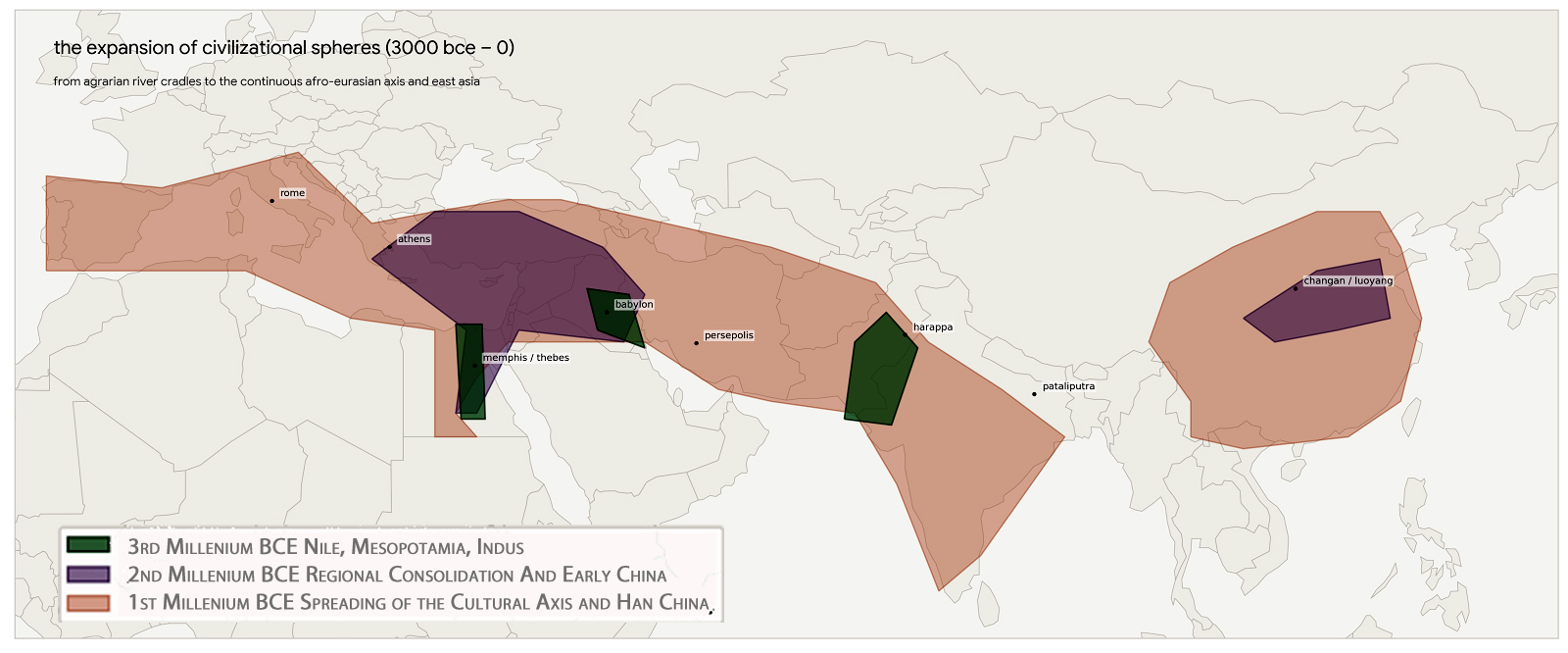
The physical integration of isolated river cradles into an unbroken civilizational band.
Green Band (3rd Millennium BCE): The primary alluvial cradles—the Nile Valley, lower Mesopotamian city-states (Sumer and Akkad), and the mature Harappan grid-cities of the Indus Valley.
Purple Band (2nd Millennium BCE): Regional expansion and structural integration across Anatolia (the Hittite Empire), the Levant, the Middle and New Kingdoms of Egypt, Assyrian trade arteries, Babylonia, and the Shang and early Zhou dynastic core in the Yellow River basin.
Warm Terracotta Band (1st Millennium BCE – 0 CE): The consolidation of an unbroken Eurasian cultural highway—connecting the Roman Mediterranean, Hellenistic successor networks, the Persian Achaemenid and Parthian realms, and Mauryan India—operating in parallel with the unified Qin–Han imperial sphere in China.
The Global Rupture (1945 CE): The Cultural Axis remained the definitive center of global power and cultural gravity until the World Wars. The post-1945 era permanently decentralized this corridor, dispersing global power into atomic, maritime, and planetary digital networks. However, what we think and do is still greatly influenced by the behavioral patterns, memes, and metaphors that developed within the Cultural Axis.
3. remarkable developments
Charismatic Leaders
Cultural evolution is punctuated by sudden mutations driven by decisive individual force. Charismatic leaders operate as systemic re-compilers, rewriting an entire civilizational tier in a single generation:
Ashoka the Great: Re-engineered the Mauryan administrative apparatus into an ethical delivery mechanism for the Buddhist Dhamma, converting statecraft into a vehicle for non-violence, social welfare, and moral governance across South Asia.
Alexander the Great: Forcibly fused the Greek philosophical and administrative Operating System across Near Eastern and Persian populations, establishing a shared Hellenistic koine that linked the Mediterranean to the Indus.
The Prophet Muhammad: Synthesized an entirely new religious, legal, and institutional App, rapidly integrating decentralized Arabian kinship structures into an expansive imperial architecture that unified the Western and Eastern halves of the Cultural Axis.
Oddballs of Evolution
Historical trajectories are non-deterministic, marked by cascade failures and singular evolutionary strategies:
The Late Bronze Age Collapse (c. 1200 BCE): An interconnected geopolitical network of great powers (Mycenaean Greece, the Hittite Empire, New Kingdom Egypt, Ugarit) suffered a systemic cascade collapse. Disruptions to long-distance tin and copper trade, compounded by environmental stress and migrations, caused the catastrophic failure of palatial administrations and the complete extinction of regional scripts (such as Linear B), throwing the Aegean and Levant into an illiterate, decentralized dark age.
The Covenantal Survival Capsule (The Jewish Trajectory): While imperial civilizations expanded by decoupling their ideological Apps from biological Hardware (allowing anyone to convert, speak Latin, or adopt the imperial pantheon), the Jewish historical trajectory took the inverse path. Hardware (endogamic biological descent), Operating System (mandatory Hebrew literacy and scriptural study), and App (the exhaustive ritual and legal codes of Halakha) were permanently locked together. This tight binding allowed scattered diaspora communities across Europe, North Africa, and the Middle East to maintain unbroken cultural coherence across two millennia without territory, temples, or military force. However, this intentional refusal to dissolve into host civilizational systems created structural friction, leaving them vulnerable to scapegoating whenever host empires encountered systemic crises.
The 19th-Century Category error: the “Aryan” Myth: The three-tier framework exposes the catastrophic theoretical mistakes of modern history. In the late 18th century, comparative philology uncovered Proto-Indo-European—a shared linguistic Operating System linking Sanskrit, Persian, ancient Greek, Latin, and Germanic languages.
Nineteenth-century theorists committed a fatal category error by conflating this horizontally transmissible linguistic software with biological Hardware. They manufactured the racial myth of the “Aryan,” falsely assuming that shared grammar and vocabulary proved shared genetic lineage and skull morphology. This category error was subsequently weaponized into an aggressive ideological App of racial hierarchy, providing the pseudo-scientific justification for imperial colonialism, totalitarian conquest, and the horrors of industrial eugenics.