
gautama the buddha
The Buddha, originally known as Siddhārtha Gautama, lived around 500 BCE in Northern India. The precise dates of birth and death are not certain. His birthplace was Lumbini, which is in the plains of present day Nepal. He was born as a prince in the Shakya clan and was brought up to become a king, but he left his wife and son and renounced lay life. After several years of living as a wandering monk, where he focused on meditation and asceticism, he was transformed through a profound awakening. His enlightenment happened under a Bodhi Tree in Bodhgaya (nowadays in Bihar). Gautama then traveled throughout the Ganges plain teaching and forming a religious community of wandering monks. He taught a middle way between sensual indulgence and the severe asceticism practiced by many other contemporary monks. He also taught a spiritual path that included discipline and meditative practices. He died in Kushinagar (nowadays in Uttar Pradesh, India). Already during his life he became known by the name Buddha, which means “Awakened One” or the “Enlightened One”.

A Buddha statue from Dhauli (India). The Buddha is forming the Bhumisparsha Mudra (earth touching gesture) with his arms and hands. (Foto M. Myshkin)
Today, the buddha stands globally as a metaphor for transcendence, tranquility and peace of mind—qualities captured in countless stone reliefs and temple statues worldwide. His teachings are practised all over the world by millions of people. However, there is no single, monolithic entity that can be called buddhism. Across the centuries, numerous lineages, scholastic debates, and monastic traditions arose, leaving behind no single orthodox body of dogma.
The term ‘Buddhism’ is a European invention coined in the early nineteenth century in an attempt to categorize the religious practices that Europeans found as they travelled in China, Thailand, Sri Lanka, Japan and many other Asian countries. Around 1820 the scholars invented the term ‘Buddhism’ and 1844 saw the first text by a European, (Eugène Burnouf – Introduction à l’histoire du bouddhisme indien), which attempted to explain the Buddha’s teachings. ‘Buddhism’ as such is a modern construct and one that is defined by its interaction with the West – a process that gathered pace after World War II.
The two major traditions that trace their origins back to the Buddha are:
- Theravada
The oldest surviving school of Buddhism, which is practised mostly in Sri Lanka, Myanmar, Thailand, Laos, and Cambodia. Adherents rely on the Tipitaka, or Pali Canon, which they view as the earliest and most accurate record of the historical Buddha’s teachings. The focus is primarily on the enlightenment of the individual. - Mahayana
A broad family of traditions diversified over the centuries and developed mainly in the Himalayas (Vajrayana), China (Ch’an), Japan (Zen), Korea (Seon), and other countries. In most of these traditions there are long lineages of masters. The Mahāyāna traditions elevate the ideal of the bodhisattva, orienting spiritual practice toward the universal liberation of all sentient beings.
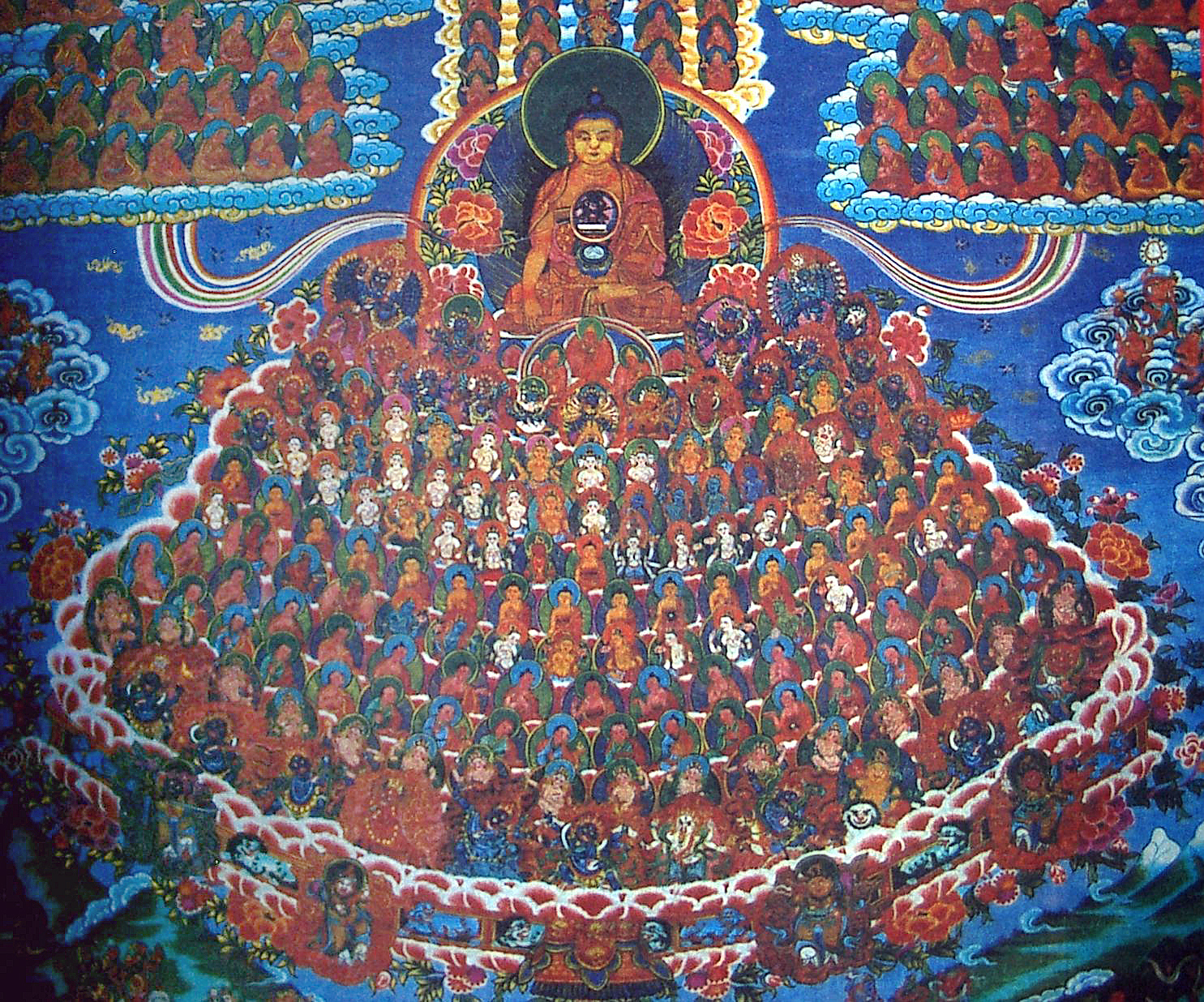
A refuge tree mural at Selung Gompa near Mt Kailash, illustrating how the masters, yidams, and protectors of the tibetan kagyu lineage branch out from the original shakyamuni buddha.
Key Terms of the early South Asian transcendental landscape
Aranyakas: Collection of texts from the Vedas compiled by forest ascetics, these texts offer reflections on the meaning of ritual symbols and practices.
Aryans: Traditional name of the people who settled in northern India and whose religious beliefs and practices were recorded in the Vedas.
Brahman: Name for ultimate reality or source of power behind all of the gods and rituals spoken of in the Vedas.
Brahmanas: Collection of texts from the Vedas that explain the meaning and purpose of the Vedic rituals.
Dasyus: Name for one of the groups or tribes of people from Northern India who were assimilated by the Aryans.
Interdependent arising: One English translation of the Pali and Sanskrit terms Paticca-Samuppada and Pratitya-Samutpada, these terms have been variously translated as, ‘‘dependent origination,’’ ‘‘conditioned co-production,’’ ‘‘co-dependent origination,’’ ‘‘interdependent origination,’’ or ‘‘interdependent arising.’’ Each of these is an attempt to capture the Buddha’s account of causality, also known as the law of cause and effect.
Kamma/Karma: the Pali and Sanskrit terms for ‘‘act’’ or ‘‘action.’’ They refer to the connection between actions and their consequences that affect one’s life both in this world and after death.
Moksha: The ultimate goal of many forms of Indian religious and philosophical practices, this term means liberation or release from the cycle of samsara.
Nibbana/Nirvana: Literally, ‘‘to extinguish’’ or ‘‘blow out,’’ these Pali and Sanskrit terms refer initially to release from samsara and the end of suffering. The Buddha reinterprets these terms to mean the extinguishing of the fires of greed, hatred, and delusion.
Rita: Name for the underlying structure and ordering of the universe and events taking place in it. It is the law-like regularity and harmony of both the moral and physical aspects of the universe.
Samsara: Literally, ‘‘wandering on,’’ this term refers to the cycle of birth, life, death, and subsequent rebirth in ancient Indian philosophy and religion.
Varna: Literally, ‘‘color,’’ this term refers to the four main social classes in ancient India: the priestly Brahmins, the warrior Kshatriyas, the merchant Vaishyas, and the peasant Shudras. This term is often mistaken for jati (birth status), which refers to one’s caste or station in society.
Yoga: Literally, ‘‘to yoke, or bind,’’ this term refers to ascetic meditative techniques for disciplining the mind and body in order to achieve ‘‘higher’’ knowledge and escape the bondage and suffering of samsara.
Examples of teachings attributed to Gautama the Buddha
The Dhammapada
literally the “path of dharma” or “verses of truth,” this anthology of 423 aphorisms is the most widely cherished text in the theravāda pāli canon. Preserved as direct poetic sayings of the buddha, many stanzas mirror the broader folk wisdom and contemplative literature of northern india, sharing parallels with passages in the mahābhārata. Its verses present an immediate, practical psychology of the mind.
The Diamond Sutra
a seminal mahāyāna text composed between 150 and 200 ce, its full title translates as “the diamond-cutter of ultimate wisdom.” This Sutra is believed by most Buddhists to record the words of the Buddha, passed down to later generations by disciples who were present when the words were spoken.
Framed as an intimate dialogue between the Buddha and his senior disciple Subhūti, it methodically slices through subtle conceptual attachments. It demonstrates that whenever a spiritual realization or virtuous act is objectified into a rigid concept, its true freedom is lost.
Buddha’s answer is focused on the understanding of emptiness (Shunyata). Emptiness here refers not to a vacuum or meaninglessness, but to the conditioned nature of all phenomena, and the true absence of attachments among phenomena. All things are interrelated and connected, empty of isolated identity, and this is the nature of reality.
The Heart Sutra
is the most condensed distillation of the perfection of wisdom literature (Prajnaparamita), recited daily in temples throughout East Asia. Spanning barely a page, the text contains the famous declaration: “form is emptiness, emptiness is form.” It reveals that emptiness is not voidness or nihilism, but the vibrant, unbounded interconnectedness of reality stripped of conceptual clinging.