
the karnak temple
The temple compound of Amun at Karnak is one of the largest religious structures in the world. It represented not only the seat of the great god Amun-Re but also contained or adjoined many chapels and temples dedicated to different deities, like Amun-Re’s consort Mut, Khonsu, Opet, Isis and Osiris. The compound was constructed from around 1550 BCE throughout the Greco-Roman period.
Its hypostyle hall (an unroofed area made of multiple colossal pillars) and the giant, hieroglyphic-encrusted papyrus columns leading up to the entrance are outstanding, especially as they were built at a time when people in most of the other places of the world didn’t even know how to make little houses.
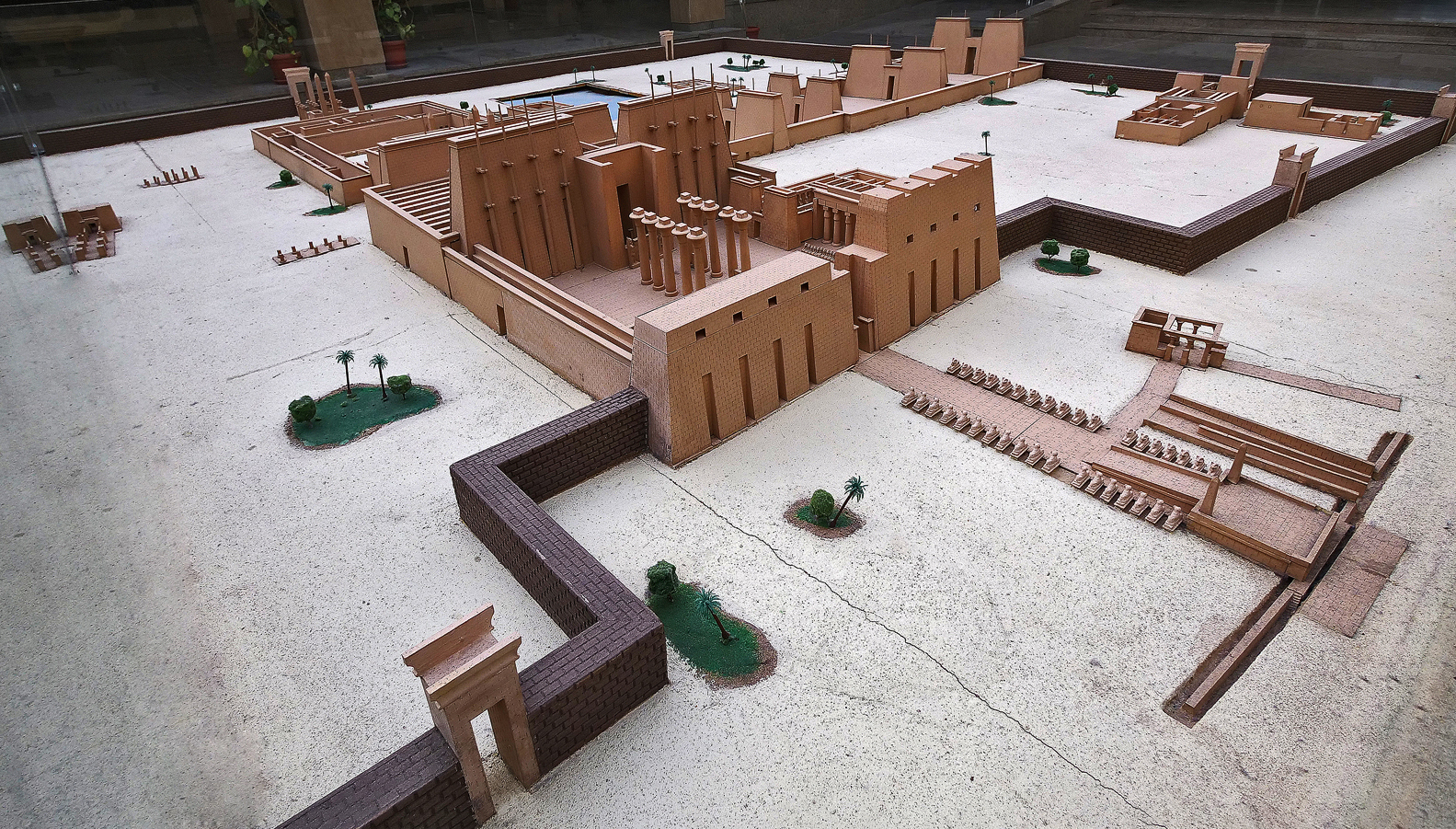
A model of the Karnak Temple at its maximum expansion with seven pylons, a roofless hypostyle hall, the water tank and some additional temples on the compound.
the main part of the compound


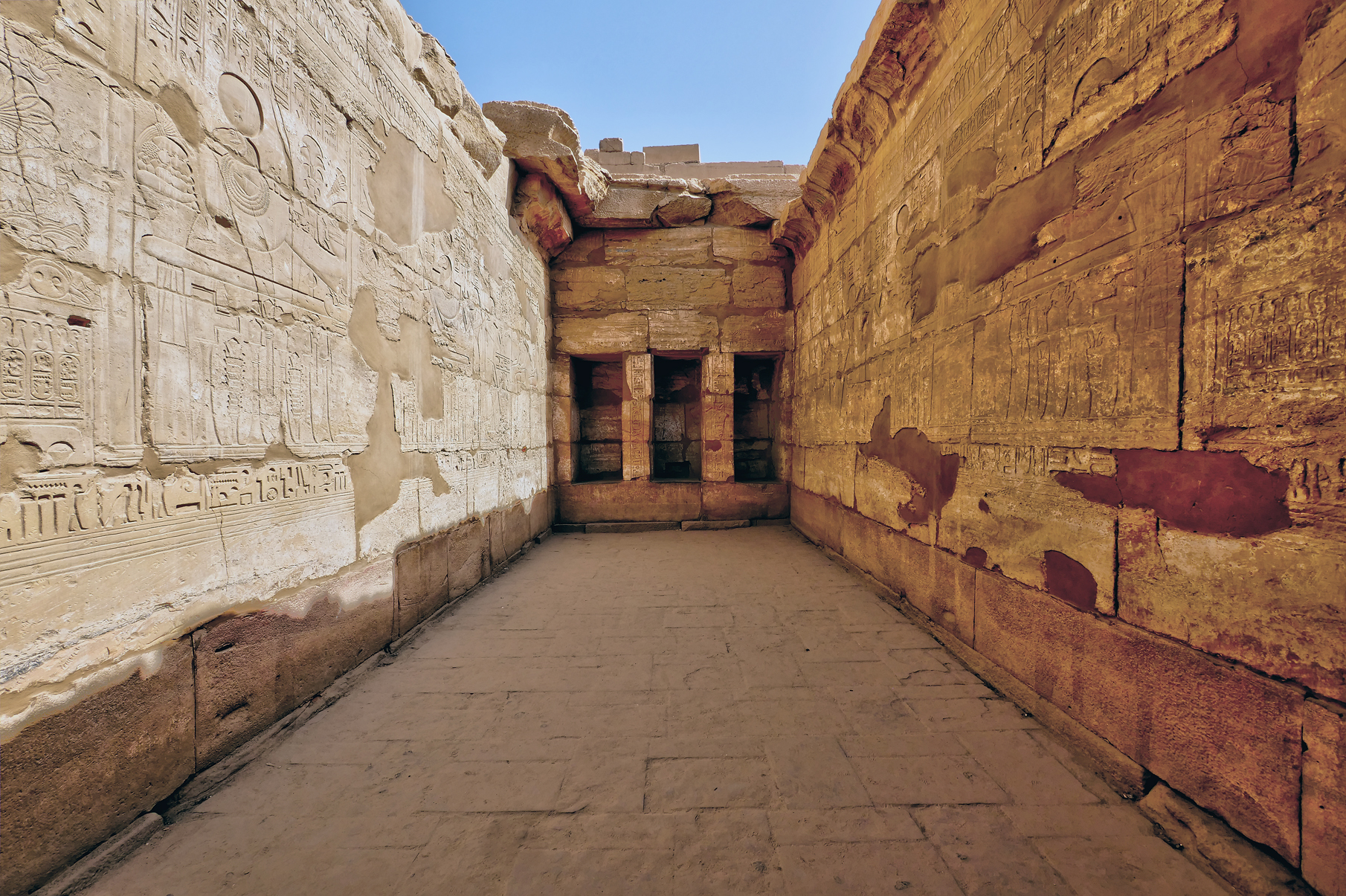


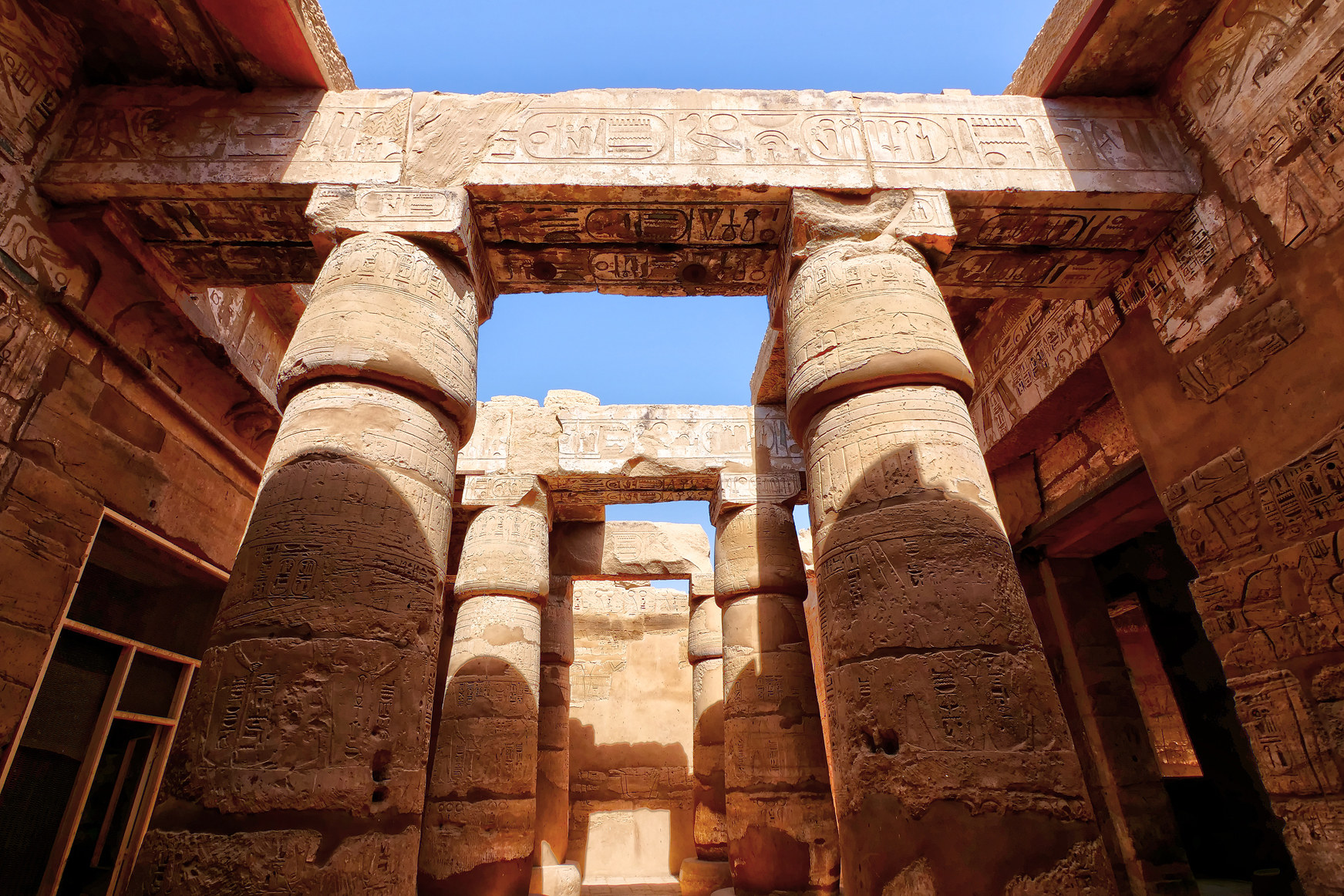
Photo 1: An avenue of criosphinxes—statues featuring the body of a lion and the head of a ram—leads to the First Pylon at the western entrance. The ram is the physical manifestation of Amun-Ra, the “Hidden One” and supreme deity of Karnak. These figures combine the supreme terrestrial might of the lion with the god’s divine creative power. The small statue of the Pharaoh positioned between the paws is physically enveloped by the deity, signifying that the king is protected directly by Amun-Ra.
Photo 2: The second pylon features recently restored artwork. These massive gateways functioned as cosmic shields, separating the chaotic outside world from the ordered environment of the inner sanctuary.
Photo 3: Young Egyptian artisans on a scaffolding restoring the ancient artwork of the second pylon. The fact that Muslims are meticulously restoring a temple and depictions of polytheistic deities is a striking cultural irony. This level of cross-religious preservation is rare, signifying a shift in perspective where the ancient monuments are viewed as essential pillars of a shared historical and national identity.
Photo 4: Open papyrus umbel capitals and architraves sit atop the central columns of the Great Hypostyle Hall. These columns, standing 24 meters high, were designed to mimic a primeval forest, where the ancient Egyptian myths were presented in striking, large-format depictions.
Photo 5: A side view of the Hypostyle Hall reveals the density of the 134 massive columns. The scale of this architecture was intended to overwhelm the human senses, reinforcing the insignificance of the individual compared to the eternal state.
Photo 6: The last standing obelisk of Hatshepsut remains a marvel of ancient engineering. The inscriptions clarify the queen’s reasons for donating the monuments and stress that each obelisk was carved from a single piece of red granite and gilded with the finest gold. These monuments acted as ritual lightning rods, connecting the earthly temple to the solar power of the sun god.
Photo 7: The central chamber of the Bark Shrine of Seti II is dedicated to Amun. This was the temporary abode for the god’s portable boat during festival processions, allowing the divine presence to move through the city.
Photo 8: A statue of Amun-Ra, the King of Gods during the New Kingdom. As the chief deity of the Egyptian Empire, Amun-Ra represents one of the earliest successful “exports” of religious imagery, eventually being identified with Zeus in Ancient Greece as Zeus-Ammon.
Photo 9: Looking across the Court of the Middle Kingdom, from which the entire Karnak complex grew, toward the rear of the central sanctuary. While the original limestone structures of the 12th Dynasty have largely disappeared, the area was embellished by Thutmose III with four bundled papyrus columns and their massive lintel. This view captures the transition from the oldest foundations of the temple to the later granite halls of the sanctuary in the background.
Photo 10: A view through the gateway located on the southern side of the Great Court, situated next to the Temple of Ramesses III. We look south toward the Temple of Khonsu and the monumental Euergetes Gate hiding behind a small rise.
Photo 11: Osiride statues of Ramesses III line the court of the king’s barque shrine. By depicting himself in the pose of Osiris—mummified and holding the crook and flail—the king creates a recursive loop between his temporal rule and his eternal, resurrected form.
Photo 12: A view of the Temple of Ramesses III from the open court into the more restricted, shadowed areas of the inner sanctuary.
the periphery of the compound
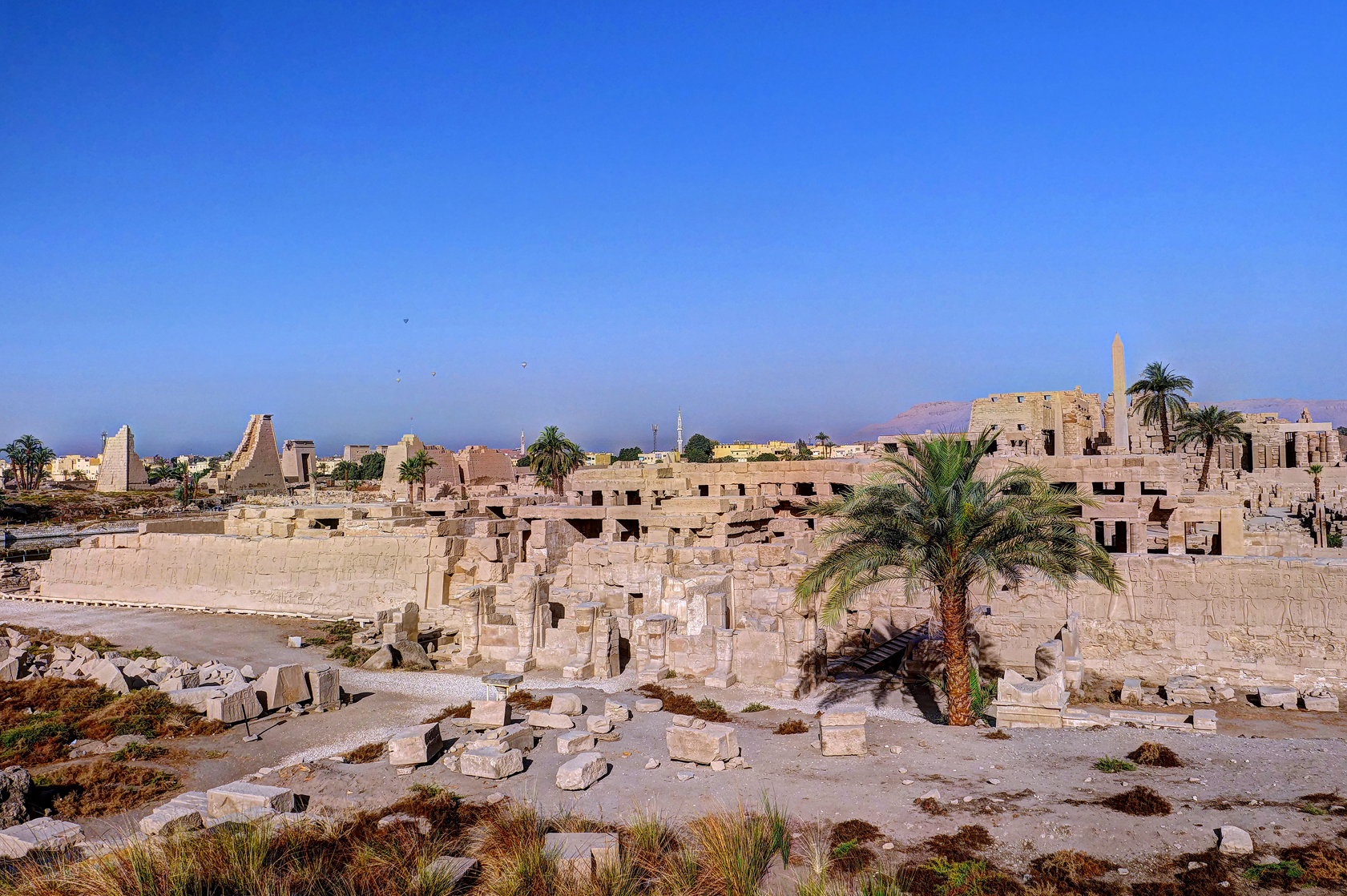


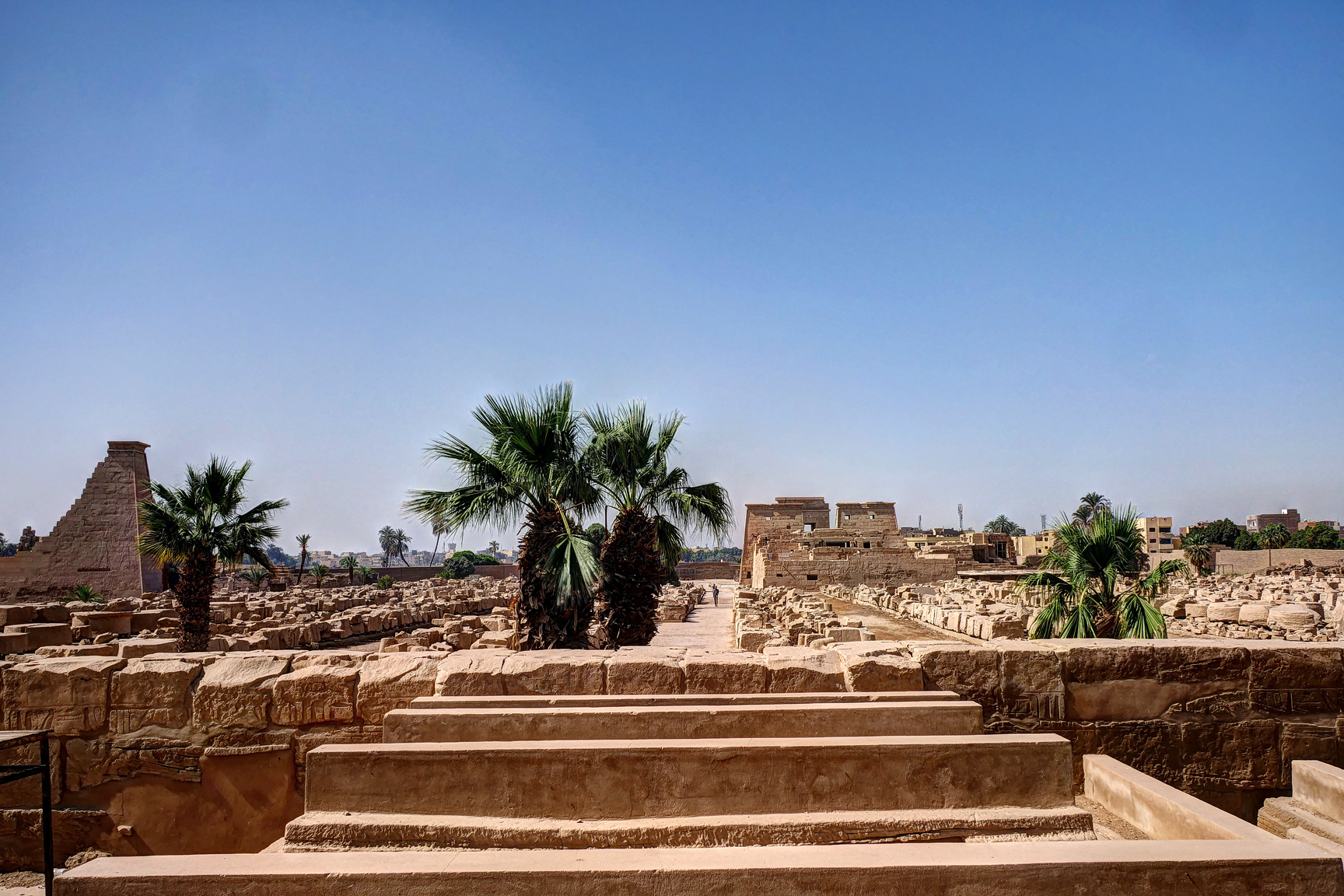
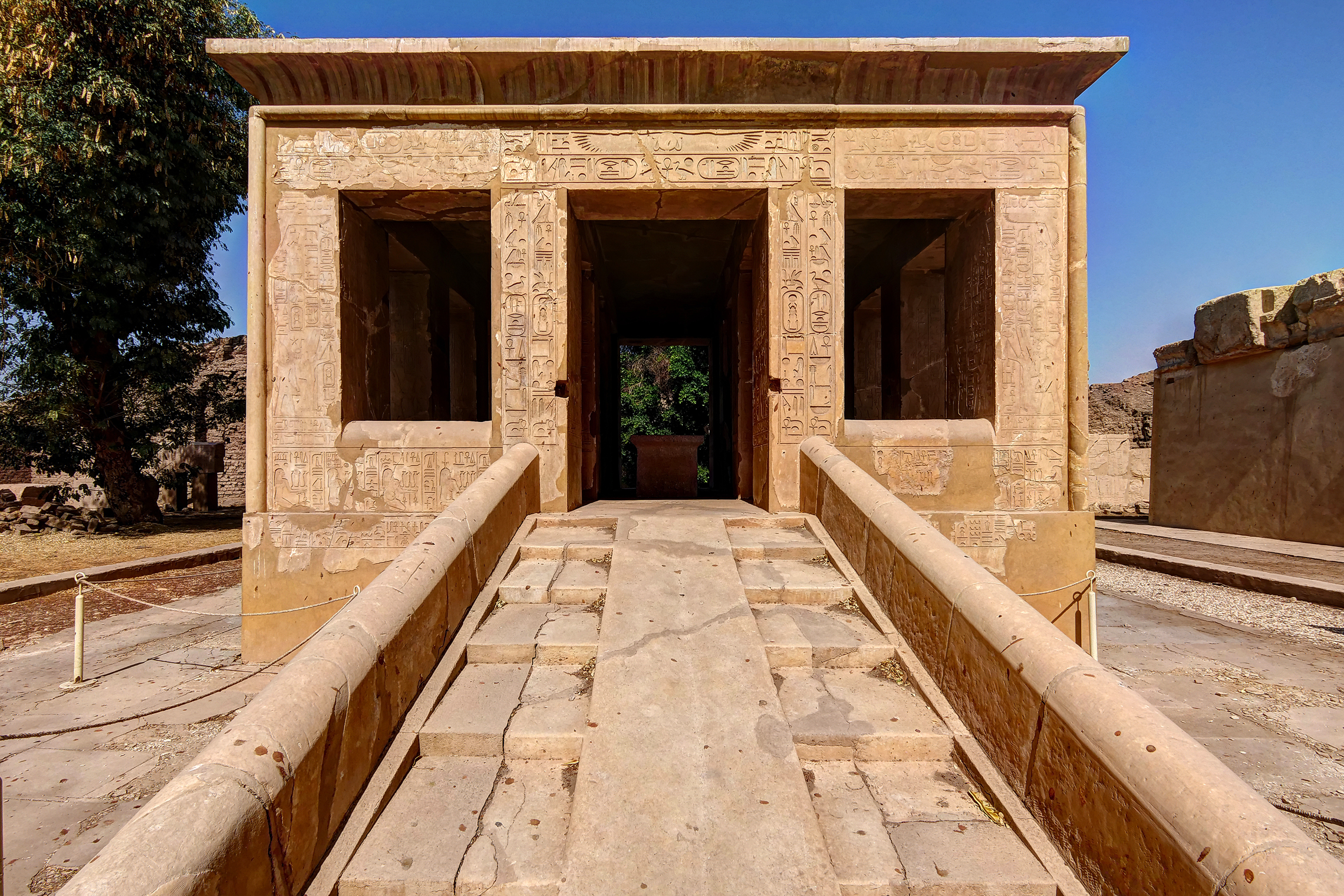
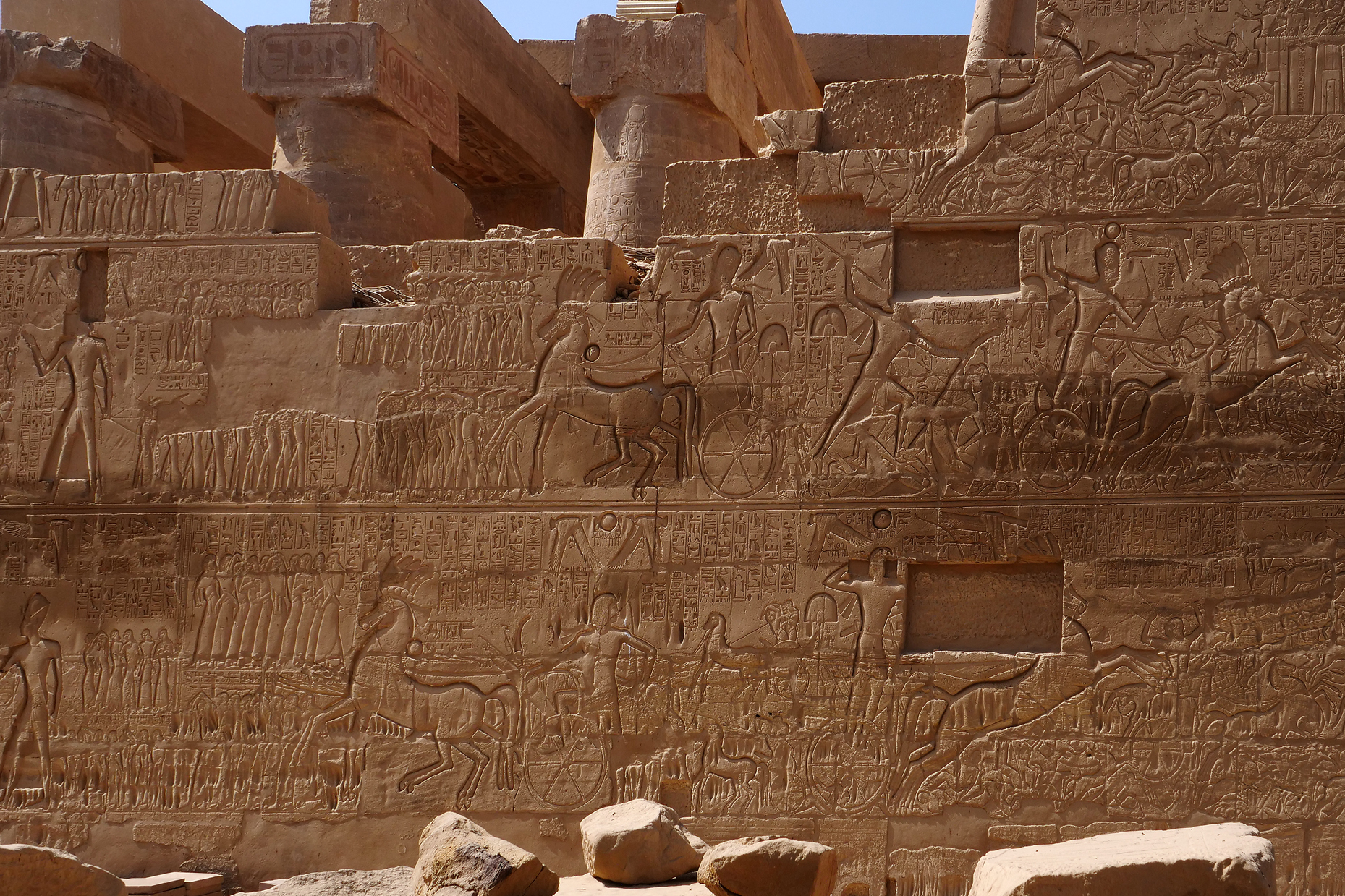
Photo 1: The eastern view of the compound illustrates the sheer scale of the Amun-Ra precinct. From this vantage point near the Osiris Heka-Djet Temple, one can see the staggering density of the ruins stretching toward the peripheral chapels. This area represents the outskirts of the ritual center.
Photo 2: The sacred lake provides a moment of reflecting stillness within the compound. Measuring roughly 120 by 77 meters, it was filled with water from the Nile and used by the priests for ritual purification four times a day. In Egyptian cosmogony, the lake represents the primeval waters of Nun—the background of existence.
Photo 3: The Temple of Amenhotep II is a small, elegant shrine situated between the ninth and tenth pylons. It was built during the 18th Dynasty and later dismantled and used as fill material for later constructions, only to be reconstructed in the modern era. It stands as a testament to the New Kingdom’s ability to balance massive scale with delicate, precise relief work.
Photo 4: The Gateway of Euergetes serves as the monumental entrance to the Precinct of Mut. Built by Ptolemy III Euergetes I in the 3rd century BCE, it is a late-stage addition to the complex. The gateway marks the period when the Greek Ptolemaic rulers adopted the Egyptian religious software, utilizing the traditional pylon architecture to legitimize their rule within the ancient cultural axis.
Photo 5: The inner decoration of the Gateway of Euergetes displays the fine relief work of the Ptolemaic period. These scenes show the Greek Pharaoh, Ptolemy III, performing rituals before the Egyptian gods. The preservation of the color and the depth of the carving illustrate how the Hellenistic rulers maintained the artistic protocols of the New Kingdom to project a seamless continuity of divine authority.
Photo 6: This view from the roof of the Temple of Ramesses III looks south toward the ninth pylon, with the Khonsu and Opet temples visible in the distance. This perspective reveals the complex urban planning of the compound, showing the alignment of the southern axial route. It provides a rare look at the structural relationship between the main sanctuary of Amun and the specialized temples dedicated to his son and his consort’s birth rituals.
Photo 7: The White Chapel of the Middle Kingdom is one of the oldest structures that could be restored in Karnak. Built by Senusret I during the 12th Dynasty, its original location is believed to have been between the 4th and 7th pylons. During the New Kingdom, the chapel was dismantled to make room for the expansion of the Temple of Amun. However, Pharaoh Amenhotep III used the blocks of high-quality limestone as fill material for the construction of the 3rd pylon. In 1938, archaeologist Henri Chevrier recovered these spolia almost in their entirety, allowing the structure to be meticulously reconstructed in the Open-Air Museum.
Photo 8: This massive relief is located on the northern outer wall of the Great Hypostyle Hall and depicts the campaigns of Seti I (19th Dynasty, New Kingdom). You can clearly see the use of sunk relief here, where the images are incised into the stone’s surface. The shadows cast into the deep carvings create a high-contrast effect that emphasizes the Pharaoh’s larger-than-life figure and his chariot charge. We see Seti I successfully fighting the Libyans and Hittites and afterwards presenting the captured enemy soldiers to his people. Ironically, the Egyptian side is always represented by an oversized Pharaoh and his giant chariot without an army, while the opponents are depicted as armies of dwarfs.
the osiris heka-djet temple
At the far east end of the huge compound lies a rather inconspicuous, now roofless chapel consisting of three small chambers—the temple of Osiris Heka-Djet (Osiris, Ruler of Eternity). In the hierarchy of the Egyptian pantheon, Osiris replaced Anubis as the chief of the underworld during the Middle Kingdom period (c. 2055–1650 BCE), ruling over those souls that had achieved eternal life.
The Karnak temple gates open daily at 6 am. One early morning in 2024, I was the only tourist strolling around the less frequented eastern area, and two guards offered in broken English to introduce me to the secrets of the chapels. Later, I supplemented my firsthand experience with information from online research and Mariam F. Ayad’s “God’s Wife, God’s Servant: The God’s Wife of Amun.” The few reliefs still recognizable in these chapels serve as a concise introduction to ancient esoteric teachings and the Egyptian metaphors of the transcendental journey.
In this temple, we see an early architectural manifestation of the myth of the seven layers that a soul must pass through to attain liberation or salvation. This concept continuously reappears in religions of later origin. In Hinduism, a human being possesses seven bodies or layers of consciousness that a yogi must internally traverse in the quest for liberation. In Sumerian mythology, as well as in the Bible and the Quran, the soul confronts seven gates after death.
It appears to me that within the geographic triangle of Greece, Egypt, Iran, and India—the crucible of most world religions—a shared pool of religious metaphors was generated in ancient days. These metaphors traveled through time and space, constantly updating their cultural software. For example, the mystery cult of Osiris and Isis traveled to Greece and across the Roman Empire. It resurfaced in the 18th century inside the Masonic imagery of Mozart’s opera “The Magic Flute,” shifted into the Theosophical movement of the 19th century, and since the 1960s, has been continually revived by various New Age and modern spiritual movements.


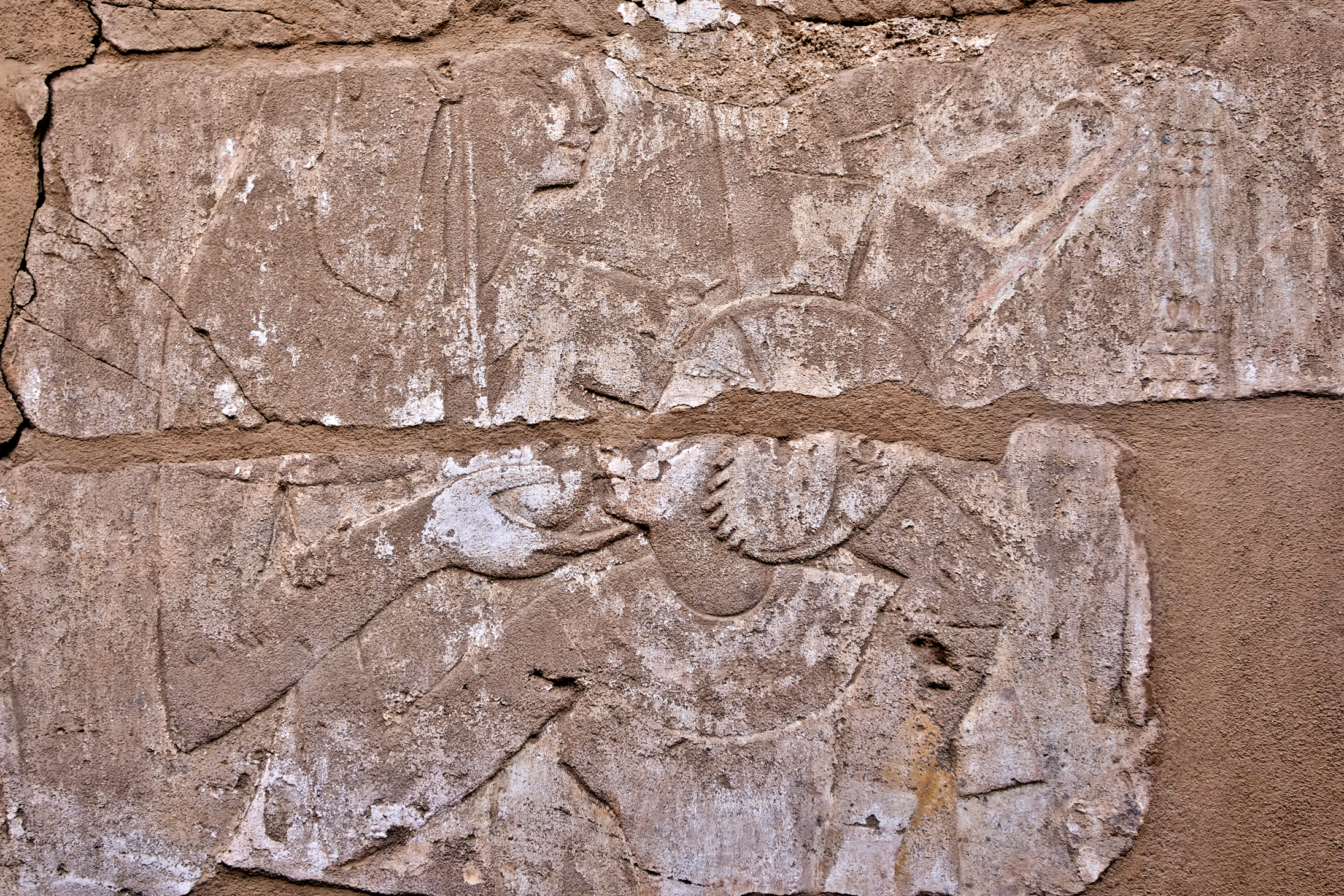
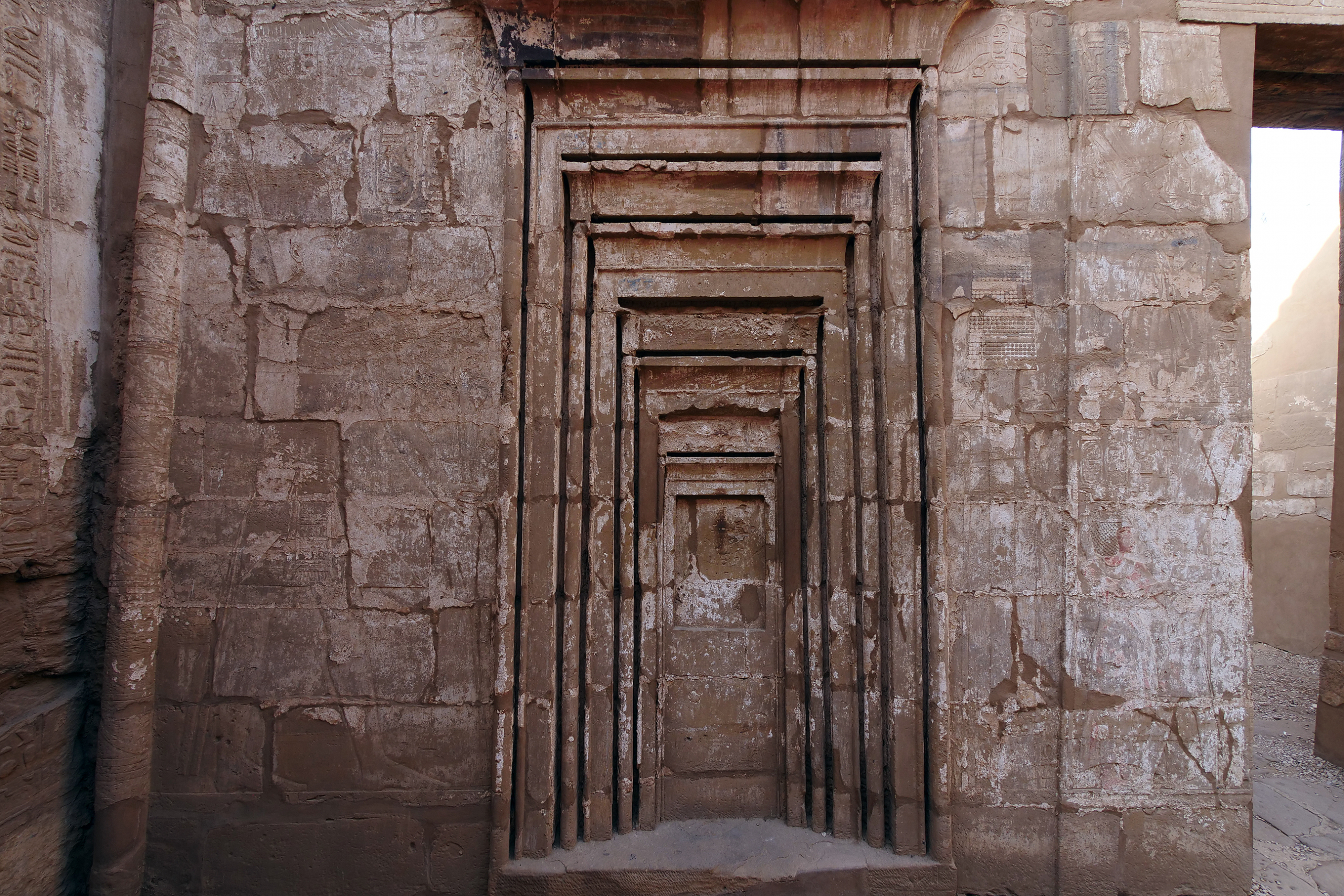
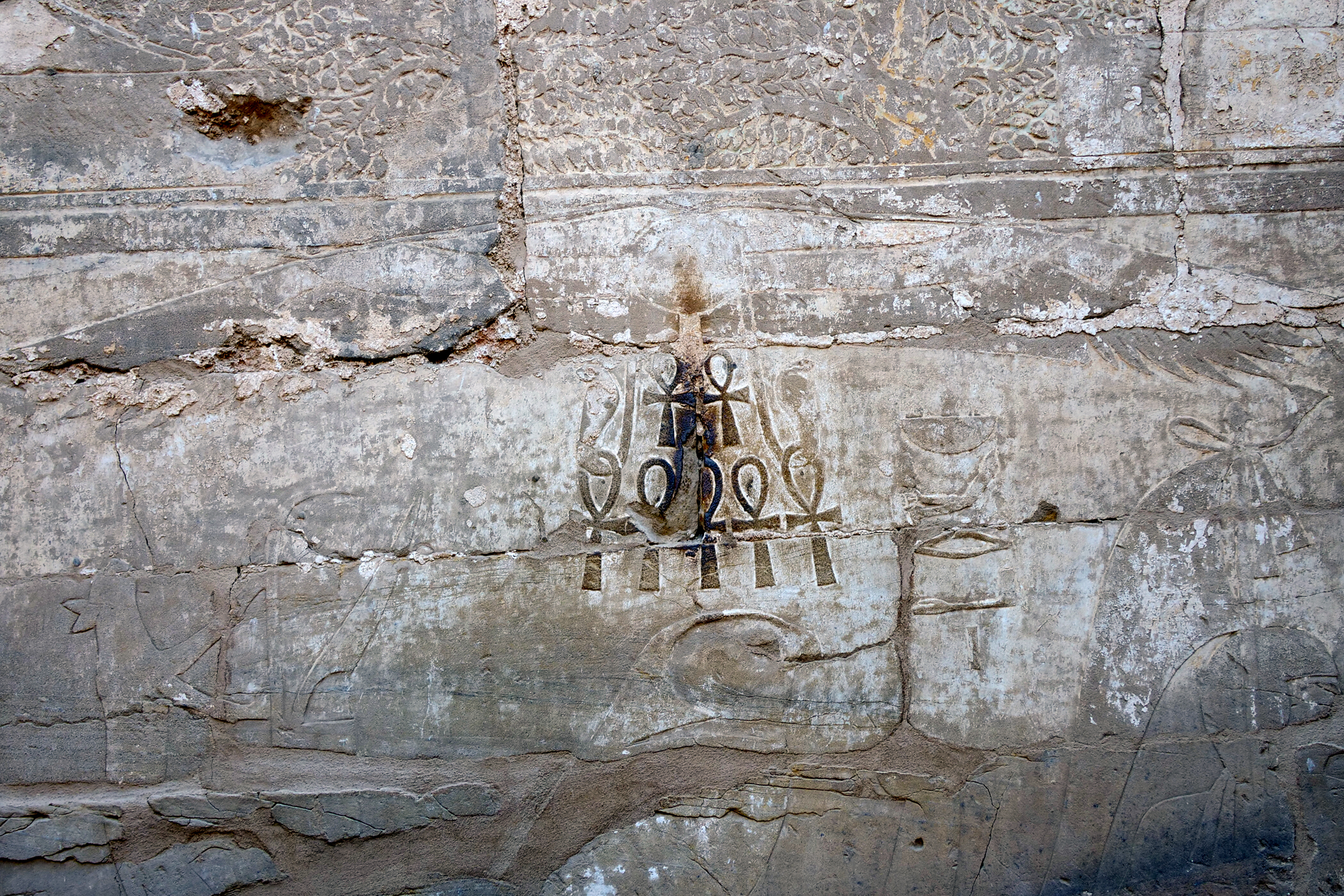
Photo 1: The Osirian chapels are in the eastern part of the complex, which was built relatively late (e.g., the gate dates back to the 30th Dynasty). Only a few repairs have been done in this area, and the damage done by ancient flooding is still visible.
Photo 2: Relief of the main chapel of Osiris Heka-Djet. The left figure is Amenirdis I, the God’s Wife of Amun (high priestess) and Divine Worshipper. She wears a voluminous, multilayered dress and a short curly wig—the tight “Nubian” style that resembles a modern helmet. In her right hand, she holds a naos-sistrum resting against her shoulder. The middle figure is Amun-Ra, who performs a dual life-giving ritual: he touches an Ankh to her nose to provide divine breath while simultaneously placing three more Ankhs into her open left palm. Behind him stands his consort, the goddess Mut, Mistress of Isherou, who places a protective hand on his shoulder. Mut carries a ceremonial object that resembles a handbag; this is actually the hieroglyphic sign for a Sed festival hall. Underneath it is the lizard-shaped hieroglyph (asha), which signifies “a great many”. Together, they are promising the priestess many jubilees of rule.
Photo 3: A powerful scene of divinization involving Shepenwepet I, the daughter of Osorkon III and a God’s Wife of Amun. She is shown being breastfed by a Hathor-like goddess, a ritual meant to transfer divine essence or “divine DNA” to the ruler. This biological and spiritual upgrade grants her the status of a divine being, providing the necessary credentials to navigate the afterlife and pass through the seven gates.
Photo 4: The Seven Gates of the Underworld: In the Egyptian Book of the Dead (specifically Chapter 147), these gates are described as a series of heavily guarded thresholds through which the soul of the deceased must pass in the Duat (the underworld) to gain eternal life. Only if the deceased has sacred knowledge of the specific names of the gate, its gatekeeper, and its herald will the soul be allowed to enter.
Photo 5: Doors can only be opened with the appropriate key. On the other side of the same wall in the adjoining chamber, one can find the seven keys in the form of seven Ankhs. These are not physical doors; instead, they represent seven demon-like deities trying to prevent the soul from entering into eternity. The temple of Osiris functioned as a training ground for the Egyptian elite to prepare themselves for the journey into the afterlife by memorizing the sacred knowledge that served as keys for the gates.
the khonsu temple
The Ancient Egyptian god Khonsu was the son of Amun and Mut and together these three deities formed the holy triad of Thebes. Khonsu was considered to be the god of the Moon and is typically depicted with a falcon head and a headdress with a lunar disc atop a lunar crescent.
The construction of Khonsu Temple began in the 20th Dynasty, under the reign of Ramses III (ca. 1184-1153 BCE) during Egypt’s New Kingdom, using sandstone blocks from earlier, dismantled, temples. The temple is aligned north-south with its entrance facing the Euergetes gate to the south, which was constructed by Ptolemy III (ca. 246-222 BCE) and opens onto the Avenue of the Sphinxes. This avenue would have been used during the annual Opet Festival to transport cult statues of Amun, Mut, and Khonsu from the Karnak Temple complex to Luxor Temple.
Further information of the Khonsu Temple
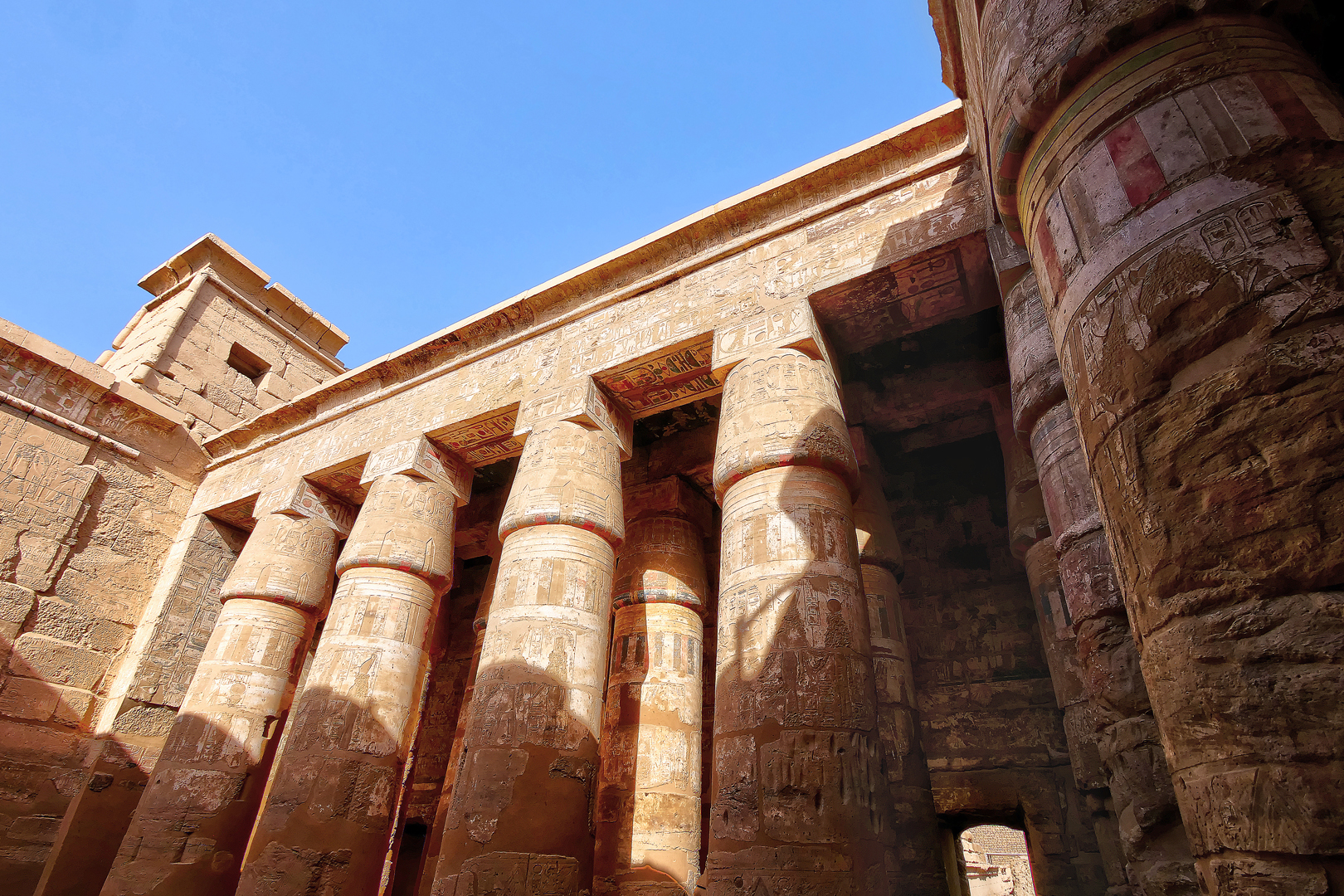
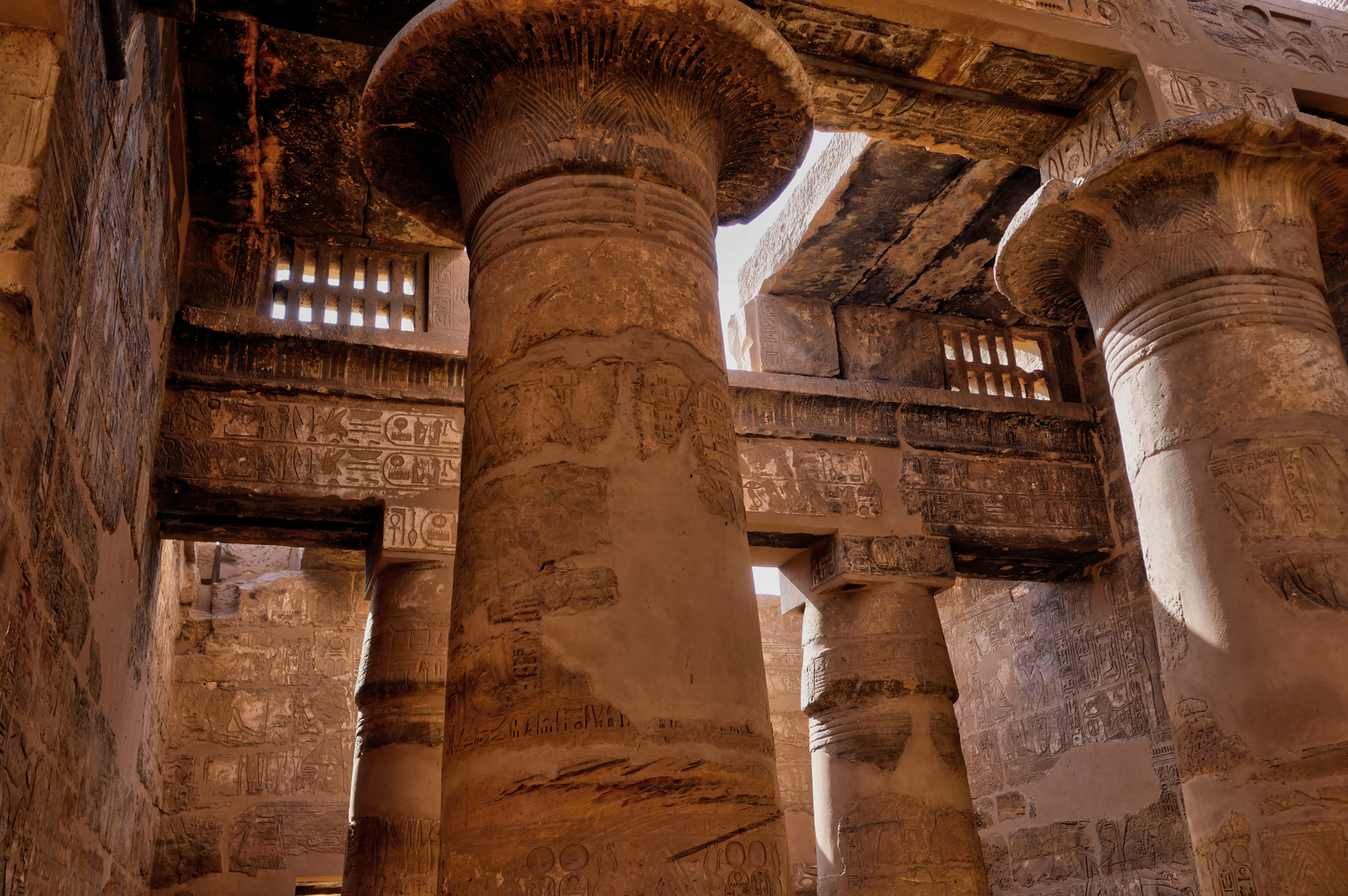
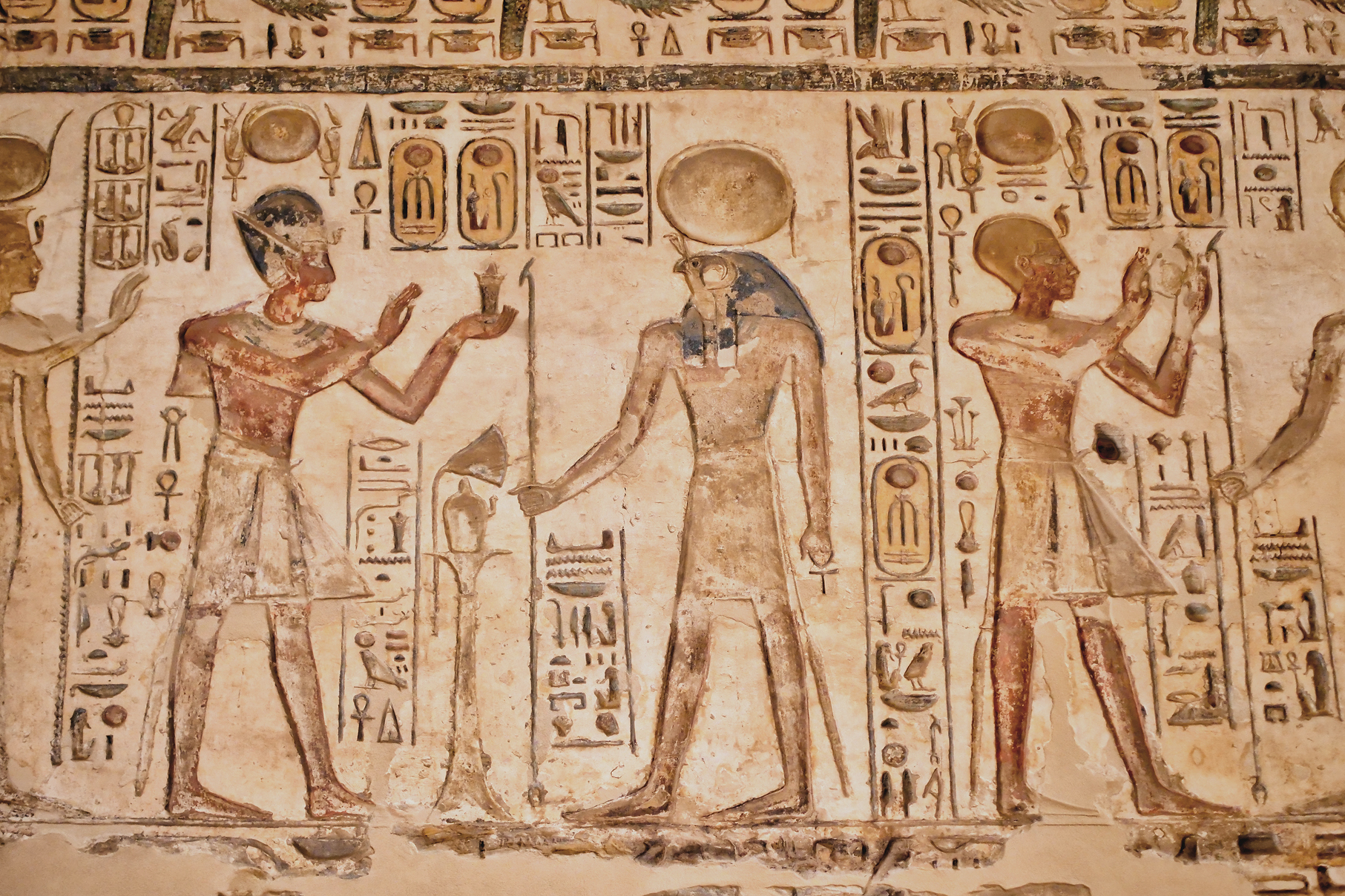

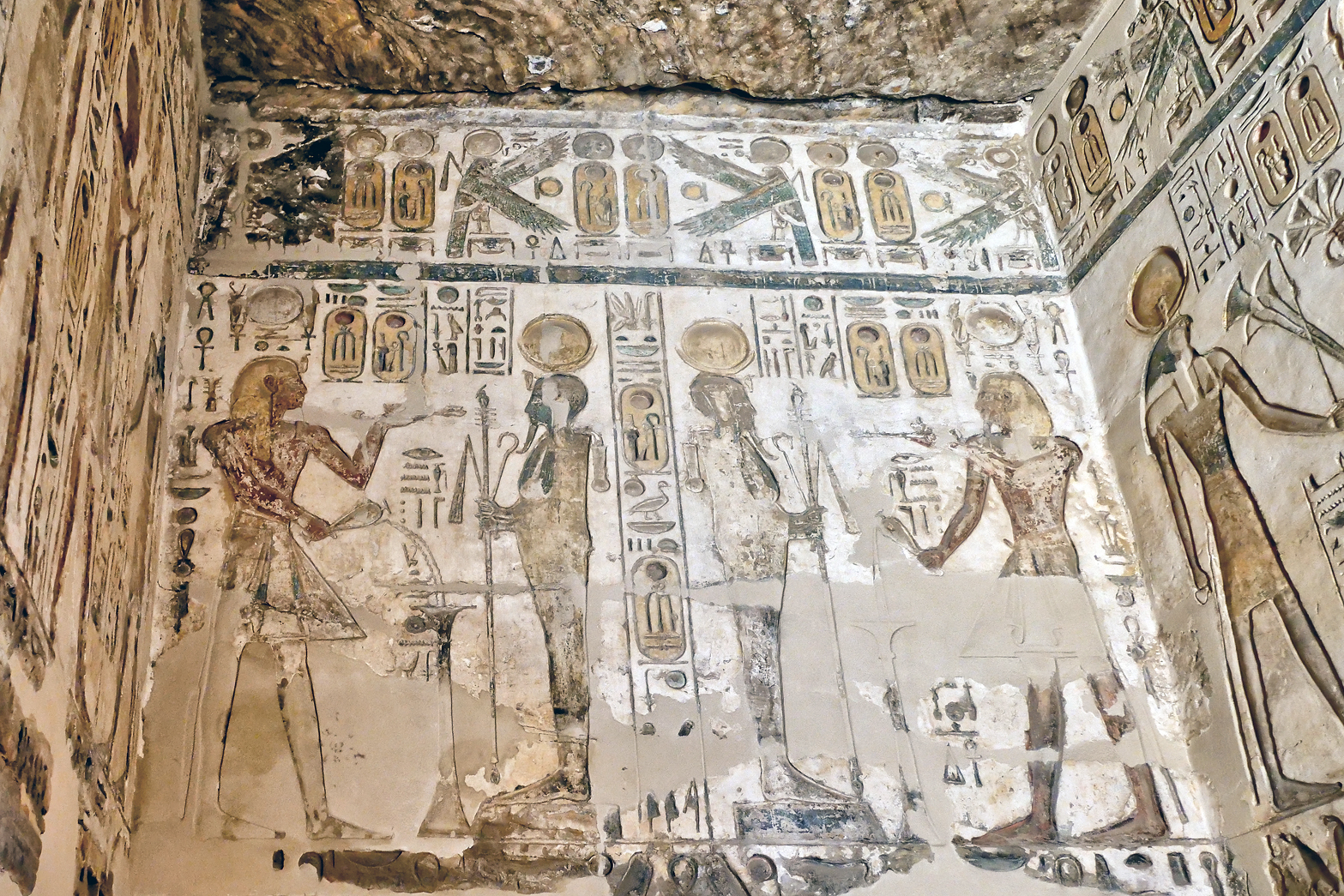
Photo 1: The Peristyle Court, largely decorated by the High Priest-King Herihor, is defined by its impressive row of columns with closed papyrus-bundle capitals. Unlike the inner sanctuaries, this area was open to the sky, serving as a transitional space for processional festivals.
Photo 2: After passing through the Peristyle Court the visitor enters the Hypostyle Hall of the Khonsu Temple.
Photo 3: In the left scene Pharaoh Ramesses IV presents an offering of sacred ointment or incense to the falcon-headed deity Ra-Horakhty, distinguished by the large, vibrant solar disk on his head. The text describes him as “the great god, lord of the sky, lord of the earth”. Behind the king is a deity named “Iusaaset” (half cut off).
Photo 4: On the left a falcon-headed solar deity receives a bouquet of papyrus or lotus stalks from a royal figure with a shaved head, a traditional marker of ritual purity. On the right, Ramesses IV is offering a small statue of the goddess Ma’at to the creator god Atum, who wears a blue corselet. Ma’at was the representation of the correct and proper order of the world, and maintaining ma’at was the primary responsibility of the king, so in this scene the king is effectively saying “I’m doing a good job and everything is running smoothly”. The column of text beneath Ramesses’ arms says “Giving Ma’at to his father Atum”.
Photo 5: A mirrored image with a Pharaoh offering to Osiris.
the opet temple
The Opet temple was the last important cult building to be constructed in the Karnak complex, located next to the Khonsu Temple. We see primarily a Ptolemaic construction and artwork built over an earlier 18th Dynasty foundation.
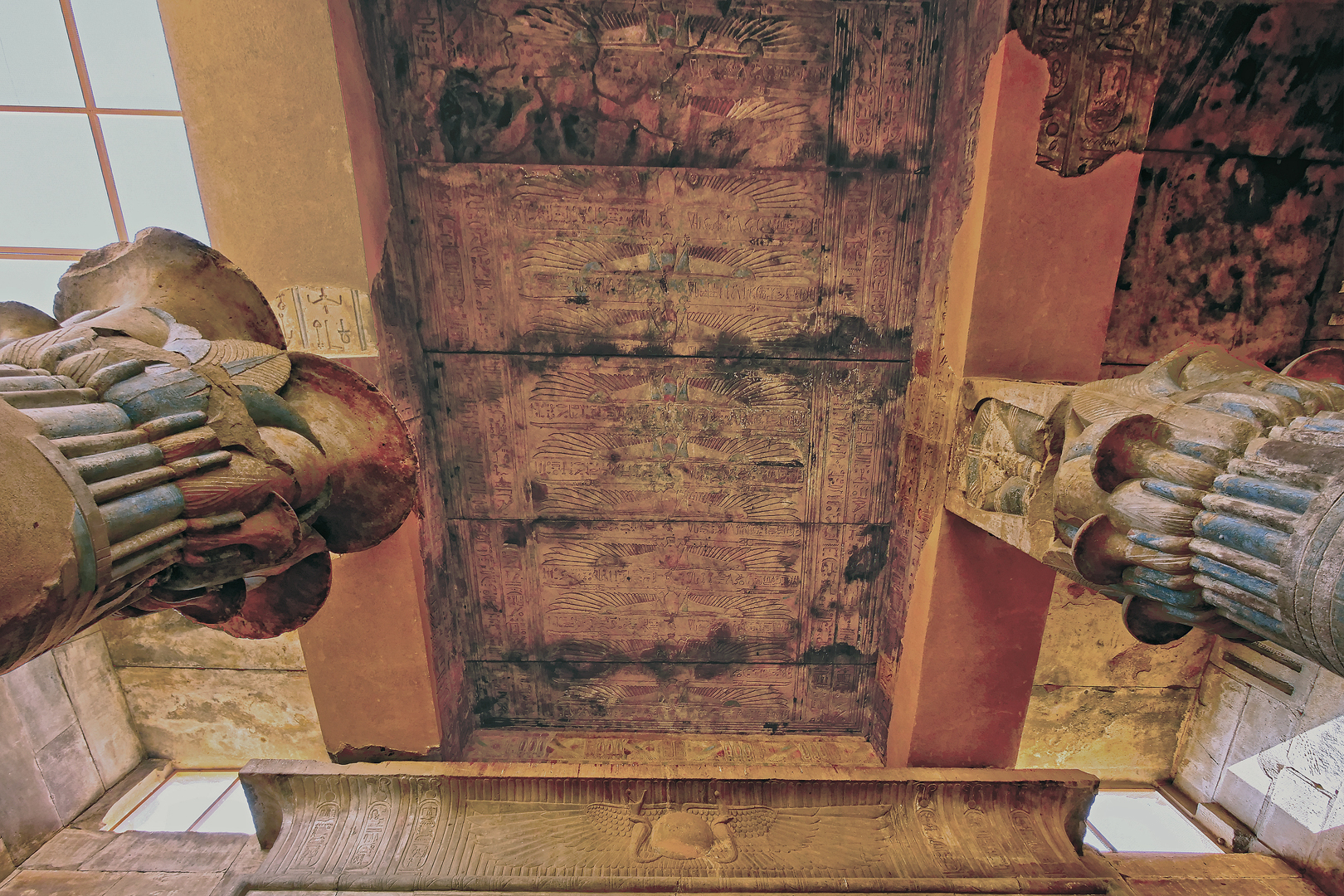
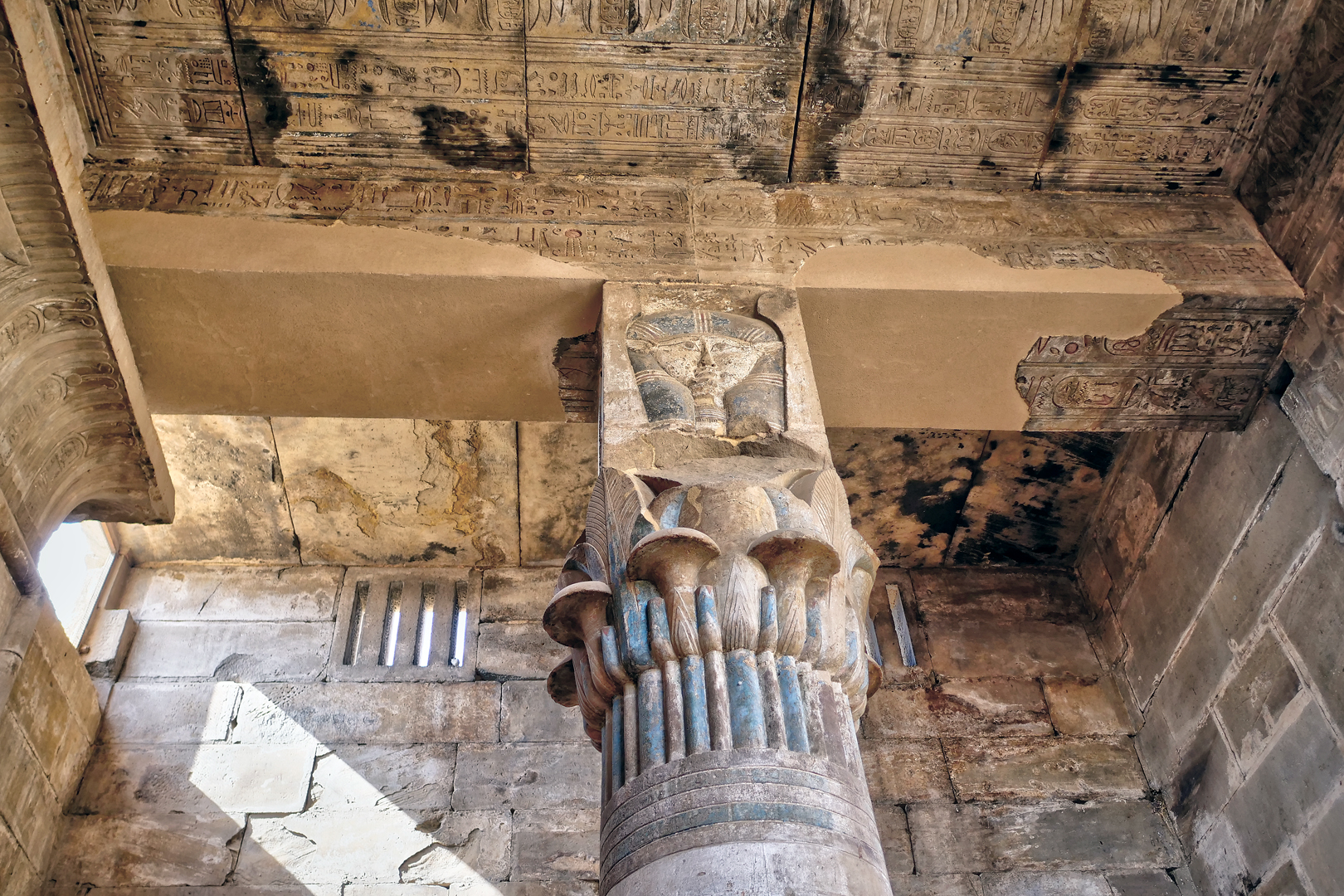
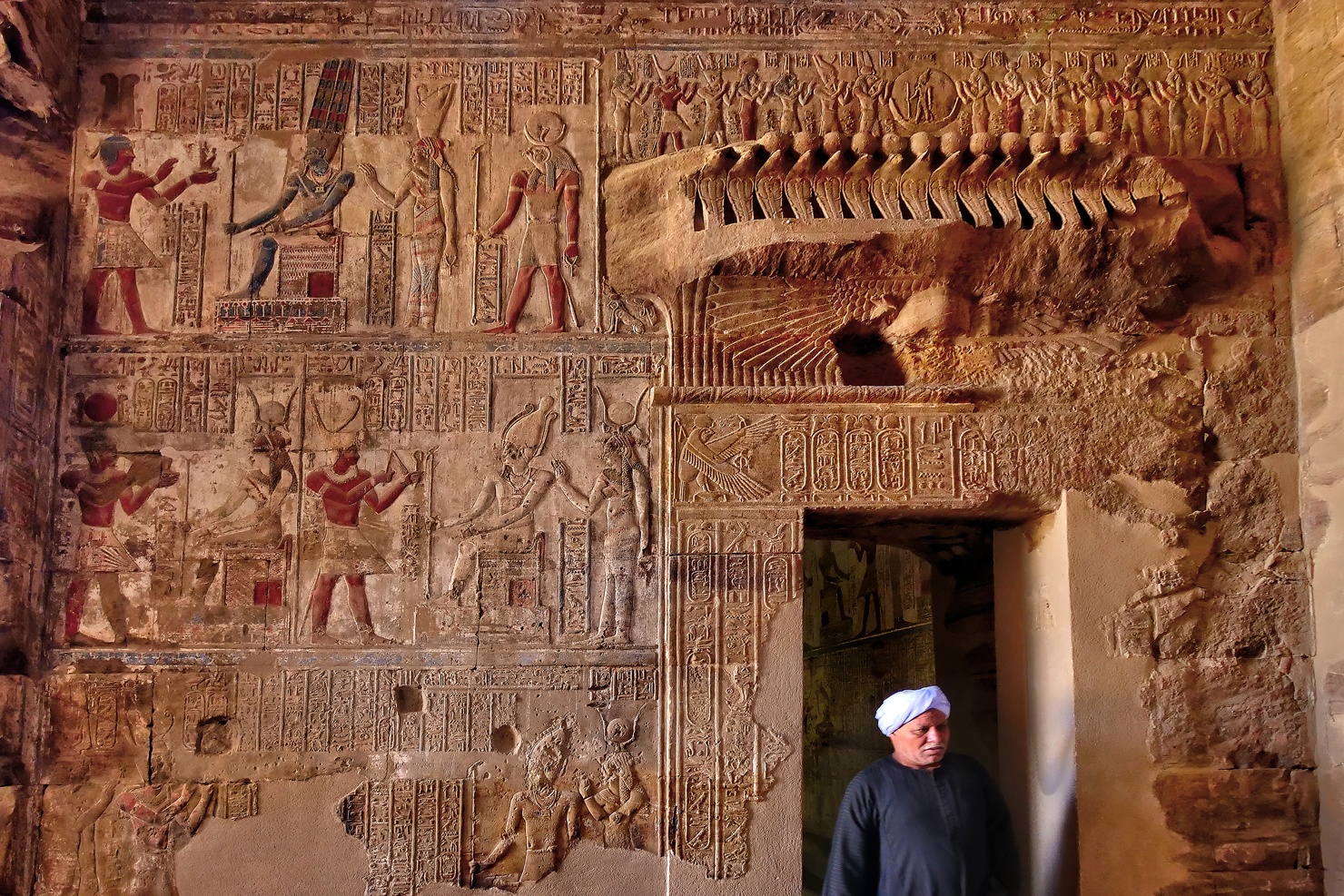
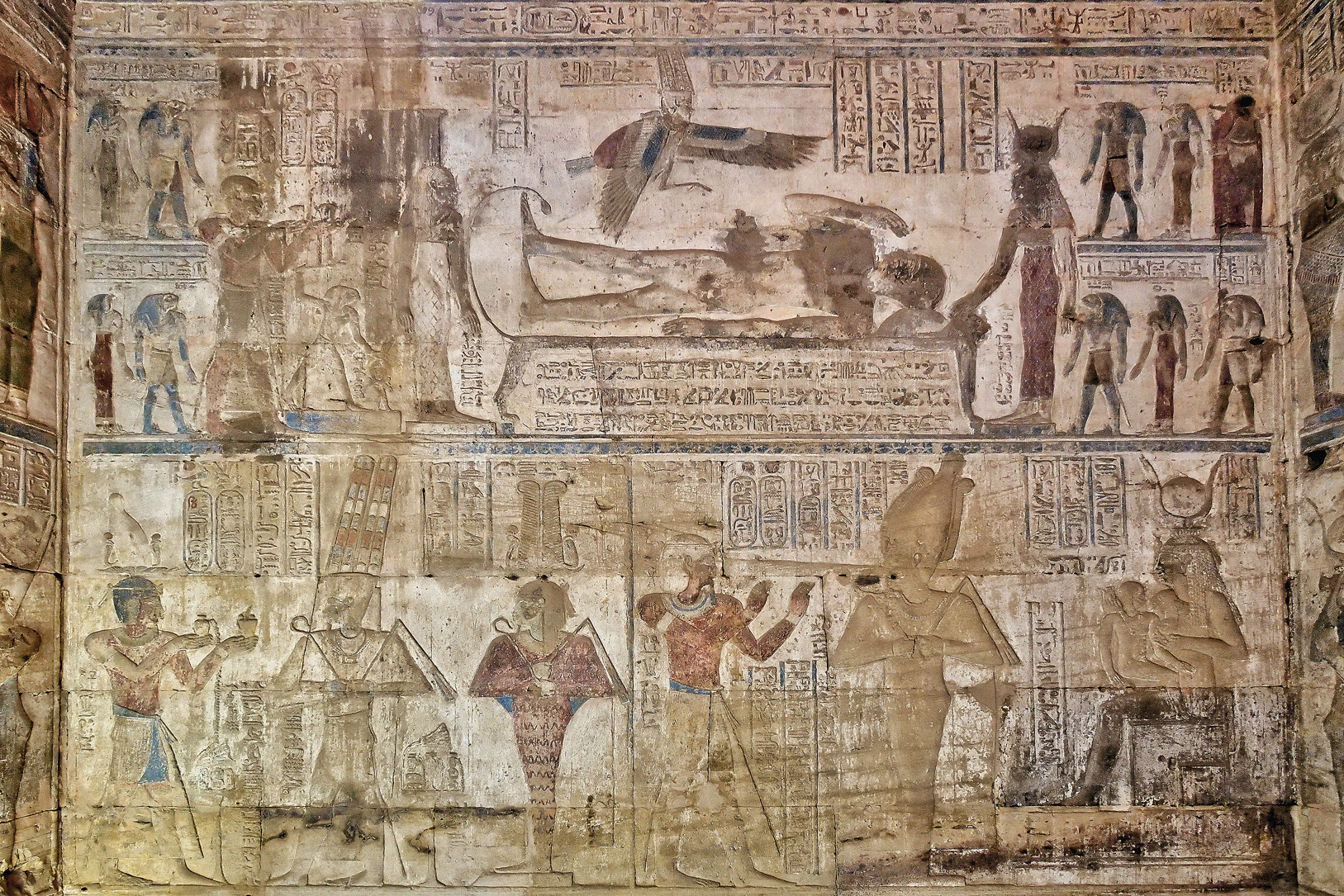
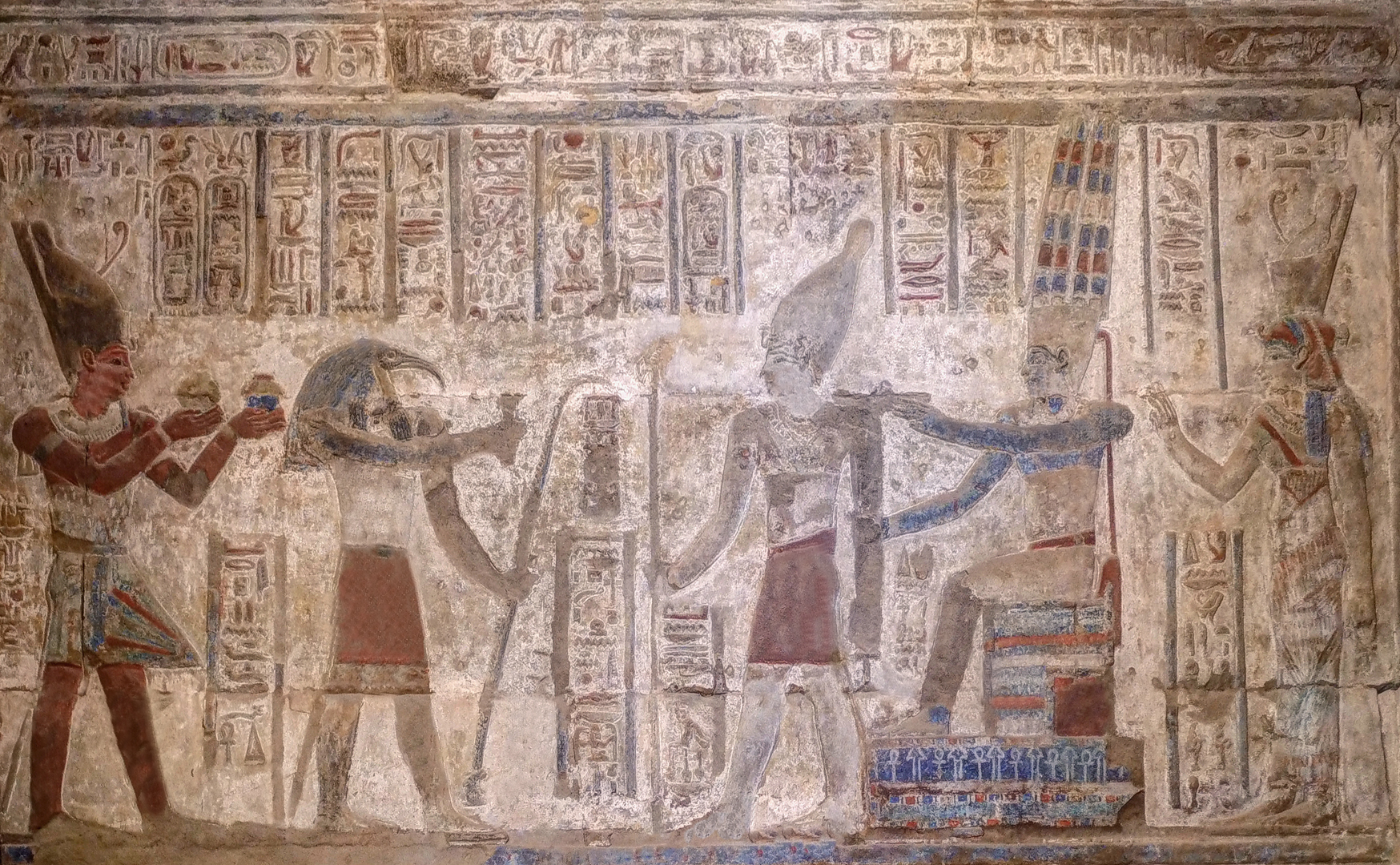

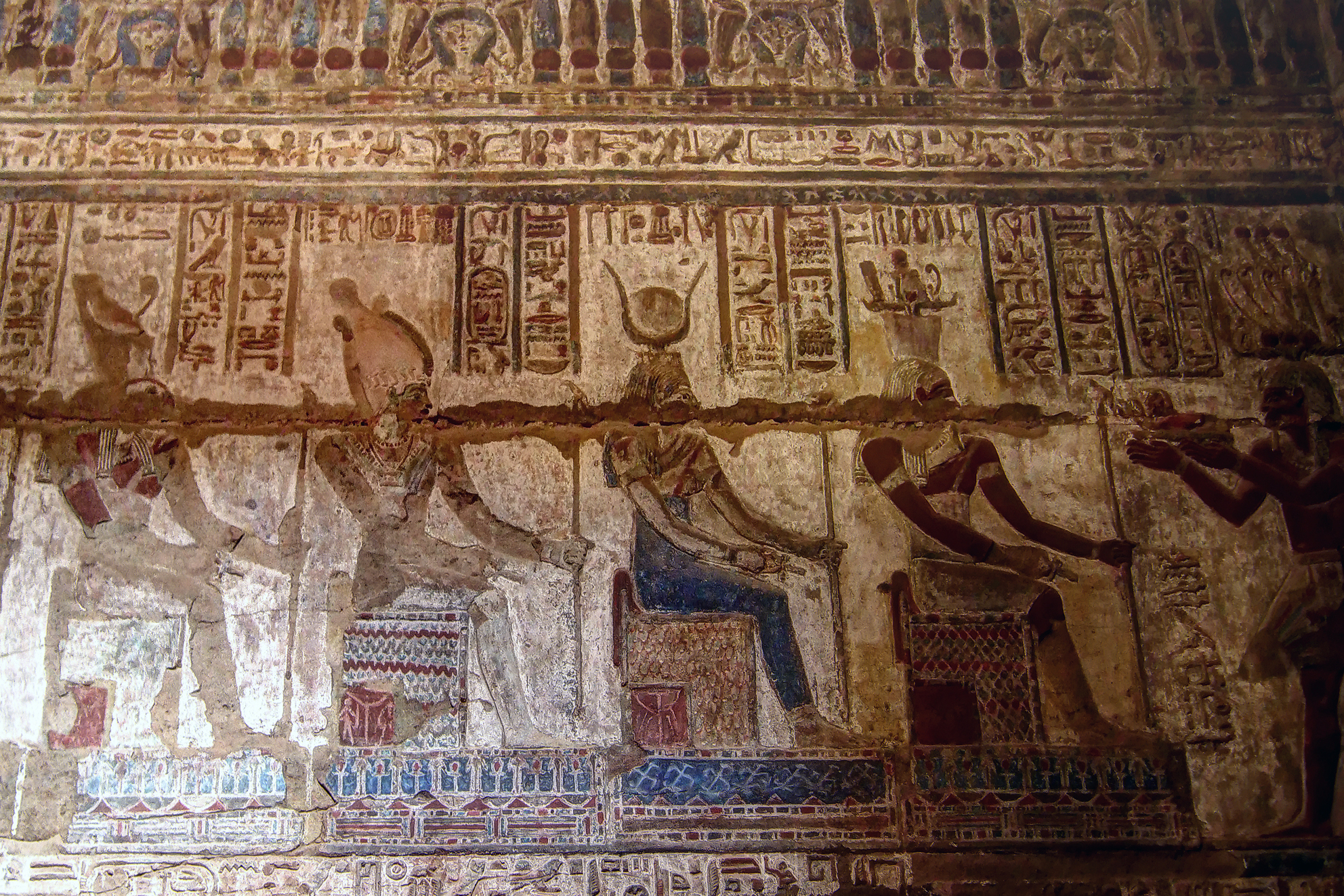
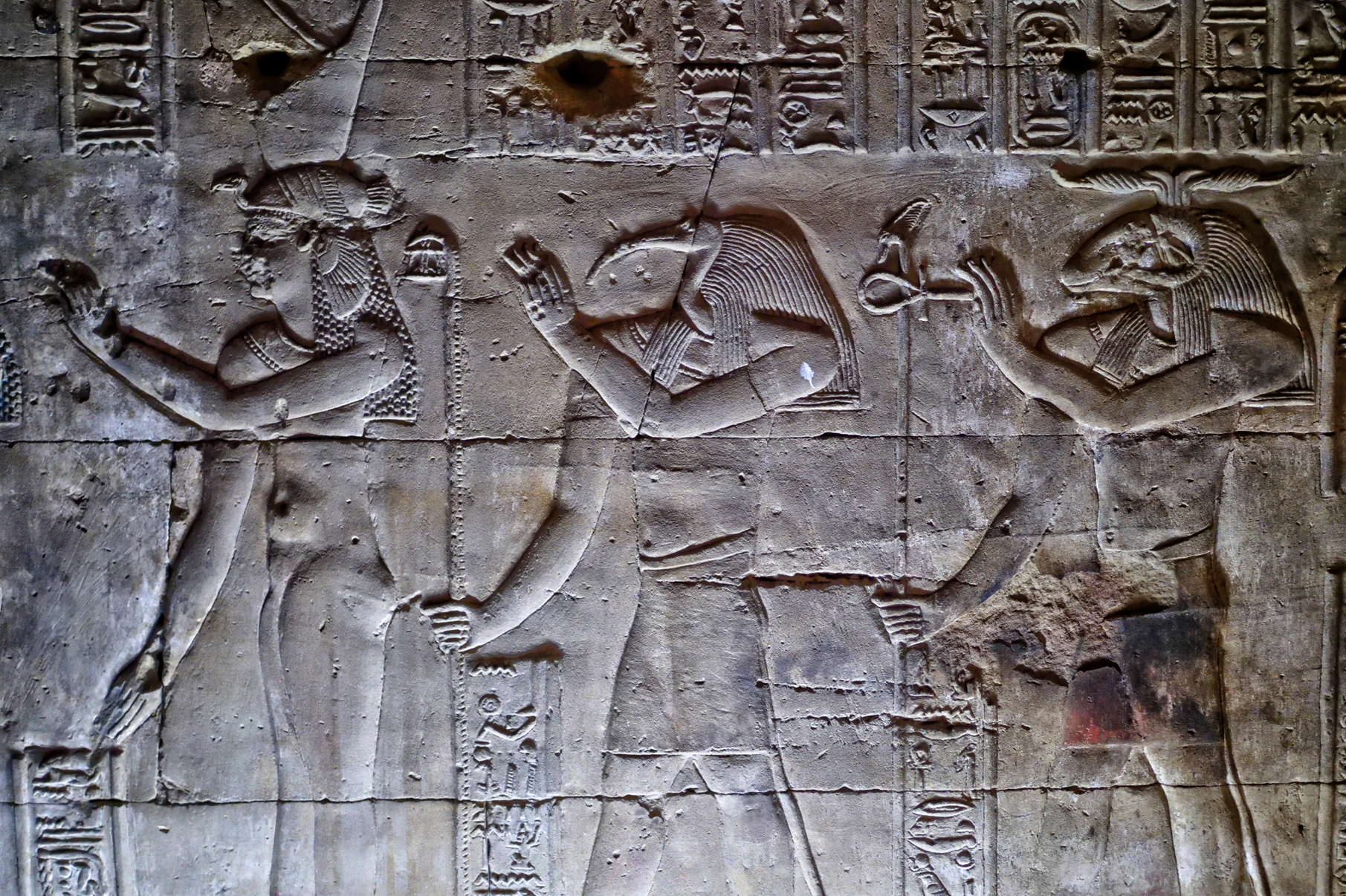
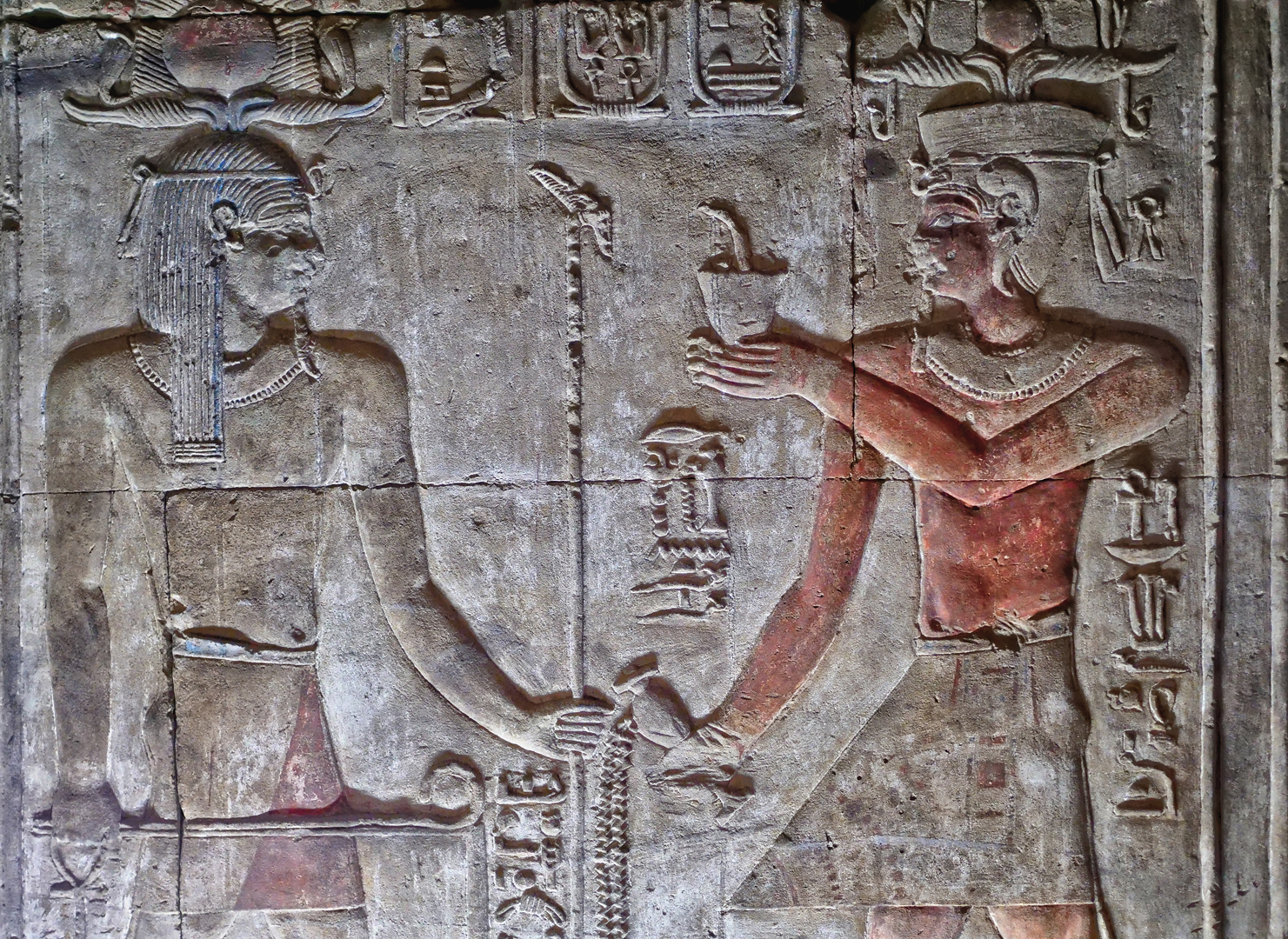
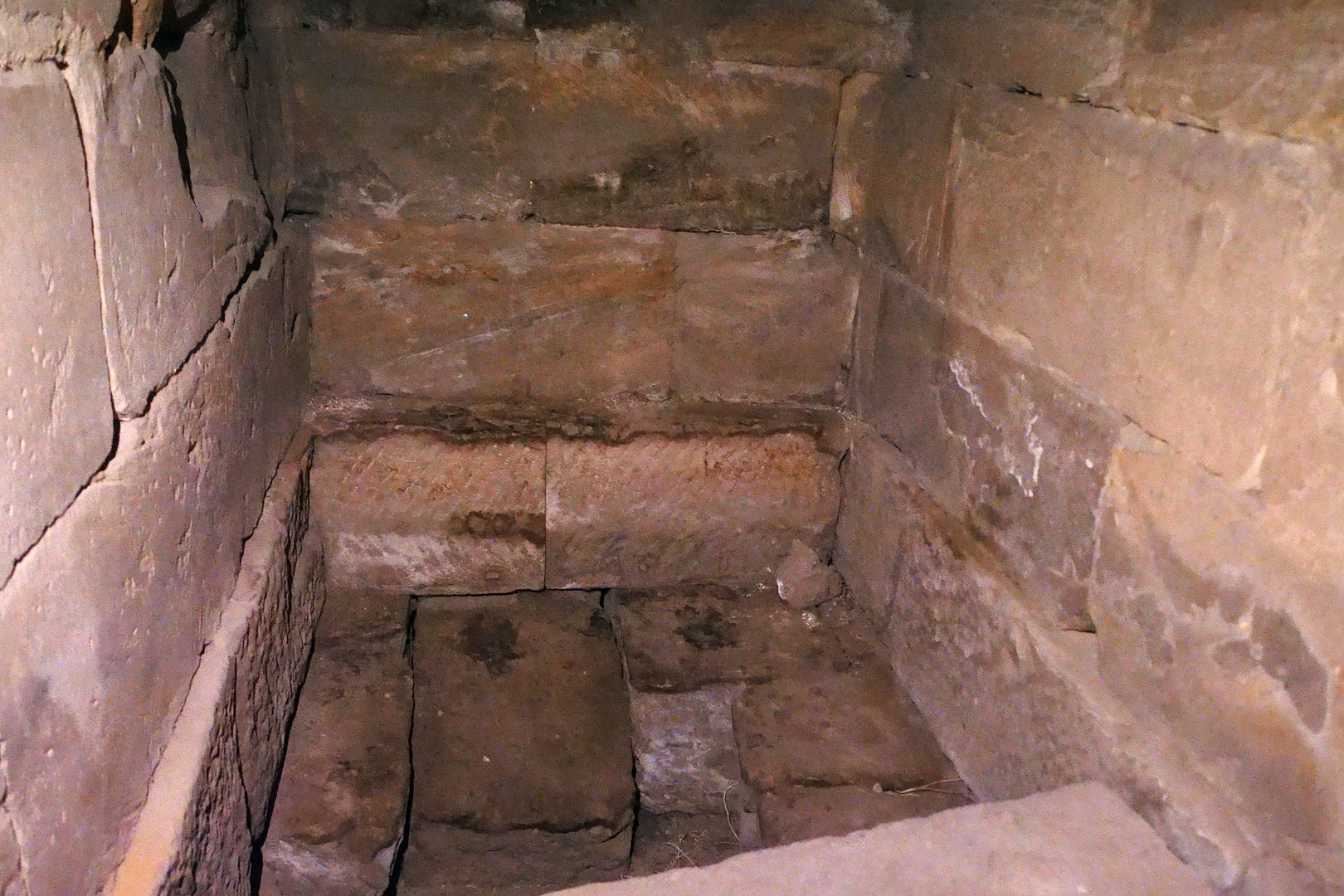
Photo 1: Looking directly up in the Hypostyle Hall. The ceiling is decorated with a rhythmic pattern of Nekhbet vultures with outstretched wings, symbolizing divine protection over the processional path.
Photo 2: On top of the columns are Hathor faces
Photo 3: One of the side chapels of the Opet Temple. On the upper register on the left a king offers gifts to the divine Karnak trinity, husband Amun, wife Mut, and child Khonsu.
Photo 4: The relief from one of the smaller chapels captures the core of the Osiris resurrection myth. After being murdered by his brother Set, the body of Osiris was divided into sixteen pieces and scattered across the Nile Valley—a theme of dismemberment that mirrors the initiatory transitions found in shamanic traditions worldwide. Set’s intention was to prevent any possibility of resurrection by fragmenting the god’s physical existence. However, through the persistence of his wife Isis, the pieces were recovered and the body was reconstituted as the first mummy. The only part that could not be found was the phallus, which had been lost to the river. To complete the ritual, a divine substitute was fashioned, restoring the god’s generative power. In this specific image, Osiris is depicted on a lion-shaped bed, receiving the life-force from the descending soul of the sun god, Ra. The erect phalli of Ra and Osiris emphasizes that the manhood of Osiris had been successfully restored. In later centuries, this specific part of the relief was chiseled away by iconoclasts who sought to delete the erotic component of the scene.
Photo 5: On the far left, the Pharaoh wears the dark blue crown and faces right while offering two jars. He is behind the ibis-headed Thoth, who also faces right and carries a scribe’s palette and a notched palm rib to record the King’s years of service. They are met in the middle by the second king, who faces left and wears the tall white crown. Behind the king Amun-Ra is seated, while at the far right, the goddess Mut watches over the scene wearing the double crown and holding an ankh in her hand.
Photo 6: On the left scene, the king—identified by his cartouche as Ptolemy VIII—wears the blue crown and presents a small figure of Maat to the seated, blue-skinned Amun-Ra. Standing directly behind the king is his queen and co-regent, Cleopatra II, wearing a vulture headdress and a highly detailed, patterned dress while holding a lotus scepter and an ankh. Behind Amun-Ra stands the goddess Mut wearing the Double Crown of Upper and Lower Egypt. In the repeating scene on the right, the king offers a model of a sacred shrine to Amun-Ra, who is backed by the goddess Maat, distinguished by her feather and red disk headdress and her feathered, camouflage-style garment.
Photo 7: The local Theban Ennead or specific manifestations of the Triad (Amun, Mut, and Khonsu) gathered to receive the king’s offerings.
Photo 8: On the left, a goddess, likely Mut in her protective role, leads the procession, followed by the ibis-headed Thoth, the divine scribe who indexes the cosmic records. At the rear is a ram-headed deity, most likely Khnum or a ram-headed form of Amun-Ra. This divine assembly illustrates the collective support of the gods for the ritual continuity and the maintenance of order within the temple.
Photo 9: The Pharaoh, likely Ptolemy VIII Euergetes II, stands on the right making a ritual offering to a deity, who is likely Amun-Ra or a local form of the god Khonsu. The King is presenting a small, ornate vessel, which typically contained sacred ointment or incense used to anoint the divine statues during the temple’s daily rituals.
Photo 10: One of the secret subterranean crypts of the Opet Temple, located at the bottom of a narrow staircase. These tiny, unadorned stone chambers were the most private storage places of the temple, designed to store sacred icons or relics related to the hidden aspects of Osiris.
Further documentation:
University of California – Digital Karnak
The Madain Project – History and Archaeology of Ancient Egypt
Projet Karnak – a comprehensive inventory of documents and inscriptions from Karnak by French researchers
University of Memphis – The Karnak Great Hypostyle Hall Project