
the valley of the kings
In the mountains near the East Bank of the Nile close to modern day Luxor hundreds of pharaohs, queens and noblemen were buried in complex subterranean systems which were dug deep into the rocks. The kings of the old kingdom in the north had built the famous pyramids for their afterlife, but later pharaohs (18th to 20th dynasty – New Kingdom) thought it was wiser to be buried in a remote valley where the graves couldn’t be discovered and plundered easily. The tombs in the Valley of the Kings are radically different from those of the Pyramid Age. During the New Kingdom (c. 1550—c. 1069 bc) the royal tombs were not built of stone or mudbrick but were laboriously cut into the mountainside. Whereas the interior chambers of the pyramids had been relatively small and mainly undecorated, the passages and burial chambers of the rock-cut tombs were much larger and were brilliantly decorated with images of the king before the gods and with new texts that would ensure his safe arrival in the Afterlife and his union with both Re and Osiris.
Over 150 tombs of pharaohs and noblemen have been excavated in the Valley of the Kings (KV) and in the nearby Valley of the Queens (QV), many of them richly decorated. Archeologists are still searching for undiscovered tombs in the area. Some contained the mummified corpses of the pharaohs or their wives. These remains have been moved to museums for preservation and high-tech forensic analysis.
Modern ‘digital autopsies’ via CT scans and genomic sequencing allow us to read their biological history, revealing the chronic illnesses and genetic bottlenecks caused by frequent incestual relationships in the royal families. In an attempt to keep the ‘divine’ bloodline pure and sovereign, Pharaohs chose family members as wives (even mothers, sisters, and daughters)—a biological strategy that sometimes resulted in physical deformities and shortened life cycles, but also concentrated the ancestral lineage.

The central region of the Valley of the Kings
Inside the tombs hundreds of images and hieroglyphs on the walls and ceilings tell us about the complex esoteric system that had developed in Egypt. The mythological functions of the deities and their interaction with the pharaohs are well documented.
With my photos I’m presenting five remarkable examples of the tombs of queens and kings. On some of the images I carefully repaired some of the damage to restore the original state of the artwork.
tombs kv 2 – ramesses IV and kv 8 – merenptah
The walls and ceilings of KV 2 are decorated with several of the Books of the Netherworld. These were not books in the modern sense of bound paper, but rather sacred, illustrated funerary texts that were inscribed almost exclusively on the walls of royal tombs and on papyri buried with the deceased to guide them through the afterlife. The Litany of Ra, the Book of Gates, and the Book of Nut were essentially a high-stakes survival guide for the Pharaoh’s soul. By surrounding himself with these images and words, the King Ramesses IV ensured he had the spiritual guidance required to navigate the murky depths of the underworld and emerge transformed into the light of the morning.
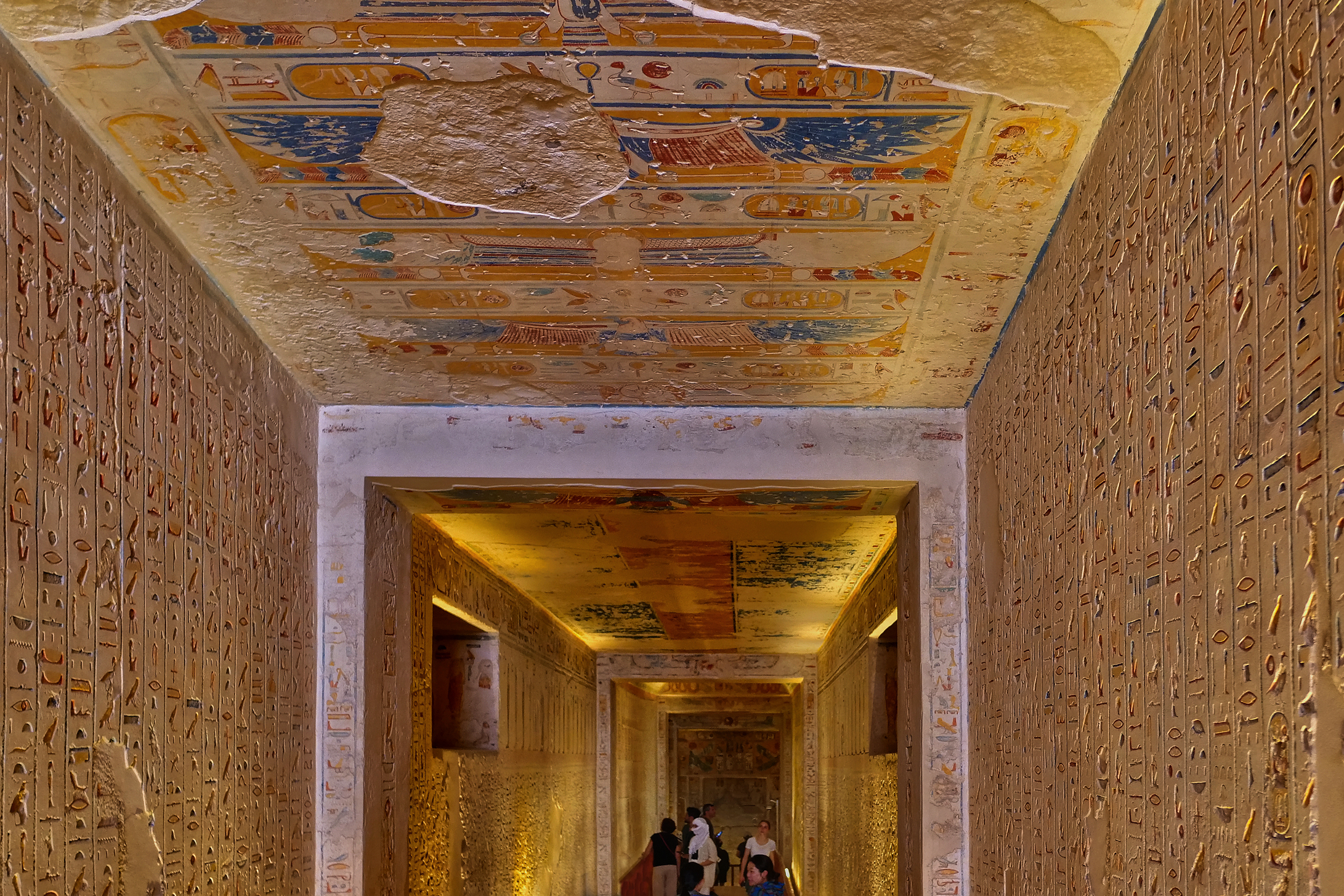


Photo 1: The walls of the entry hall are decorated with the Litany of Ra—a hymn of praise to the sun god Ra, identifying him in 75 different forms. By reciting these names, the Pharaoh “becomes” Ra, gaining divine power to pass through the dangerous regions of the night.
Photo 2: Further down the entry hall (KV 2). The ceiling decoration is called the Book of Nut (also known as the “Fundamentals of the Course of the Stars”). It explains the celestial mechanics of the universe. It depicts the sky goddess, Nut, arching over the earth; she swallows the sun at evening and gives birth to it at dawn, symbolizing the Pharaoh’s own rebirth. Notice the deep blue backgrounds on the ceilings representing the night sky, populated with stars and yellow-ochre barques (boats) that carry the celestial bodies.
Photo 3: These hieroglyphic inscriptions on the walls of the entry hall of KV 2 are part of the Litany of Ra. The thousands of small, repetitive columns of hieroglyphs on the side walls are the invocations of the different aspects of the sun god.
Photo 4: Scene from the Book of Gates (KV 2). This text describes the sun god’s journey through the twelve hours of the night, each separated by a massive gate guarded by a serpent. The Pharaoh must know the secret names of these guardians to pass. The image depicts a division of the underworld where gods or blessed souls are shown in a ritual procession, moving toward the next gate.
Photo 5: In KV 8 (tomb of Pharaoh Merenptah) we see Ra, the sun god of the ancient Egyptians giving Ankh to Merenptah. Sometimes Ra was merged with Horus (god of kingship, healing, protection etc.) and became Ra-Horakhty, often depicted with a falcon head. One of his tasks was to empower the pharaohs and turn them into superhuman leaders of the Egyptian people.
Photo 6: A column showing the same motif of Ra-Horakhty and Merenptah in KV 8.
tomb kv 47 – siptah
Pharaoh Siptah reigned from 1204-1198 BCE. He was crowned king in his teens and did not live long. Not much is known about his leadership, but there are some beautiful reliefs and paintings in his tomb.


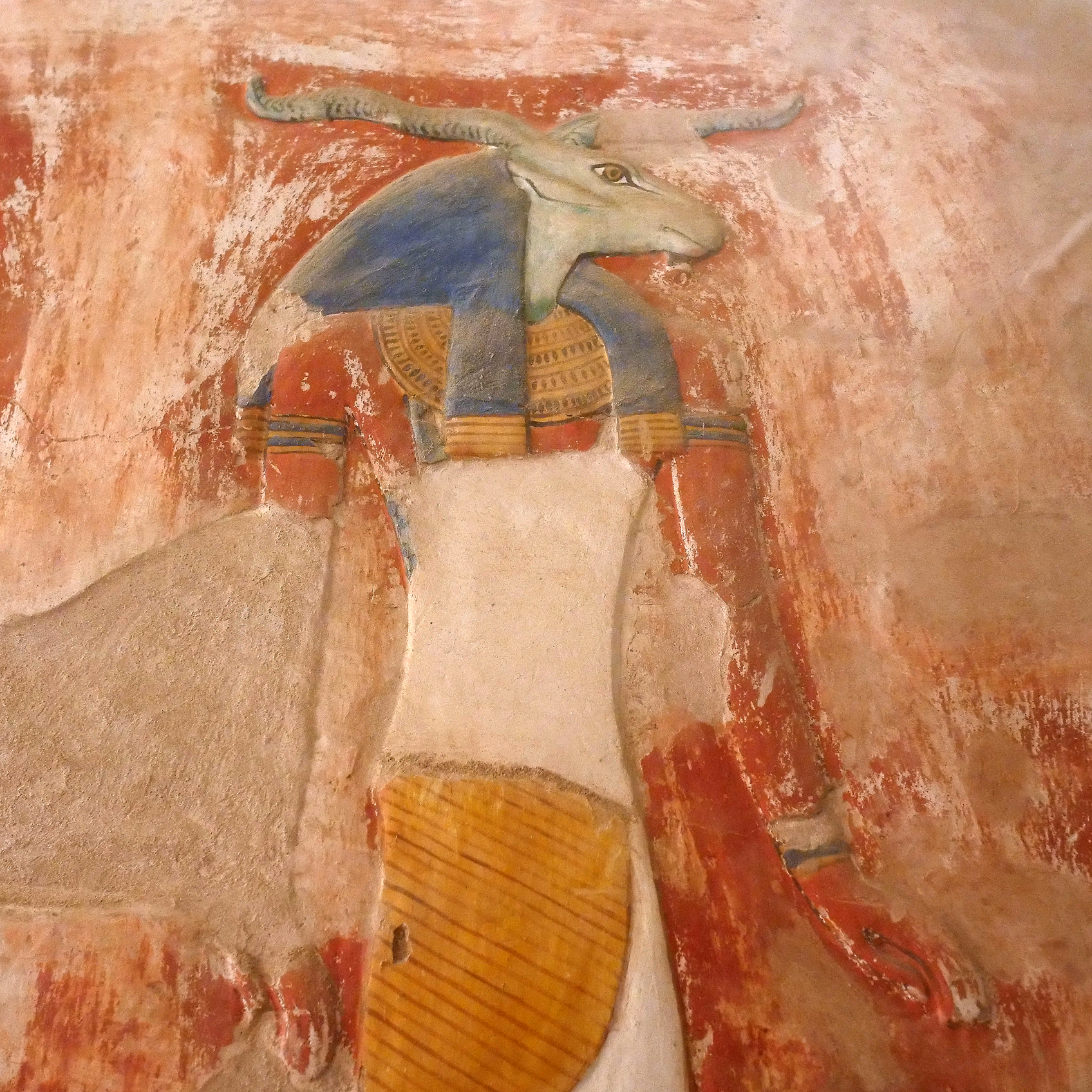

Photo 1: Pharaoh Siptah (left) receiving life from Ra-Horakhty in a relief from the entrance to Siptah’s grave chamber in the Valley of the Kings. Ra, often depicted with a falcon head, again was merged with Horus (god of kingship, healing, protection etc.) and became Ra-Horakhty. One of his jobs was to empower the pharaohs and turn them into superhuman leaders of the Egyptian people.
Photo 2: Anubis in his zoomorphic form as a jackal.
Photo 3: Khnum, as usually depicted with the head of a ram, was one of the earliest-known Egyptian deities—the creator who fashions human bodies on his potter’s wheel.
Photo 4: The Winged Goddess Maat. In ancient Egyptian religion Maat was the personification of truth, justice, and the cosmic order. She was the daughter of the sun god Ra and associated with Thoth, god of wisdom. She wore the ostrich feather—perfectly symmetrical on both sides of the quill— on her head that was the measure to determine whether the soul of the departed would reach the paradise of the afterlife successfully. The deceased would be only admitted to the afterlife when the heart of the person weighed exactly the same as Maat’s feather. Interesting to see that the very patriarchally organised Egyptians chose a woman as personification of the supreme principle. The man performs the law, but the woman is the law. She is the non-negotiable field in which the the actor of the patriarchal principle must operate much like the Yoni – Lingam dynamic of the Vedic system.
tomb kv 17 – pharaoh seti I. travels through the underworld
Tomb 17 is one of the largest and deepest cave systems in the Valley of the Kings. You need to buy an extra ticket to gain admission, but it is well worth it.
A relatively well preserved series of images in Pharaoh Seti’s tomb was created according to the Book of Amduat. This book—inscribed on the walls of temples and tombs—describes in detail the journey that a deceased person undertakes in the hours following physical death. The Pharaoh is instructed how to successfully navigate the transition from death to eternal life through the underworld. The common belief was that a Pharaoh would attain immortality only if he would master the challenges following his death. If he would fail he would simply die and disappear forever.
However, in the Book of Amduat, the stakes were even higher. The Pharaoh isn’t just traveling for his own soul; he is merged with the Sun God, Ra. If he fails to overcome the serpent Apophis, it isn’t just that the Pharaoh disappears forever—it’s that the sun fails to rise, and the entire universe reverts to Isfet (chaos). The people didn’t just want him to succeed for his sake; their entire world depended on his successful navigation of the 12 hours. Therefore a successful journey through the underworld was a question of do or die for the whole empire.
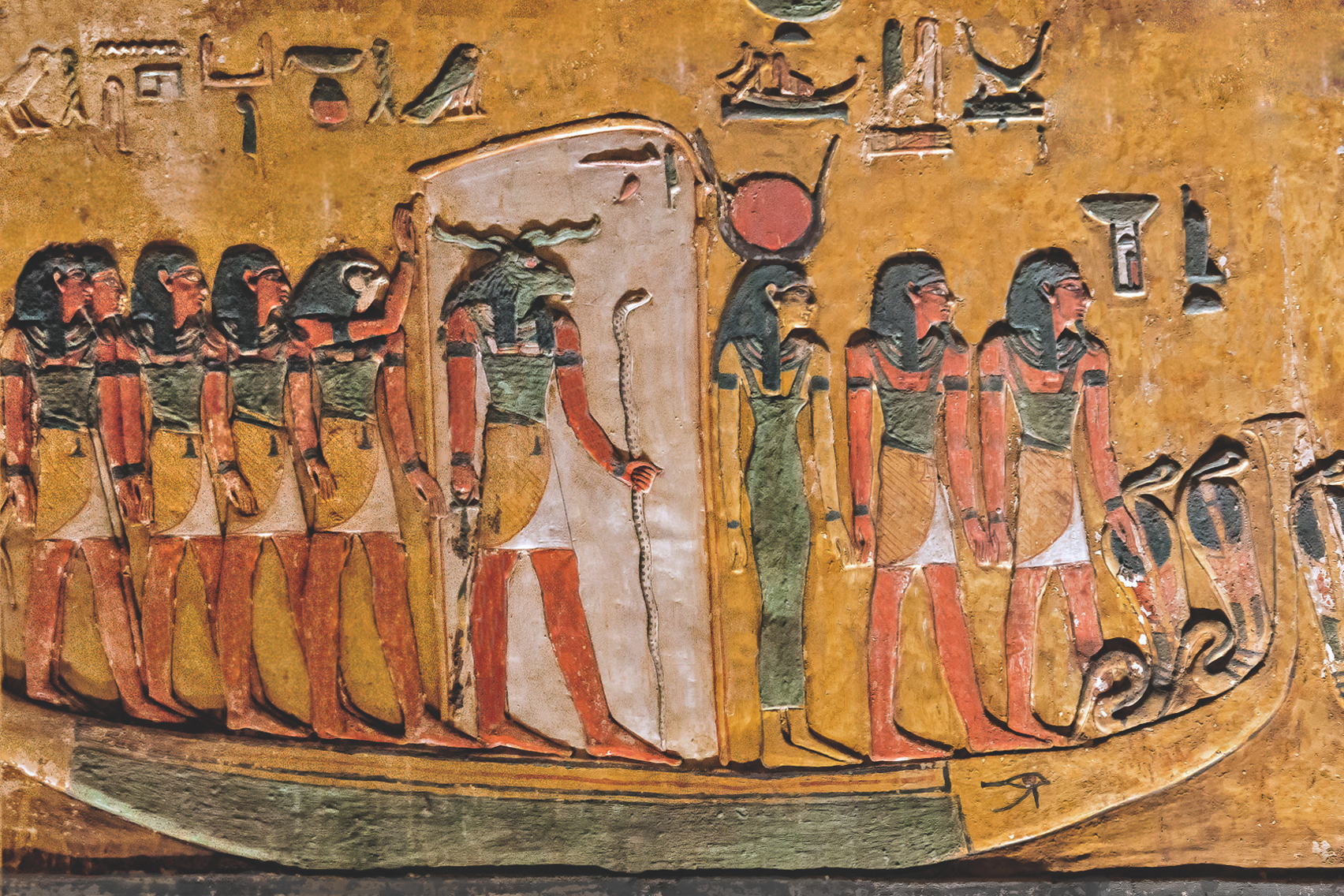
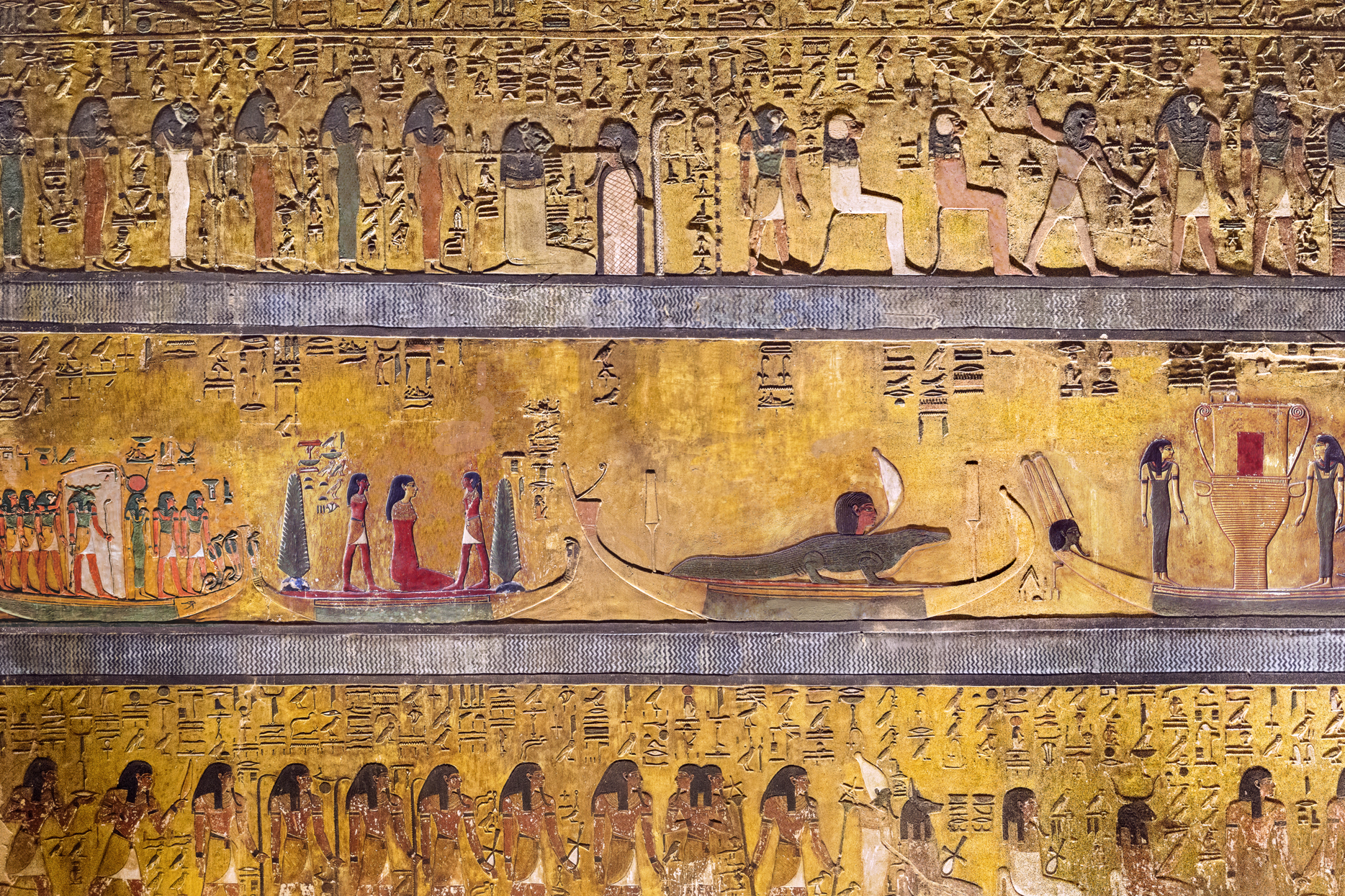
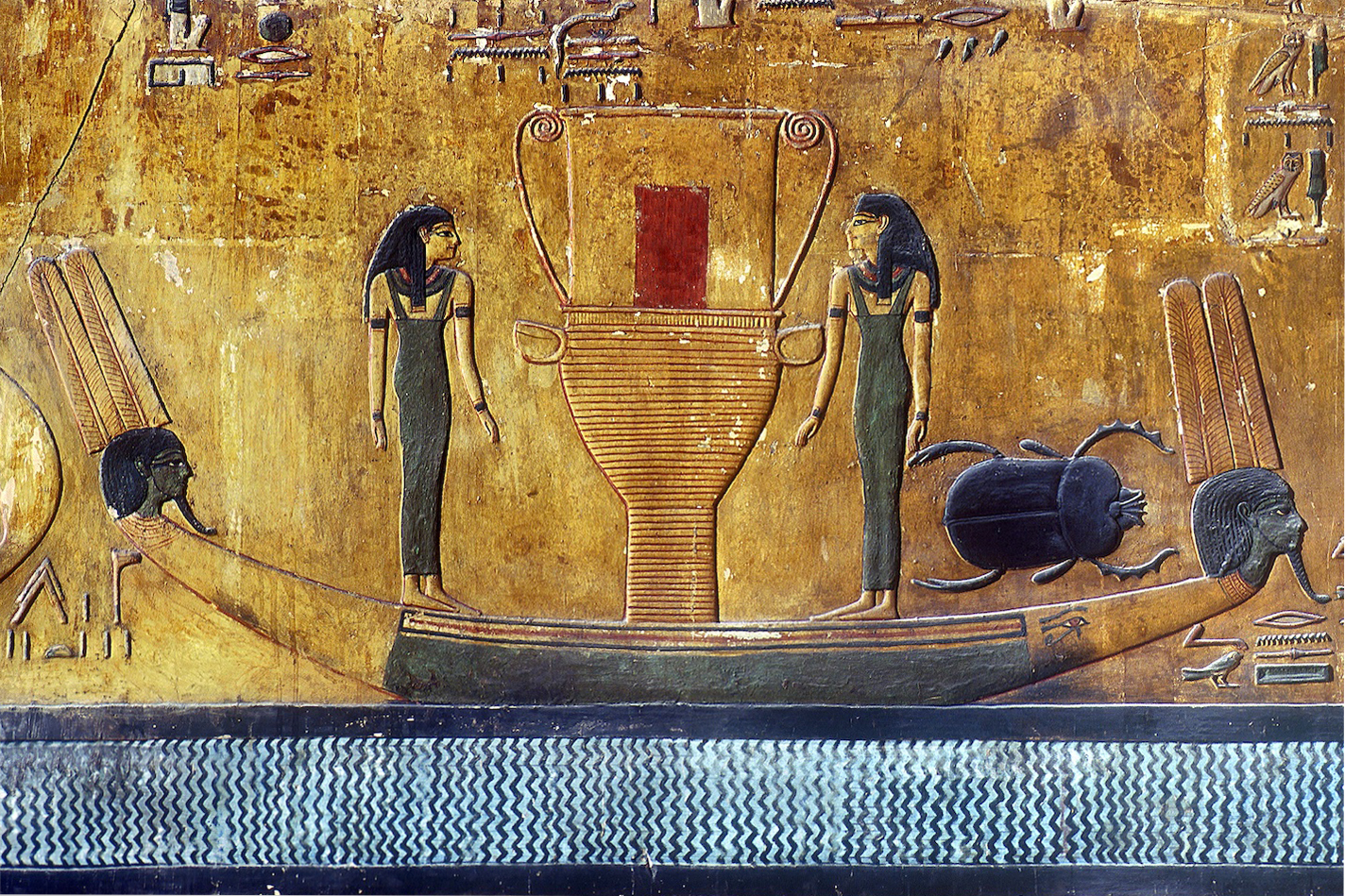
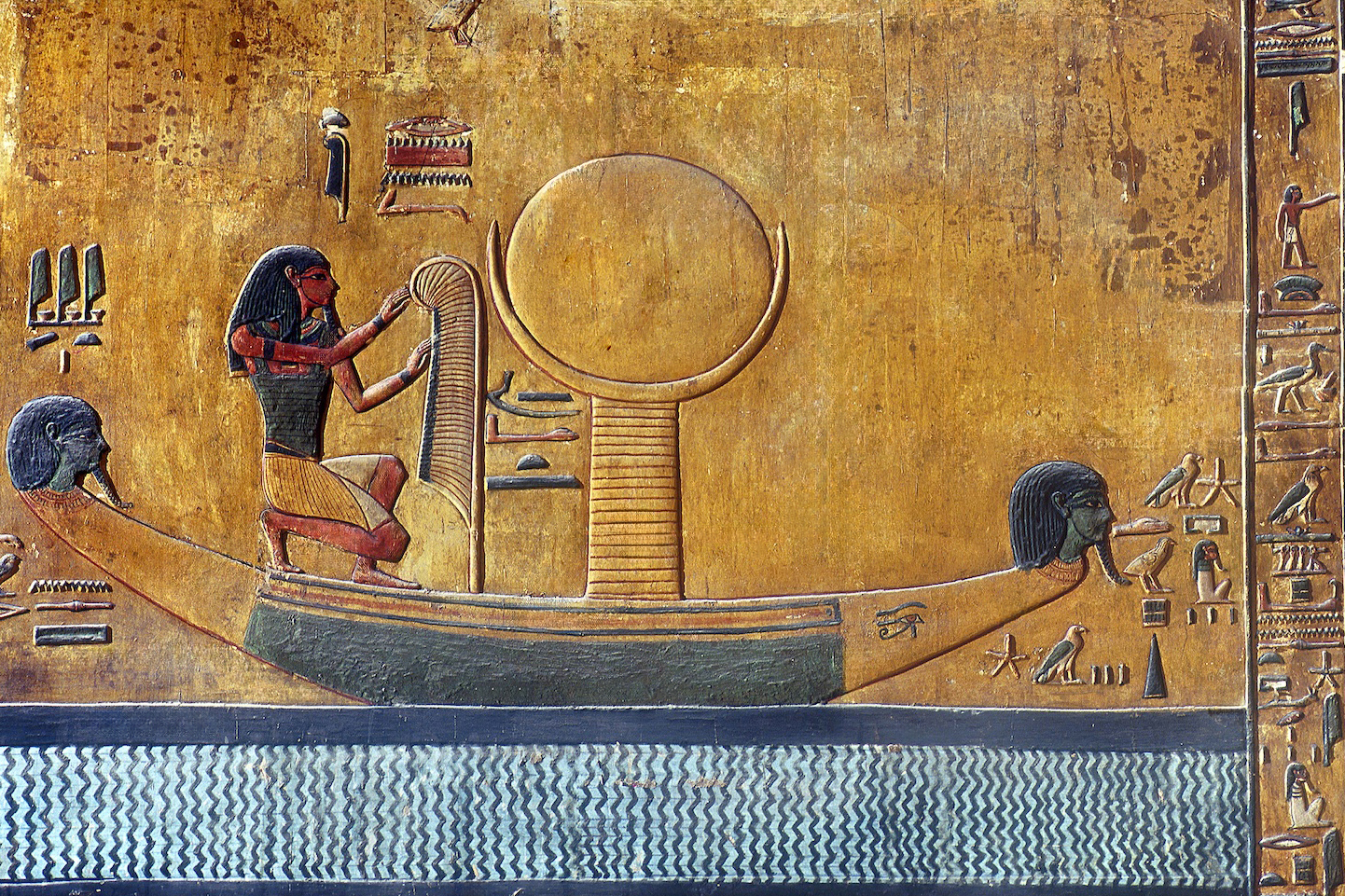
The procession of five boats in the 2nd Hour of the Amduat as we see it here represents the precise moment the Pharaoh’s soul enters the Field of Wernes, a vast, watery marshland where he must prove his worth and begin his transformation.
The Pharaoh does not travel alone on his difficult journey. He can rely on a strong team that accompanies him on five boats moving from the left to the right:
(1) The Lunar Barque (Heading the procession on the right) carries the Moon Disk and Maat’s Feather. It represents the Sacred Time and the Truth that leads and clears the path, and stabilizes the soul. (Photo 4)
(2) The Barque of the Sistrum/Scarab: The boat carrying the Sistrum (Hathor’s symbol of vibration and joy) or the Scarab (Khepri’s symbol of rebirth). It provides the “rhythm” for the journey. (Photo 3)
(3) The Barque of the Crocodile-Lizard: The boat featuring the Crocodile with a human head. This represents the Human Intellect riding upon the primal forces of nature, guiding the King through the murky depths. (Photo 2, the third boat from the left)
(4) The Barque of Neper (Provisioner): This is the boat of the Grain God with two plants growing from it, ensuring the Pharaoh has the spiritual nourishment (the “Bread of Life”) to survive the night. The three seated red-clad female deities are known as the “Mistresses of the Field” harvesting the grains. (Photo 2, the second boat from the left)
(5) The Solar Barque (The Flagship): The boat carrying Sun God (Ra), Sia (the god of perception) and the goddesses Isis and Nephthys in the form of two snakes. Ra appears with a ram’s head because he is in his nocturnal form, signifying the sun’s physical journey through the earth. These are the spiritual guides of the procession, representing the core essence of the Pharaoh merging with the Divine. (Photo 1)
The figures above and below the procession of barques are the inhabitants of the 2nd Hour who cheer the boats as they pass.
Placing the Crocodile Barque—representing the “Human Intellect” or “Sovereignty”—in the physical center of the wall suggests that the Pharaoh’s conscious mind is the pivot point between the “Front Guard” (Time/Truth) and the “Flagship” (The Divine Rebirth).
tomb qv 66 – queen nefertari
The tomb is known for its exceptionally well-preserved colors and artistic depictions, which is why it is often referred to as the “Sistine Chapel of Ancient Egypt.” The tomb was discovered in 1904 by the Italian explorer Ernesto Schiaparelli.
Queen Nefertari was the favorite wife of powerful Ramesses II. She is one of the best known Egyptian queens, among such women as Cleopatra, Nefertiti, and Hatshepsut, and one of the most prominent Egyptian royal consorts. She was highly educated and able to both read and write hieroglyphs, a very rare skill at the time. She used these skills in her diplomatic work, corresponding with other prominent royals of the time. Her lavishly decorated tomb is one of the largest and most spectacular in the Valley of the Queens.
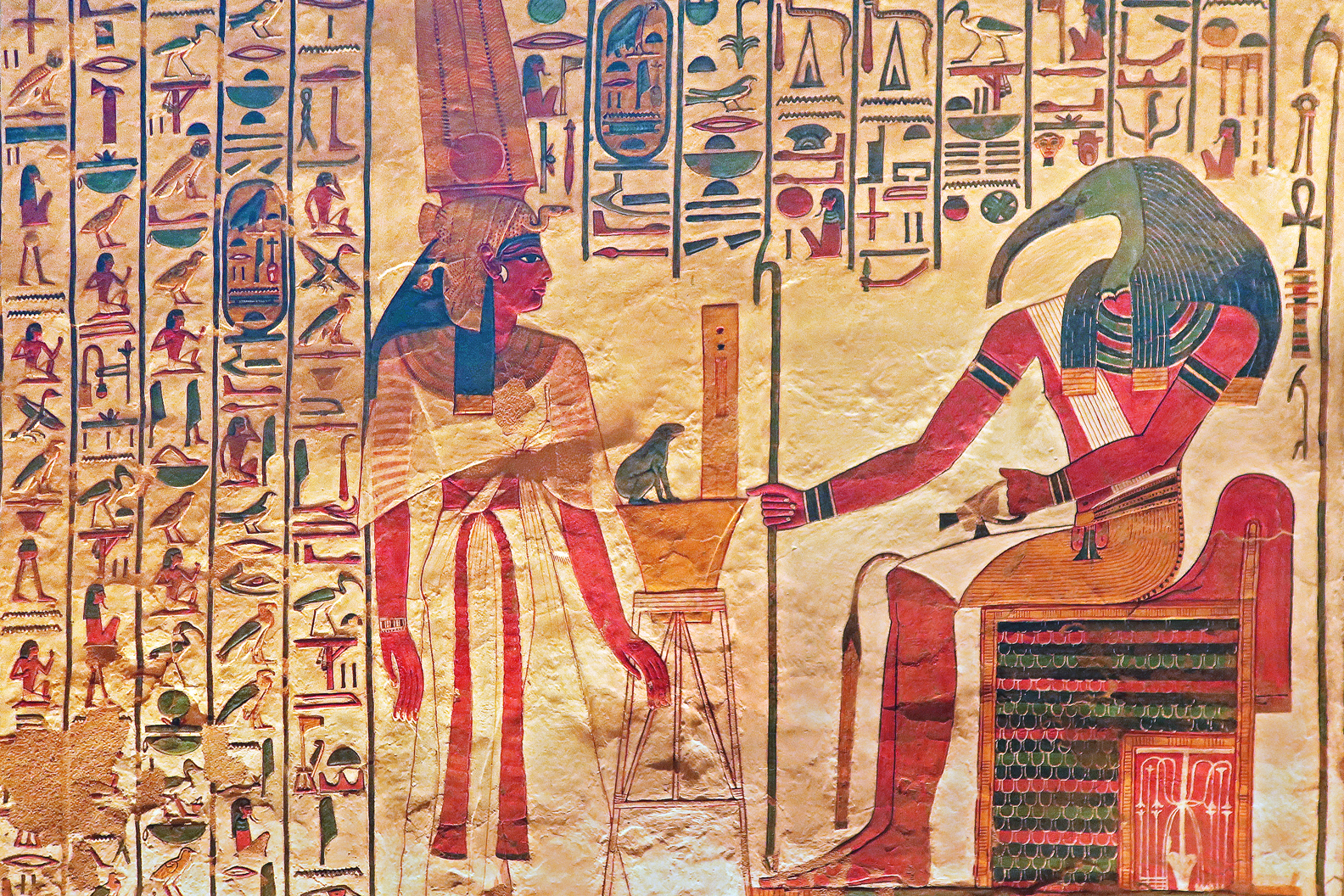
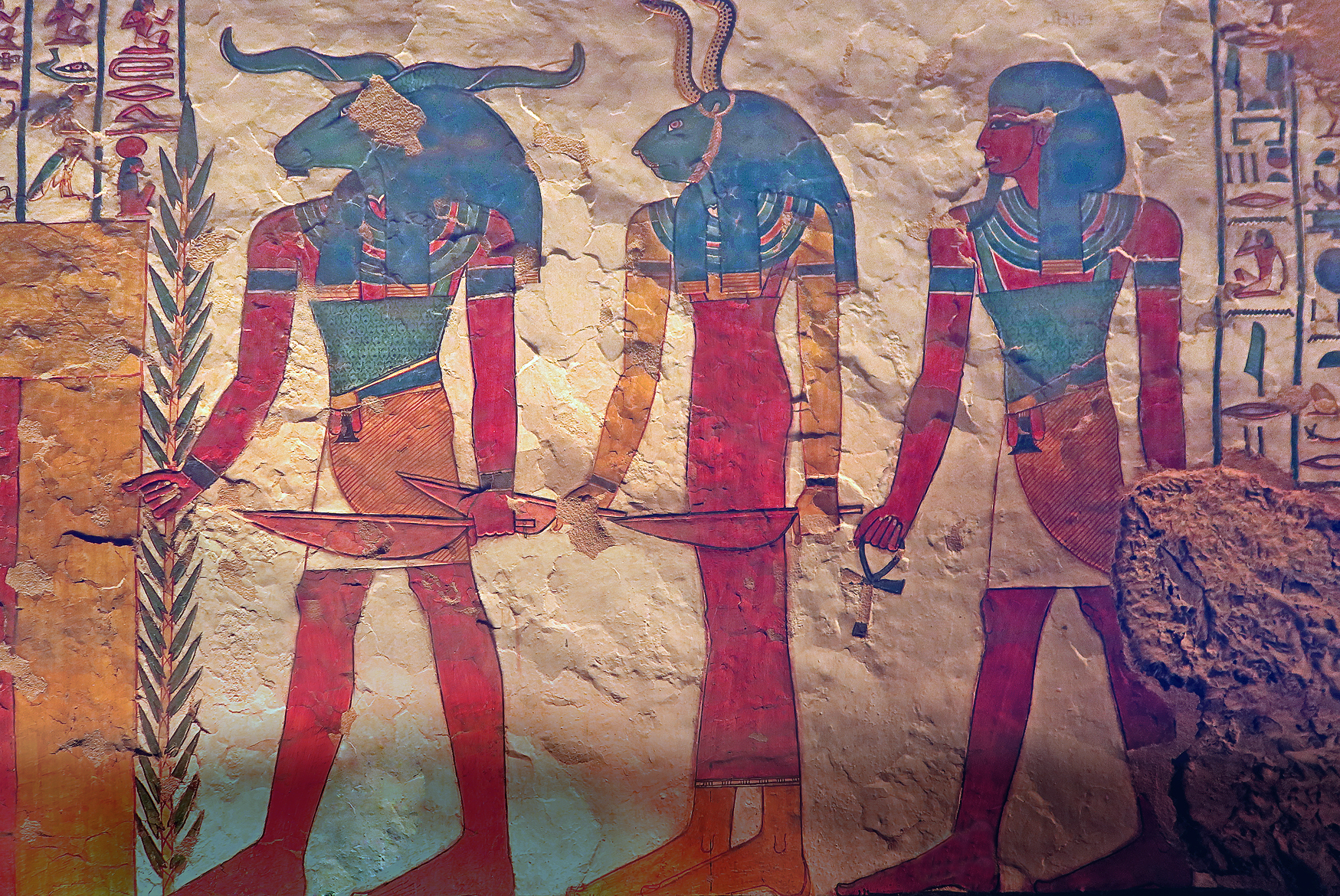
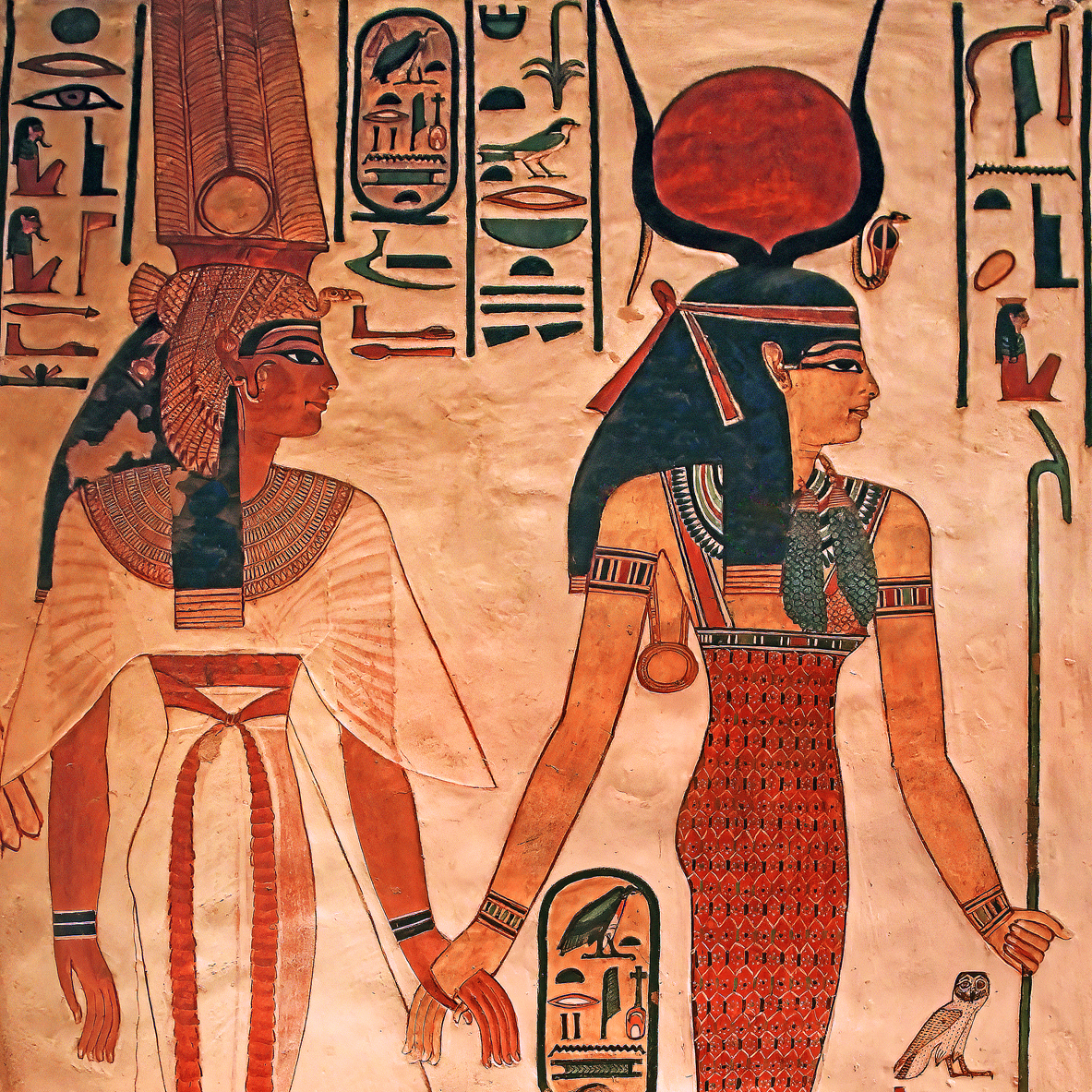
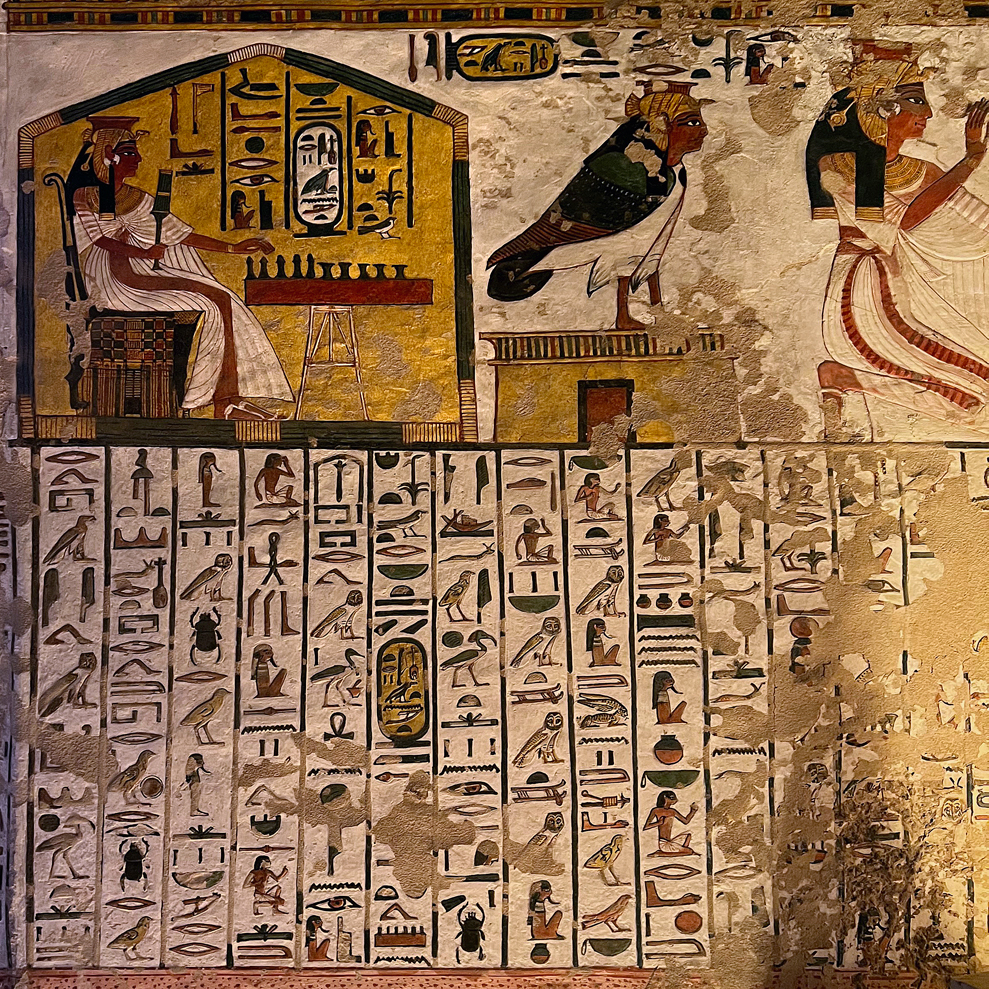
Photo 1: Nefertari stands before Thoth, the scribe of the gods, who holds the writing palette used to record the judgment of the soul. In this scene, Nefertari is receiving the Ankh, the symbol of life, signifying her successful transition into the sacred realm. The detailed wall paintings throughout the tomb act as a visual map for her journey through the various stages of the afterlife.
Photo 2: This image depicts a specific encounter during Nefertari’s journey, based on the spells found in the Book of the Dead. These three figures are divine guardians stationed at one of the celestial gates that protect the path to the Kingdom of Osiris. The first figure is the ram-headed god Khnum, acting here as a protective gatekeeper armed with a knife to repel chaotic forces. The second figure is the goddess Qed-Her, depicted with a feline head and carrying a knife to symbolize her role as a fierce protector of the underworld’s passages. The third figure is a minor protective deity, representing a specific hour or gate through which Nefertari must pass to reach her final destination.
Photo 3: Nefertari is led by the hand by the goddess Hathor through the entrance hall. Hathor acts as a sponsor and guide, physically escorting the Queen into the presence of the gods. It is the final ritual of welcome, where the Queen is officially introduced as someone worthy of entering the most restricted areas of the divine realm.
Photo 4: This composite of vignettes illustrates different aspects of the Queen’s transformation. On the left, Nefertari is shown in a kiosk playing the game of Senet, symbolizing her ability to move successfully through the “game” of the afterlife. In the center, she appears as a Ba—the aspect of the soul that can travel between the physical and spiritual worlds, depicted as a bird with a human head. On the right, Nefertari is shown kneeling in prayer, maintaining the constant state of piety required to sustain her immortality.
copyright for the photos of Nefertari’s tomb by dreamstime & wikipedia:
ID 273272441 @ Raniahegazi
ID 273272545 @ Raniahegazi