The Temple of Queen Hatshepsut at Dayr al-Baḥrī on the West Bank of the Nile
Built in 1470 BCE, this mortuary temple is a masterclass in ancient Egyptian architecture—far more advanced to its contemporaries in the Mediterranean neighborhood. Designed as Hatshepsut’s mortuary during her lifetime, it also served as a sanctuary for the god Amun and various other deities. The structure consists of three broad terraces, leading to an inner temple area built against and into the cliff face itself.
The main axis of the temple is aligned so that on the winter solstice (the shortest day of the year), the first rays of the rising sun enter the deepest part of the sanctuary.

Hatshepsut was the female king of Egypt (reigned as coregent c. 1479–73 BCE and in her own right c. 1473–58 BCE) who attained unprecedented power for a woman, adopting the full titles and regalia of a pharaoh. The elder daughter of the 18th-dynasty king Thutmose I and his consort Ahmose was married to her half brother Thutmose II, son of the lady Mutnofret. Since three of Mutnofret’s older sons had died prematurely, Thutmose II inherited his father’s throne c. 1492 BCE, with Hatshepsut as his consort. Hatshepsut bore one daughter, Neferure, but no son. When her husband died about 1479 BCE, the throne passed to his son Thutmose III, born to Isis, a lesser harem queen. As Thutmose III was an infant, Hatshepsut acted as regent for the young king.
For the first few years of her stepson’s reign, Hatshepsut was an entirely conventional regent. But, by the end of his seventh regnal year, she had been crowned king and adopted a full royal titulary (the royal protocol adopted by Egyptian sovereigns). Hatshepsut and Thutmose III were now corulers of Egypt, with Hatshepsut very much the dominant partner. Hitherto Hatshepsut had been depicted as a typical queen, with a female body and appropriately feminine garments. But now, after a brief period of experimentation that involved combining a female body with kingly (male) regalia, her formal portraits began to show Hatshepsut with a male body, wearing the traditional regalia of kilt, crown or head-cloth, and false beard. To dismiss this as a serious attempt to pass herself off as a man is to misunderstand Egyptian artistic convention, which showed things not as they were but as they should be. In causing herself to be depicted as a traditional king, Hatshepsut ensured that this is what she would become. (Britannica).
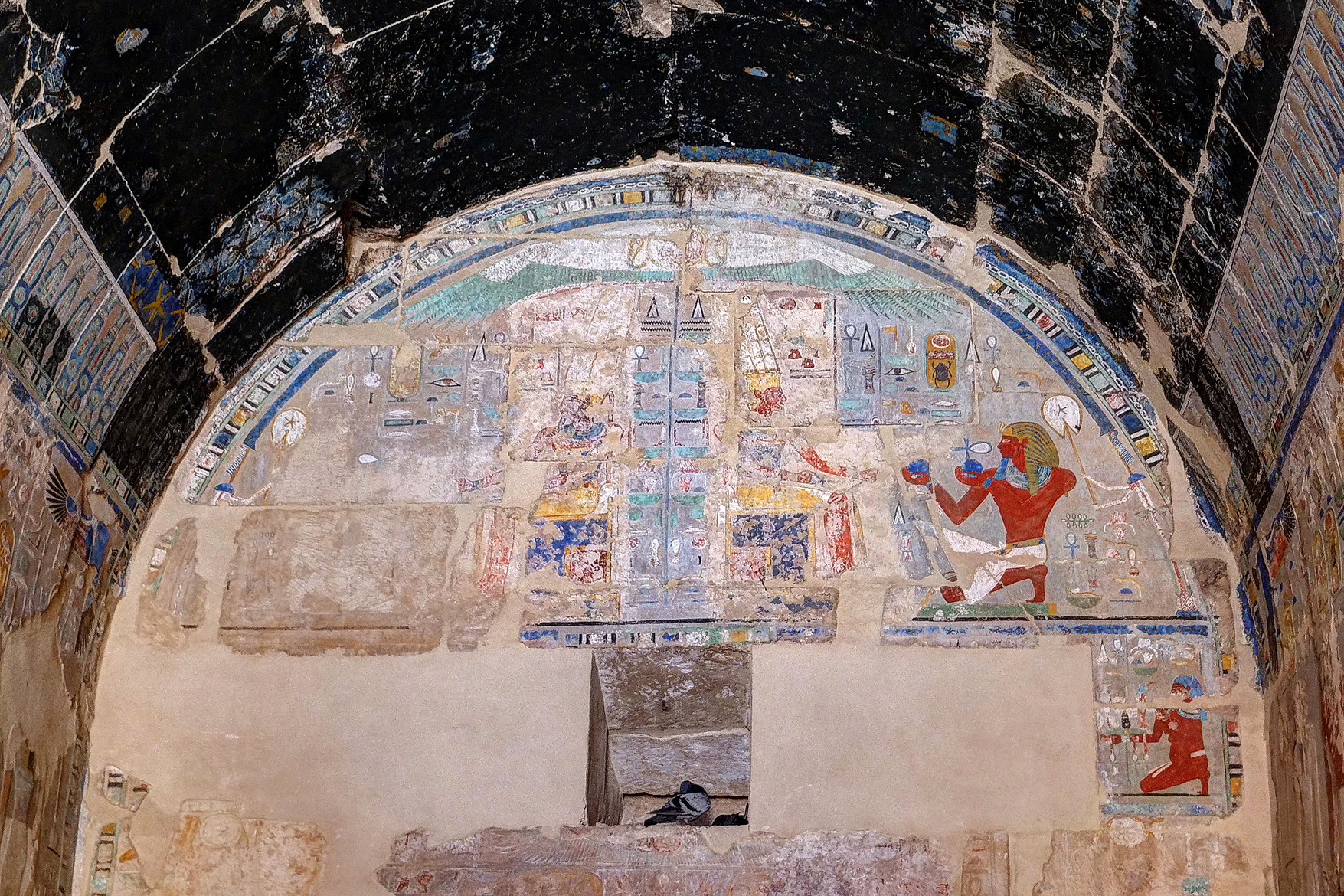
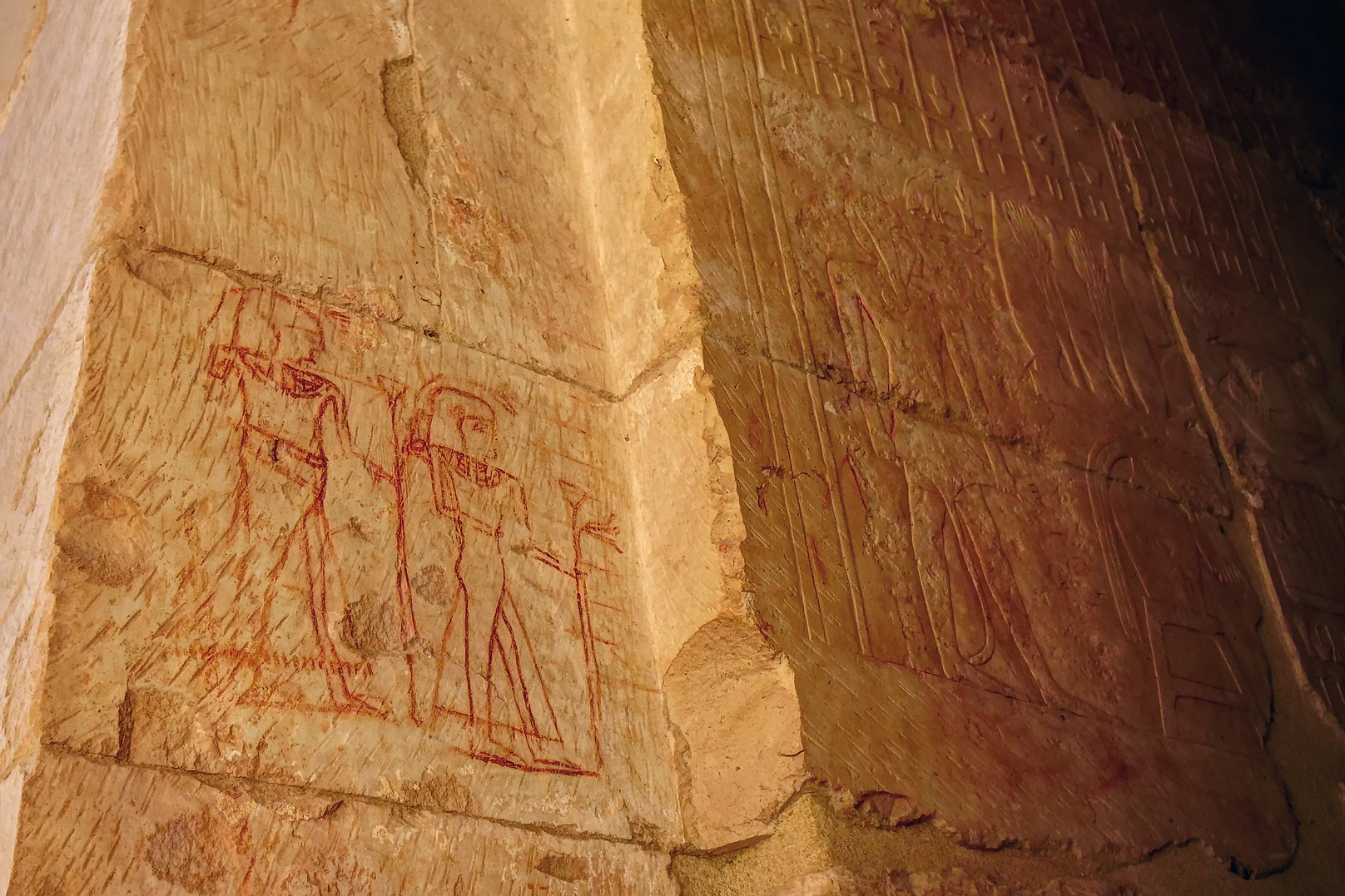
When the Egyptian religion was replaced by Christianity the Copts took over many of the ancient places of worship and turned them into churches. They didn’t bother much about the old artwork—just a few drawings and inscriptions were added here and there for the new church to be ready (see picture 4). Nowadays the guides call it Coptic graffiti.

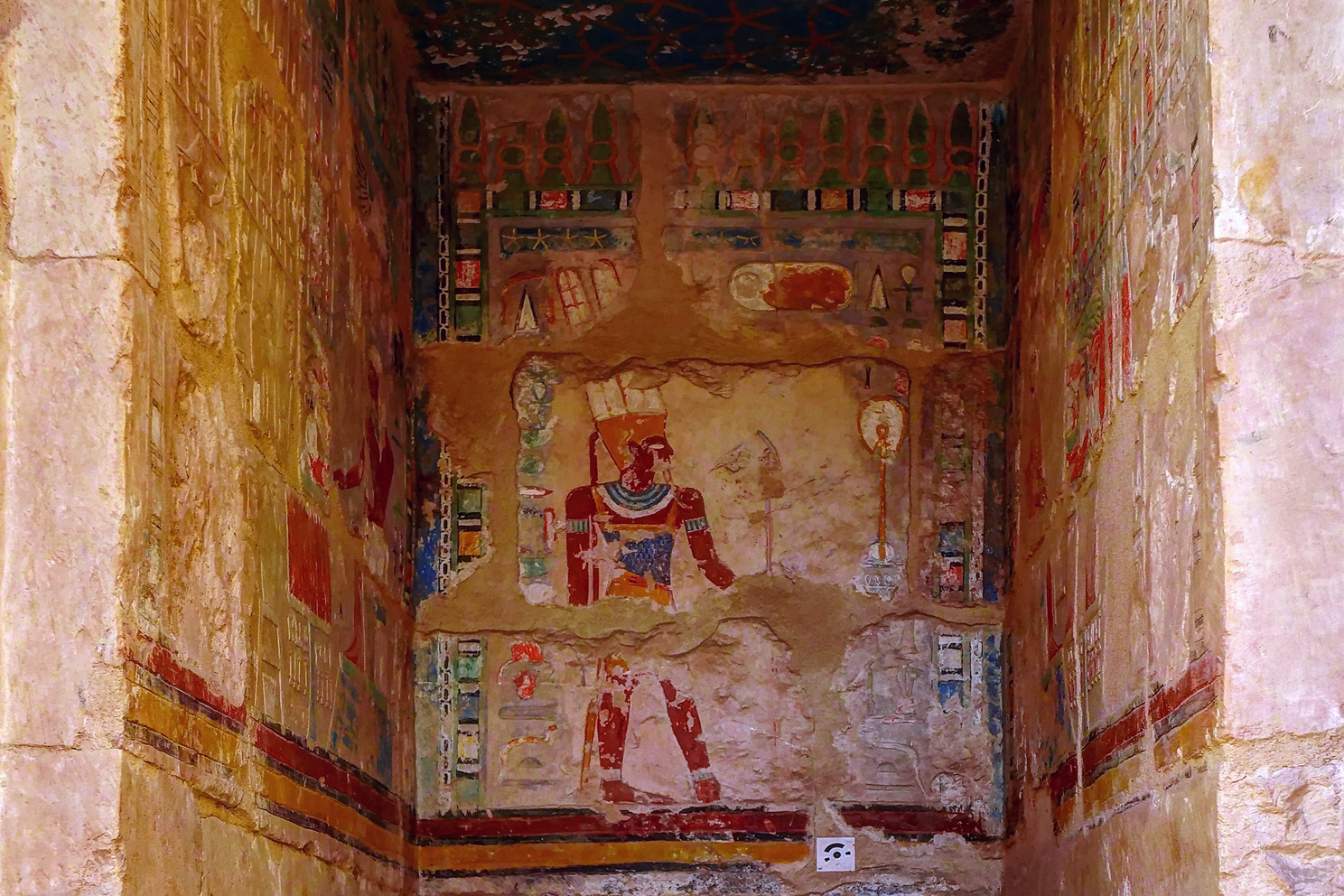
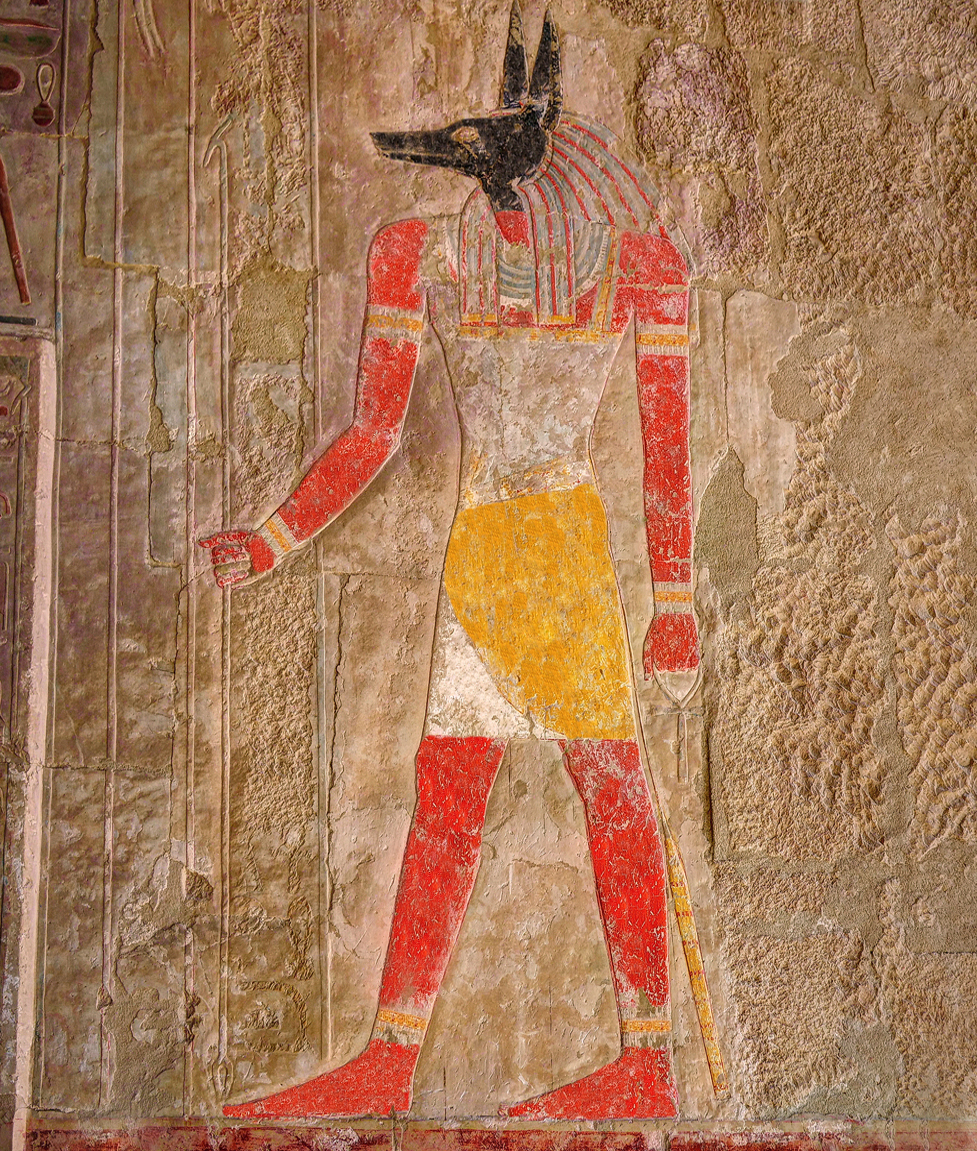
One of the largest chapels was dedicated to the important deity Anubis (picture 3, below). Like Hades in Greece and Yama in India, Anubis was the original Egyptian ruler of the underworld, where people end up after their deaths. He led the deceased into the realm of darkness. Later Osiris took his position, but Anubis remained an major deity, who was worshipped in special shrines. In his lead hand he carries the Was-Sceptre (a symbol of power and dominion), in his back hand he holds the Ankh (☥, symbolizing life). The Ankh was a very popular symbol in Egyptian culture. Gods gave life to the Pharaohs by handing them an Ankh. When the Coptic Christians started to convert Egyptians they used the Ankh as the Coptic cross and called it crux ansata. Nowadays the goth movement uses the symbol and it can be shown as ☥ on the computer.
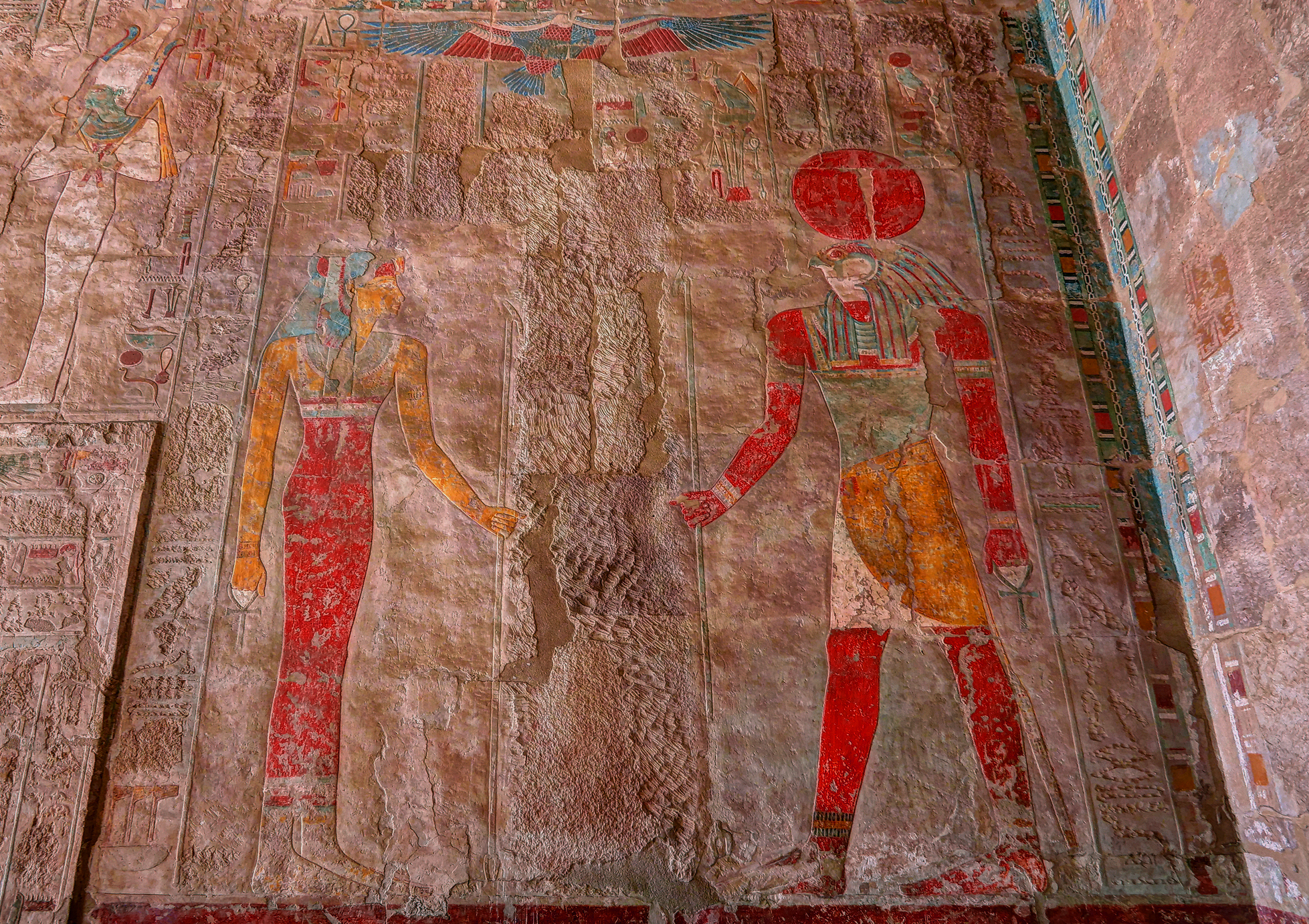
Picture 4 (below) shows us another oddity of Hatshepsut’s temple. On the left is a goddess (likely Hathor or Isis), and on the right is Ra-Horakhty (the Sun God Ra combined with “Horus of the Horizon”), recognizable by his falcon head topped with a sun disk. The two deities are essentially “pouring” life into the space between them where Hatchepsut’s picture used to be. This was a popular motif for the pharaos—to show their divine origin and legitimation for the common people. However, after her death, her stepson and successor, Thutmose III, ordered her images and names to be chiseled away. This wasn’t necessarily out of personal hatred, but to “fix” the historical record: by erasing her, he was re-establishing the traditional male-to-male succession from Thutmose II directly to himself.