
mahendra’s egypt
© mahendra myshkin 2024
the red sea
In March 2024, I went to the Egyptian Red Sea coast for a writing retreat. Besides a few ancient harbours like El Quoseir many settlements on the desert coast of the Red Sea are of fairly recent origin. A lot of tourist resorts have been built offering coral reefs, pleasantly warm water all year round, calm beaches, and an ideal setting to write and research.
the ancient culture
Over a period of more than 3000 years—from the time of the first pyramids to the last arrangements at the Temple of Hathor at Dendera—the soil and the sands of Egypt bore the longest lasting culture in history, which produced an unparalleled succession of achievements in the fields of art, architecture, politics, religion and science.
The unparalleled continuity in the Nile valley allowed the Egyptians to refine their conceptual thinking which effected the visual imagery of their art and their religious metaphors. New forms of speculative and abstract thought developed.
The richness of the Egyptian polytheistic world inspired other cultures to copy from them. From Egypt many ideas spread into Iran, Mesopotamia, Greece, the Roman empire and even to India.
For a few days I visited the ancient sites around Luxor and in Dendera. With great fascination, I explored the surprisingly well preserved ancient temples, statues, paintings, and tombs. With my patient companion, the Panasonic GH 5, I captured my impressions:


the gods
Many ideas about gods and the human afterlife had originated from animistic-shamanic practice of the paleolithic hunter-gatherer tribes and were initially copied by the Egyptians. In the early days of the Egyptian polytheistic culture the deities were mostly personalized versions of natural phenomena (e.g. Gods of thunder, sun, moon ocean, etc.). Over the course of time hundreds of gods and goddesses were invented and worshipped. The characteristics of individual gods could be hard to pin down. Most had a principle association (for example, with the sun or the underworld) and form. But these could change over time as gods rose and fell in importance and evolved in ways that corresponded to developments in Egyptian society and thinking.
When we look at the Egyptian pantheon, we may notice that female deities are represented in human shapes, while male gods were depicted in four progressively diverse forms as:
1. zoomorphic, either animals or birds;
2. zoomorphic, but with parts of the human body;
3. humans, with animal or bird heads;
4. fully anthropomorphic.
Among those hundreds of gods, I selected eleven major players who represent a complete spiritual and administrative team that governed every aspect of existence, from the creation of the body to the judgment of the soul.
Here is the powerful First XI of deities.
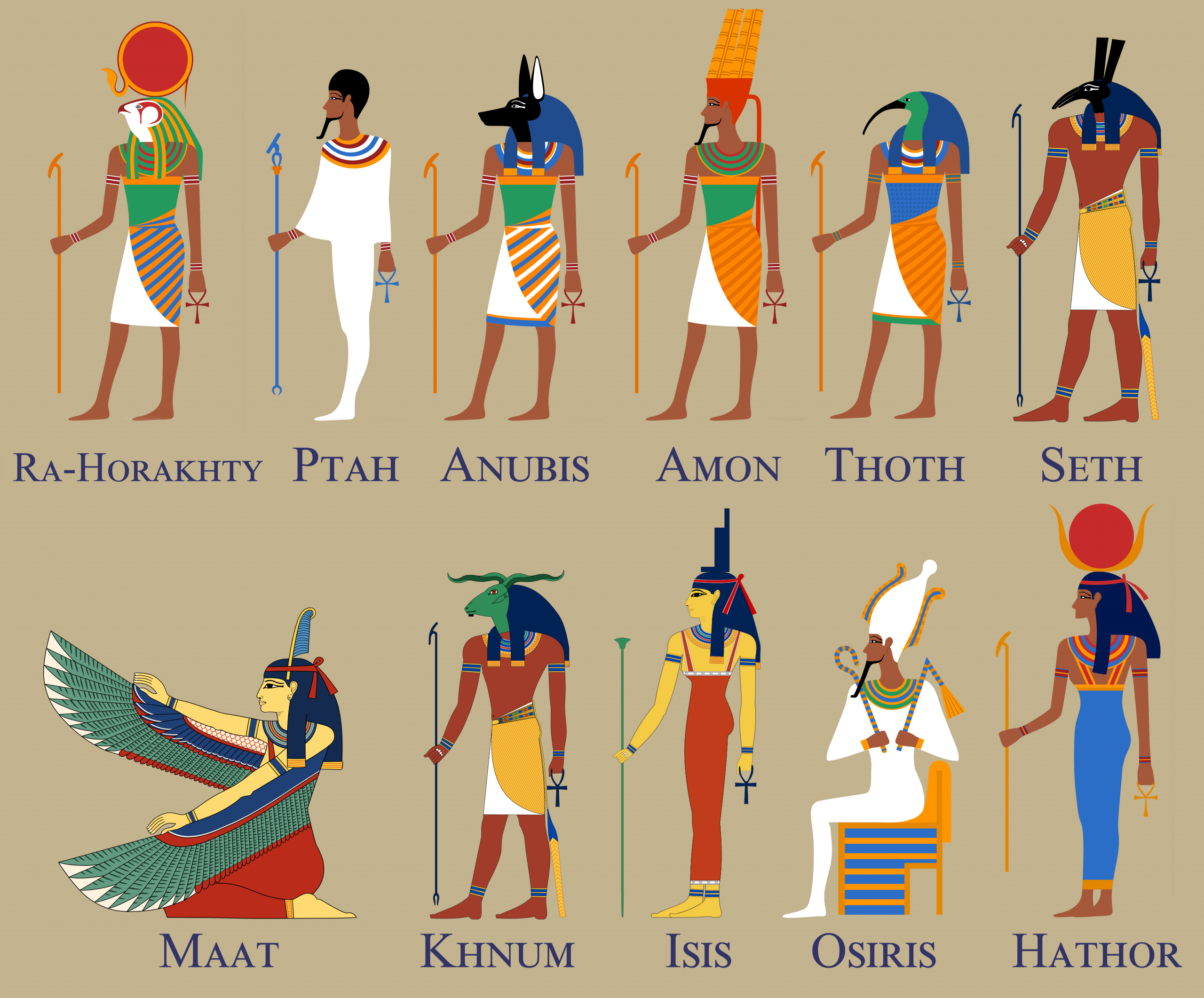
| Deity | The Role (Position) | Key Iconography | |
| 1 | Amon (Amun) | The Captain: King of the Gods and the “Hidden One”. | Man with a tall, double-plumed crown. |
| 2 | Ra-Horakhty | The Powerhouse: The Sun God and source of all life. | Sun disk on his head, often with a falcon’s face. |
| 3 | Osiris | The Anchor: Lord of the Afterlife and Resurrection. | Mummified king holding the crook and flail. |
| 4 | Isis | The Playmaker: Goddess of Magic and the Divine Mother. | Throne-shaped headdress or cow horns with a sun disk. |
| 5 | Hathor | Goddess of love, beauty, music, dancing, and fertility. She is the “mistress of joy” who welcomes the dead into the next life. | A headdress of cow horns with a sun disk between them. Sometimes with cow ears or as a full cow. |
| 6 | Ptah | The Architect: Creator of the physical world through thought. | Mummiform man with a skullcap holding a powerful staff. |
| 7 | Thoth | The Strategist: God of Wisdom, Writing, and the Moon. | Man with the head of an Ibis or a Baboon. |
| 8 | Maat | The Referee: Goddess of Truth, Justice, and Cosmic Order. | A single ostrich feather worn on the head. |
| 9 | Anubis | The Guardian: Protector of the Dead and God of Embalming. | Jackal-headed man. |
| 10 | Khnum | The Creator: The potter who fashions humans on his wheel. | Ram-headed god. |
| 11 | Seth (Set) | The Wildcard: God of Chaos, Storms, and the Desert. | Composite “Set Animal” with a curved snout and squared ears. |
the hieroglyphs
Today we can observe the metamorphoses that the ancient metaphors underwent over the centuries, because the Egyptians left us a lot of inscriptions written in hieroglyphs—symbols that may be representing the objects that they depict but usually stand for particular sounds or groups of sounds. In 1822, French orientalist Jean-Francois Champollion published his first breakthrough in the decipherment of the Rosetta hieroglyphs, showing that the Egyptian writing system was a combination of phonetic and ideographic signs. Western scientists have deciphered hieroglyphs and their development into hieratic and demotic signs during the last two centuries. Thanks to these people we know a lot about the pharaohs and the culture they created and lived in, even though the rise of Christianity in the 2nd and 3rd centuries CE caused the decline and ultimate demise not only of the ancient Egyptian religion but of its hieroglyphics as well.
Here is an example of a frieze with hieroglyphs in the open air museum of the Karnak temple compound:
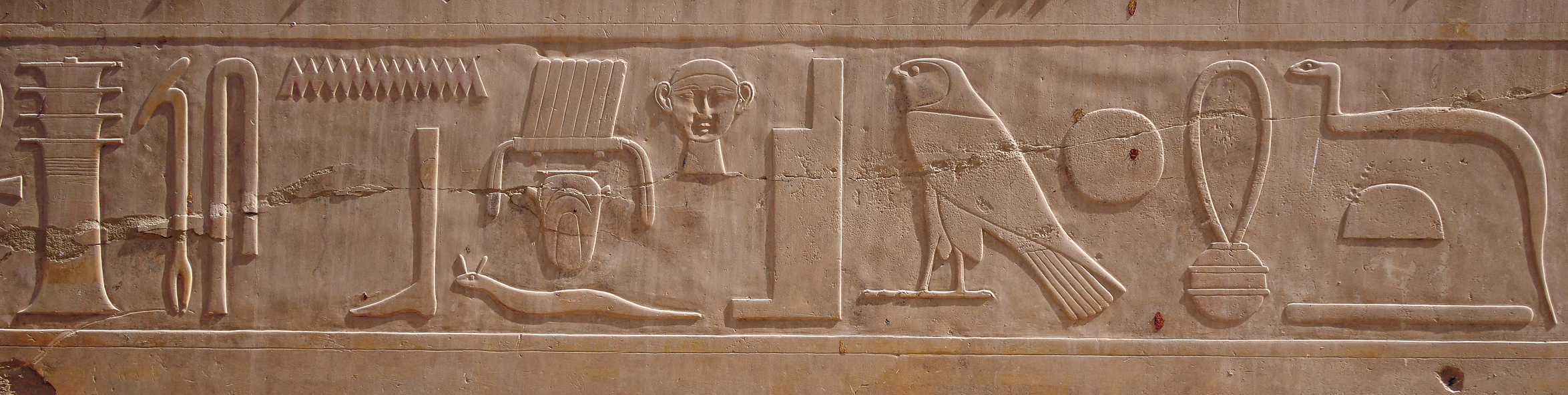
The inscription is an appraisal of the reigning pharaoh. It can be deciphered as
“All Life, Stability, and Power are given to the Lord. Truth (Maat) is upon him, who is protected by Ra and Horus for all eternity.”
The sequence “Maat is upon him” is the centerpiece here. It’s a legalistic and spiritual claim that the Pharaoh is the only one capable of holding up the “heavens” of the temple. His life force has been given to him directly from the Gods. Thus empowered he is superior to all normal mortals.The symbols from right to left—as deciphered with the help of Google Gemini:
| # | Form | Hieroglyph Name & Transcription | Symbolic Meaning |
| 1 | Cobra with loaf and horizontal staff | Uraeus on Basket | The “Rearing Cobra” on a basket signifies the goddess Wadjet and the King as “Lord of the Two Ladies”. |
| 2 | Ball with parallel lines and oval string | Shen Ring & Solar Disk | Represents eternity and the “encircling” protection of the sun god. |
| 3 | Sun Disk | Ra | The sun god, the primary source of life and power. |
| 4 | Falcon | Horus | The god of kingship; identifying the Pharaoh as the “Living Horus” on Earth. |
| 5 | Double L-Block | Maat Pedestal | The platform of “Truth” and “Cosmic Order”. |
| 6 | Head | Tep / Hr | A frontal face used as a preposition meaning “Upon” or “Over”. |
| 7 | Viper with basket and “dryer” | Viper & Basket | The suffix “His” and “Lord”, referring to the Pharaoh’s possession of Order. |
| 8 | Foot with leg and water/wave | Foot & Water | Phonetic signs often used in prepositions like “to” or “for”. |
| 9 | Was with “pipes” | Was Scepter | The scepter of “Power” and “Dominion”. |
| 10 | Pillar with 3 tops | Djed Pillar | The symbol of “Stability”. |
| 11 | Ankh (hidden) | Ankh | The symbol of “Life”. |
the timeline
An introduction to ancient Egyptian history from the prehistoric times onwards.
| Era | Date Range | Key Dynasties & Historical Milestones |
| Predynastic Period | Before c. 3100 BCE |
Early settlements, farming development, pottery, and copper smelting. Evidence of early writing and kings at Abydos. |
| Early Dynastic Period | c. 3100 – c. 2686 BCE |
1st & 2nd Dynasties: Capital at Memphis; Royal graves at Abydos. King Narmer, King Djer, and the reunification under Khasekhemwy. |
| Old Kingdom | c. 2686 – c. 2181 BCE |
3rd – 6th Dynasties: The Age of Pyramids. Djoser’s Step Pyramid; Sneferu’s Dahshur pyramids; Great Pyramids at Giza; first Pyramid Texts under Unas. |
| First Intermediate Period | c. 2181 – c. 2055 BC |
7th – 11th Dynasties: Political fragmentation. Herakleopolitan rulers in the north vs. Theban rulers (Mentuhotep I, Intef series) in the south. |
| Middle Kingdom | c. 2055 – c. 1650 BCE |
11th & 12th Dynasties: Reunification by Mentuhotep II. Capital at Itjtawy; White Chapel at Karnak; land reclamation in the Faiyum; Queen Sobekneferu. |
| Second Intermediate Period | c. 1650 – c. 1550 BCE |
15th – 17th Dynasties: Hyksos “Shepherd Kings” rule the Delta while Egyptian kings maintain a stronghold in the south. |
| New Kingdom | c. 1550 – c. 1069 BCE |
18th – 20th Dynasties: The Empire Age. Hatshepsut, Thutmosis III, Amenhotep III (Luxor), Akhenaten (Amarna), Tutankhamun, and Ramesses II (Abu Simbel). |
| Late Eras & Transitions | c. 1069 – 332 BCE |
3rd Intermediate & Late Period: Dynastic shifts, High Priests in power, and successive Kushite, Saite, and Persian conquests. |
| Ptolemaic & Roman Periods | 332 BCE – BC 395 |
Greek & Roman Rule: Alexander the Great; the Ptolemies; Cleopatra; Egypt becomes a Roman province; rise of Christianity. |
| Byzantine Period & End | 395 – 641 |
Final Transitions: Closure of pagan temples (Philae); final hieroglyphic inscription (AD 394); Islamic conquest of Egypt (AD 641). |